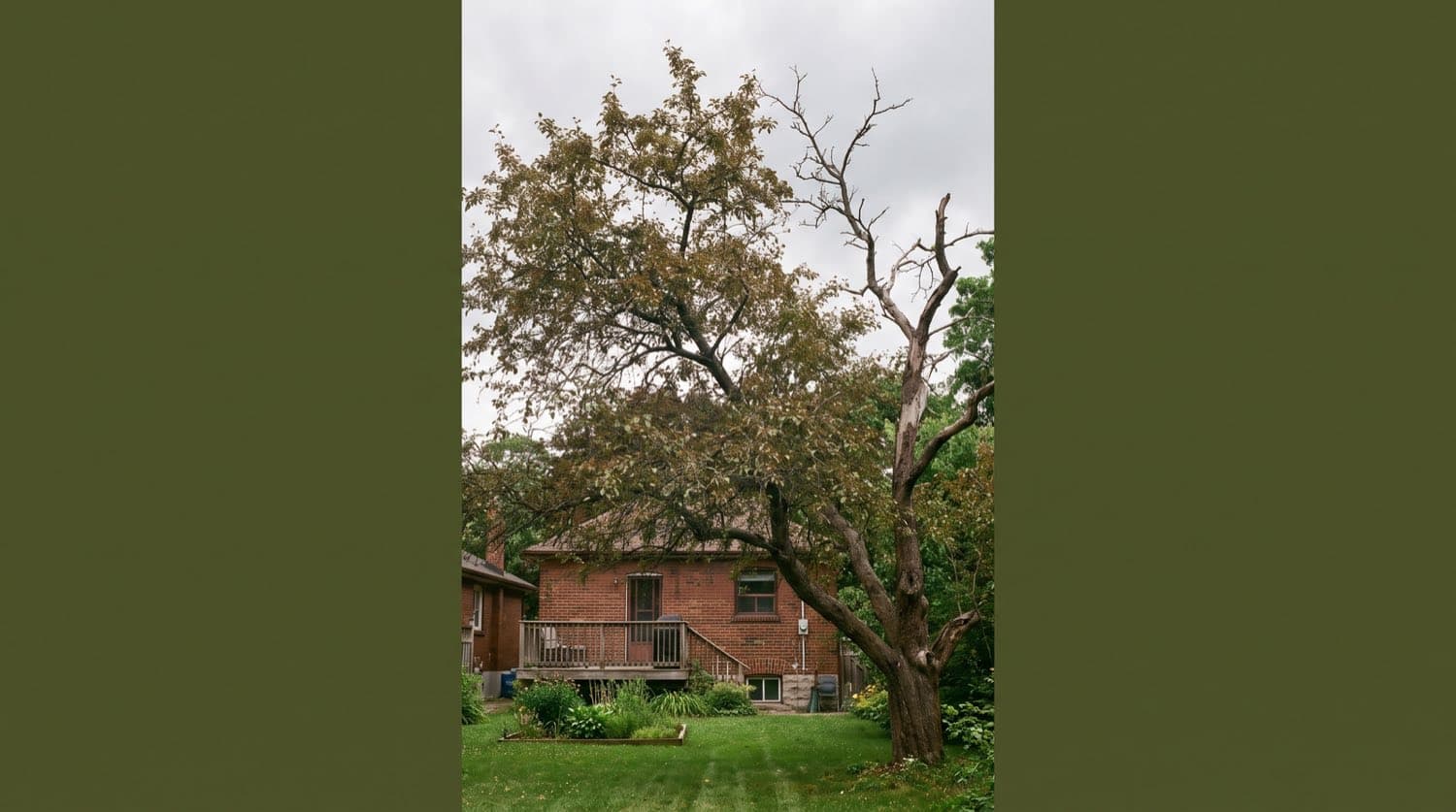
Answer First: The clearest signs a tree is dying are canopy dieback that starts at the top, large amounts of deadwood, bark cracking or peeling off, no or very late leaf-out, and fungus at the base. The quickest test is the scratch test: scratch a twig, and green and moist underneath means alive, brown and dry means dead. In Ontario, ash trees specifically are being killed by emerald ash borer, which leaves 3 to 4 mm D-shaped exit holes and top-down dieback (Natural Resources Canada).
A struggling tree does not die all at once, and the early warnings are easy to miss until a limb comes down. Reading those signs, and knowing which Ontario pest is behind so many of them, tells you whether you are looking at a tree that needs care, a tree that needs to come down, or a hazard that needs an arborist today.
What are the general signs a tree is dying?
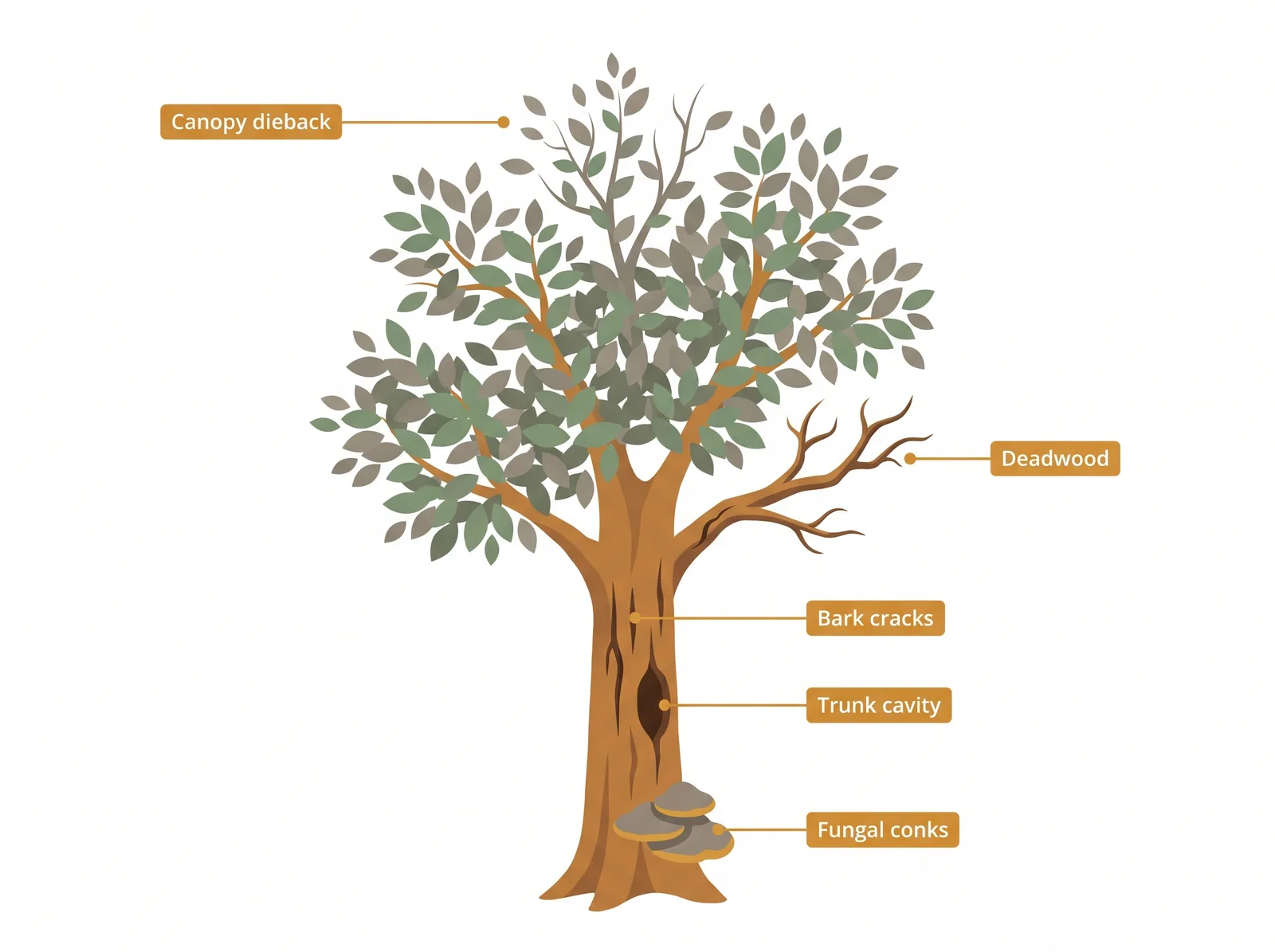
Start with the canopy and work down the trunk. A dying tree usually shows several signs together, and the pattern matters more than any single one.
- Canopy dieback and thinning. Bare branches and sparse leaves, typically starting at the top and outer edges and working inward, are the most telling sign.
- Late or no leaf-out. A tree that stays bare well into spring while its neighbours leaf out, or leafs out only on part of the crown, is in trouble.
- Deadwood. Large dead branches, or a growing share of dead wood in the crown, signal the tree can no longer support that growth.
- Bark problems. Cracking, splitting, or bark falling away in sheets exposes the living tissue underneath.
- Fungus at the base or on the trunk. Mushrooms or hard shelf-like conks often mean root or trunk decay is already advanced.
- A new or worsening lean, especially with soil lifting or cracking on one side of the root zone.
Quotable: A dying tree usually shows canopy dieback from the top down, plus deadwood, bark loss, and fungus at the base. One sign can be stress; several together point to a tree in serious decline.
The scratch test: is it dead or just dormant?
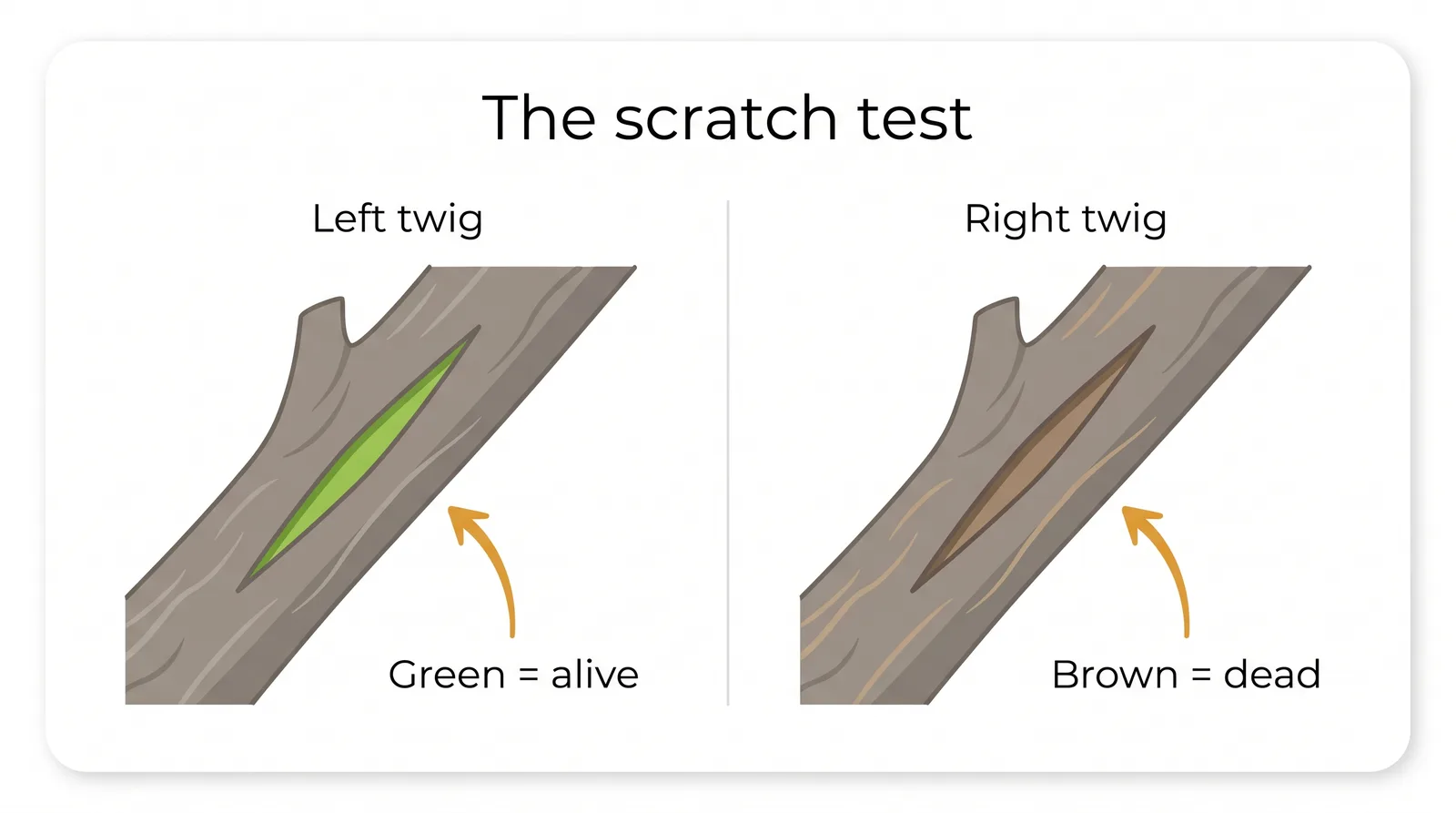
The scratch test is the fastest way to separate a dead tree from a dormant one. Scratch a small twig or a patch of bark with a fingernail or knife blade. If the layer just beneath is green and moist, that section is alive; if it is brown, dry, and brittle, that section is dead.
Two things make the test reliable:
- Test several branches, high and low. A tree can be dead in the upper crown but still alive in the lower trunk, so one green scratch does not clear the whole tree, and one brown scratch does not condemn it.
- Mind the season. A healthy tree in winter dormancy still scratches green under the bark. That is exactly how you tell a dormant tree from a dead one when nothing has leaves.
Scratch test — a quick field check where you scrape a thin sliver of bark off a twig: green, moist tissue underneath means that part of the tree is still alive, while brown, dry tissue means it has died.
Is it emerald ash borer? The Ontario ash killer
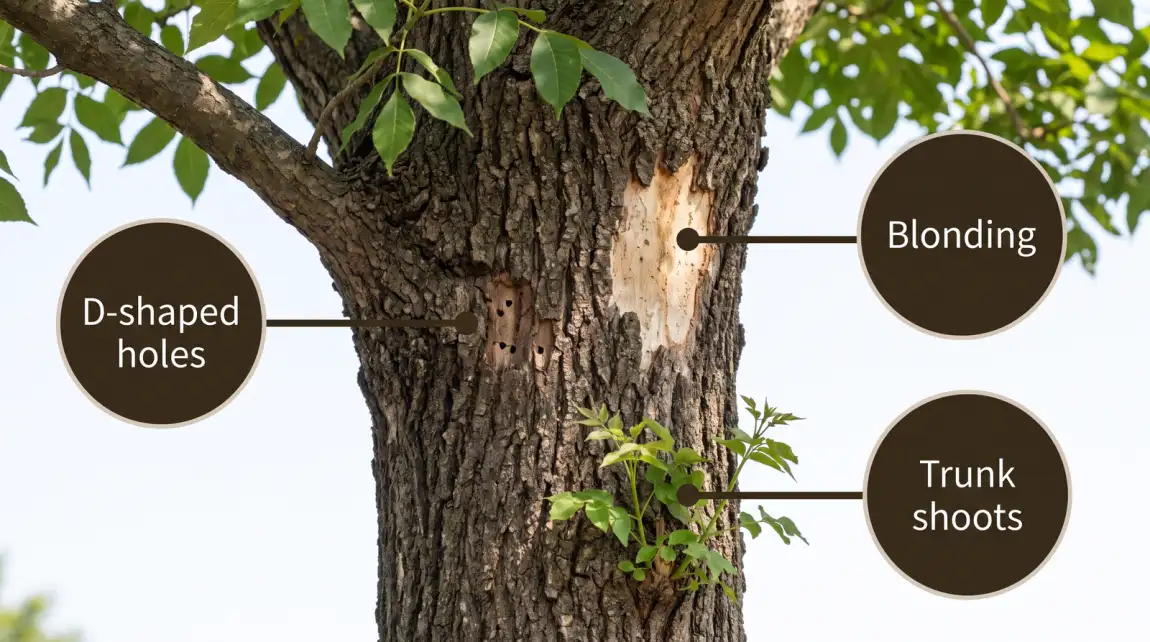
If it is an ash tree in decline, suspect emerald ash borer first. This invasive beetle has killed millions of ash trees across Ontario, and it kills them in a recognizable pattern (Natural Resources Canada). If your tree is an ash, look for this specific set of signs:
- D-shaped exit holes, 3 to 4 mm wide, in the bark, where adult beetles chew out in late spring and early summer.
- Canopy dieback from the top down, thinning and defoliating in the upper crown first.
- Epicormic shoots, clusters of new leaves sprouting straight from the trunk and lower branches, a stress response.
- Vertical bark splits, sometimes revealing the tunnels beneath.
- Blonding, pale patches where woodpeckers have flaked off the outer bark to eat the larvae underneath.
- S-shaped galleries winding just under the bark, the larval feeding tunnels that girdle and kill the tree (Canadian Food Inspection Agency).
From the data: YardQuote tracks 650 landscaping companies across the GTA, 613 of them with three or more reviews at an average of 4.77 stars (YardQuote tracking, July 2026). A dying ash is one of the most common tree calls in the region because of emerald ash borer, and while many crews handle the takedown and cleanup, an ash 30 cm or more in diameter still needs a certified arborist and a City permit to remove.
Ontario has other tree threats worth knowing, from Dutch elm disease on elms to oak wilt, an emerging concern the province monitors. But for the sheer number of dying trees in Toronto yards right now, emerald ash borer on ash is the one to rule in or out first.
When is a dying tree a hazard you must act on?
The moment it can hit something if it fails. A dying tree in the middle of a field can be left to nature; the same tree over your roof, driveway, or a walkway is a liability. Treat these as prompt arborist calls:
- Large deadwood over a target, a house, car, deck, or path.
- A lean with lifting or cracked soil at the roots, which suggests the root plate is failing.
- A trunk cavity, hollow, or fungal conks on the trunk, all signs of internal decay and reduced structural strength.
- Any dead ash near a structure, because ash killed by emerald ash borer become brittle and shed limbs unpredictably.
A certified arborist can diagnose whether a tree is treatable or done, and whether it is safe to leave standing. If the verdict is removal, our guide to the Toronto tree removal process covers the 30 cm permit rule and the steps, and if a storm has already brought part of it down, emergency tree removal in the GTA walks through the urgent version. Good pruning timing for Ontario trees also helps keep a stressed but living tree on the mend.
To get a vetted local pro to assess or remove a declining tree, browse landscaping companies in Etobicoke and other GTA areas, or request a quote and compare up to three side by side. Your contact details only go to the one you pick.