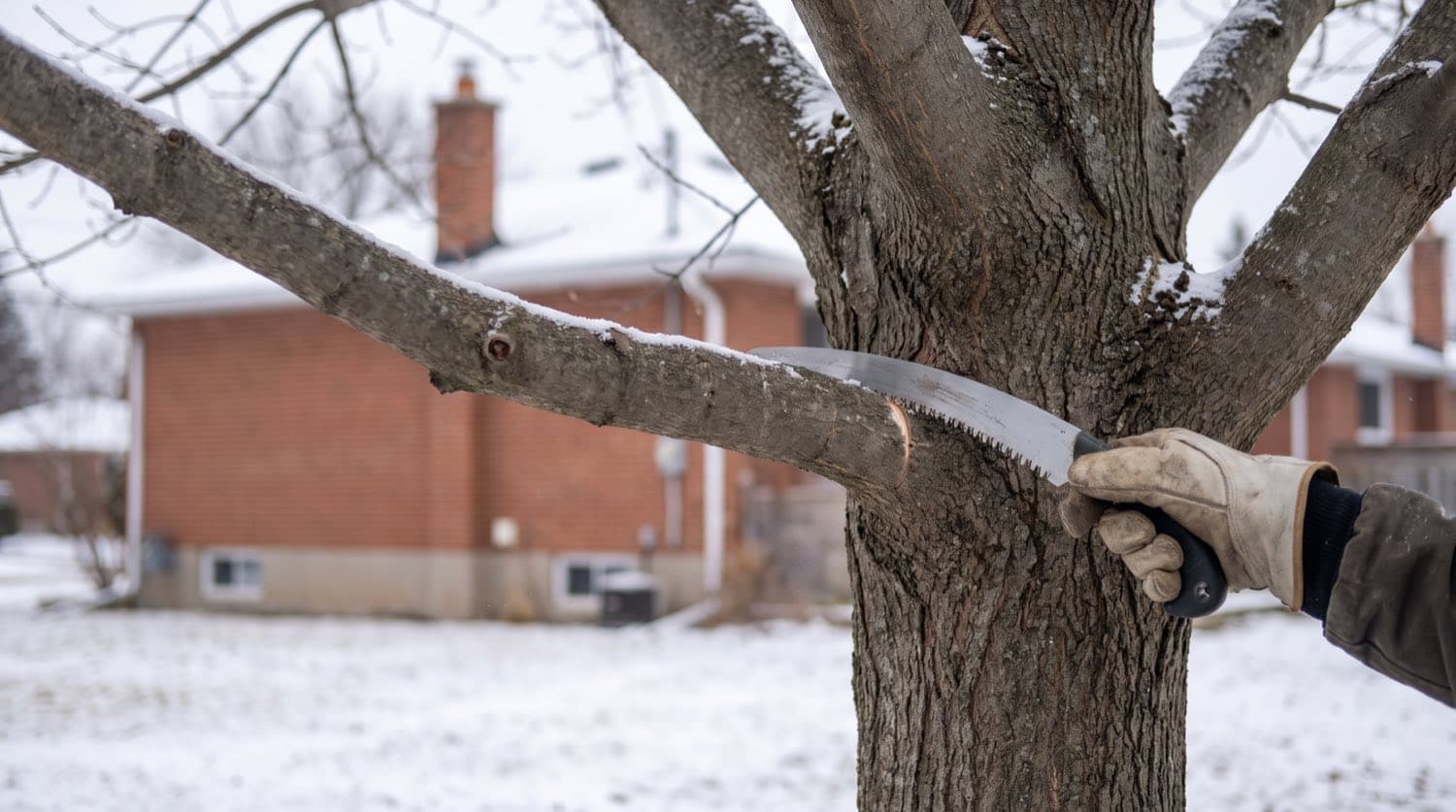
Answer First: Most trees in Ontario prune best in the dormant season, roughly December through February, when disease-spreading insects are inactive and the bare structure is easy to read. The critical exception is oaks: never prune them between April and November, because the sap beetles that spread oak wilt are active then and a fresh cut invites infection that can kill a red oak in one season. Dead or dangerous limbs can come off any species at any time.
Timing a pruning cut is not fussiness. On the wrong tree in the wrong month, a clean cut is an open wound that insects and disease walk right into. Ontario has a few specific hazards, oak wilt now among them, that turn "when" into a question worth getting right.
When is the best time to prune most trees in Ontario?
For most deciduous trees, prune in the dormant season, roughly December through February. Three things line up in your favour then: the leaves are down so you can actually see the branch structure, the tree is not burning energy on growth, and the insects and fungi that spread tree disease are dormant too.
Dormant-season cuts also heal fast. The tree wakes up in spring ready to seal the wound and push new growth, so a clean winter cut is well on its way to closing before pests are active. This is the default for oaks, lindens, honey locusts, and most shade trees on a GTA lot.
Dormant season — the winter stretch after a tree drops its leaves and before spring growth starts, when the tree is resting. It is the safest pruning window for most species because both the tree and its pests are inactive.
What is the tree pruning timing chart for Ontario?
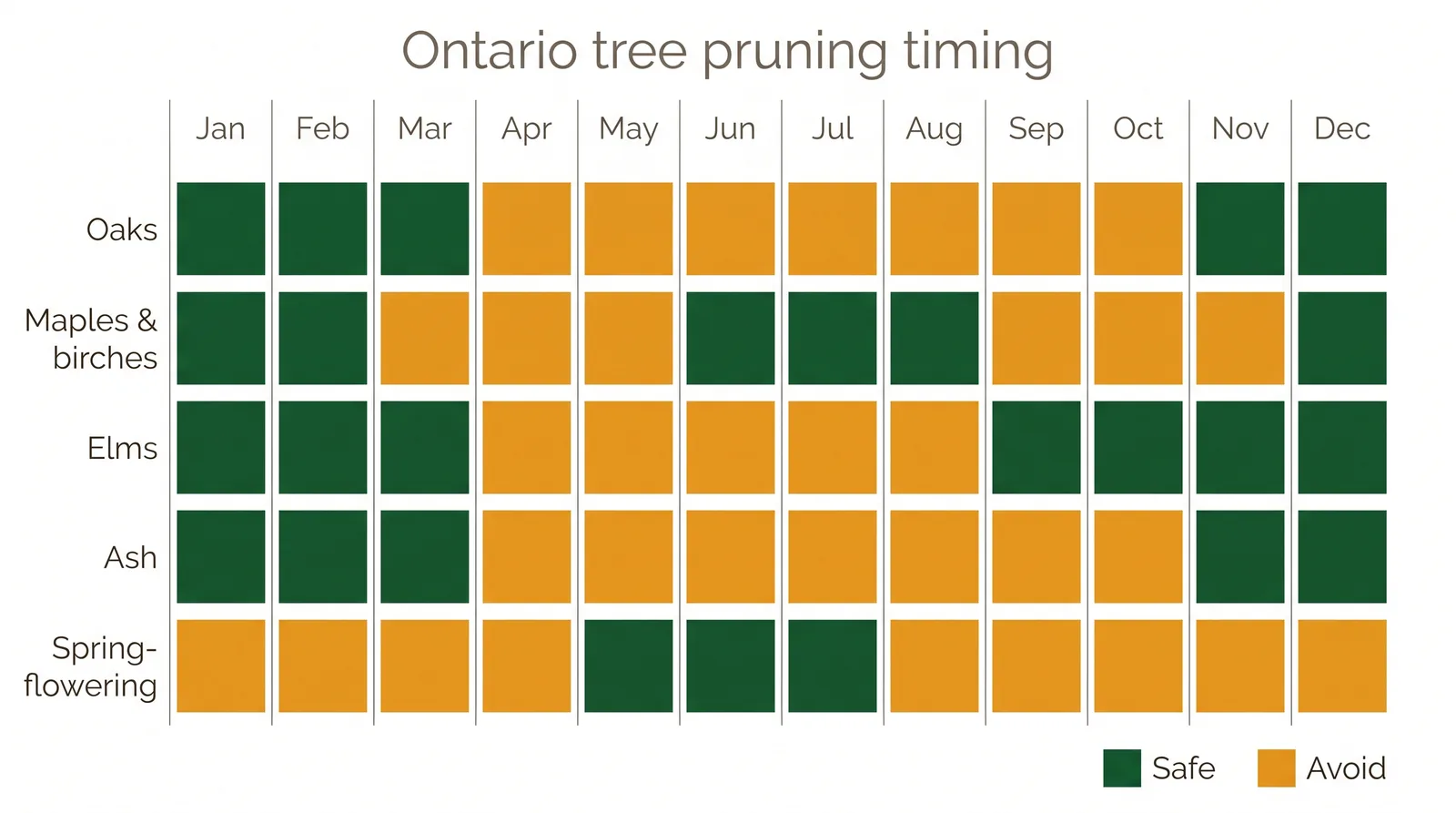
Different species have different rules, and the safest approach is to match the cut to the tree. The chart below summarizes the windows that matter most in the GTA.
| Tree type | Best time to prune | Avoid | Why |
|---|---|---|---|
| Most shade / deciduous trees | December to February (dormant) | — | Insects dormant, structure visible |
| Oaks | November to March only | April to November | Oak wilt spread by sap beetles (Ontario) |
| Maples, birches, walnuts | Deep winter (Dec–Feb) or midsummer | Late winter / early spring | They bleed sap when cut as sap rises |
| Elms | Dormant winter | April to August | Dutch elm disease spread by elm bark beetles |
| Ash (untreated) | Dormant winter | Growing season | Emerald ash borer active; avoid spreading it |
| Spring-flowering trees | Right after they bloom | Winter (removes flower buds) | Buds form on last year's wood |
| Any tree: dead / hazardous limbs | Any time | — | Safety outweighs seasonal timing |
Quotable: In Ontario, most trees prune best in winter dormancy (December to February), but oaks must never be cut April to November, and maples and birches should be pruned by mid-February to avoid bleeding sap.
Why must you never prune oaks between April and November?
Because of oak wilt, and this is the one rule on the chart that can kill a tree outright. Oak wilt is a fungal disease (caused by the fungus Bretziella fagacearum) that was first detected in Canada in 2023 in Niagara Falls, with further Ontario detections in Niagara-on-the-Lake and the Township of Springwater (Government of Ontario).
It spreads in two ways. Underground, through grafted roots between neighbouring oaks, and above ground by sap beetles (nitidulid beetles) that are active from April through November. Those beetles are drawn to the sweet sap that seeps from a fresh pruning cut, and they can carry fungal spores straight into the wound. Red oaks are especially vulnerable and can die within a single season (Canadian Food Inspection Agency).
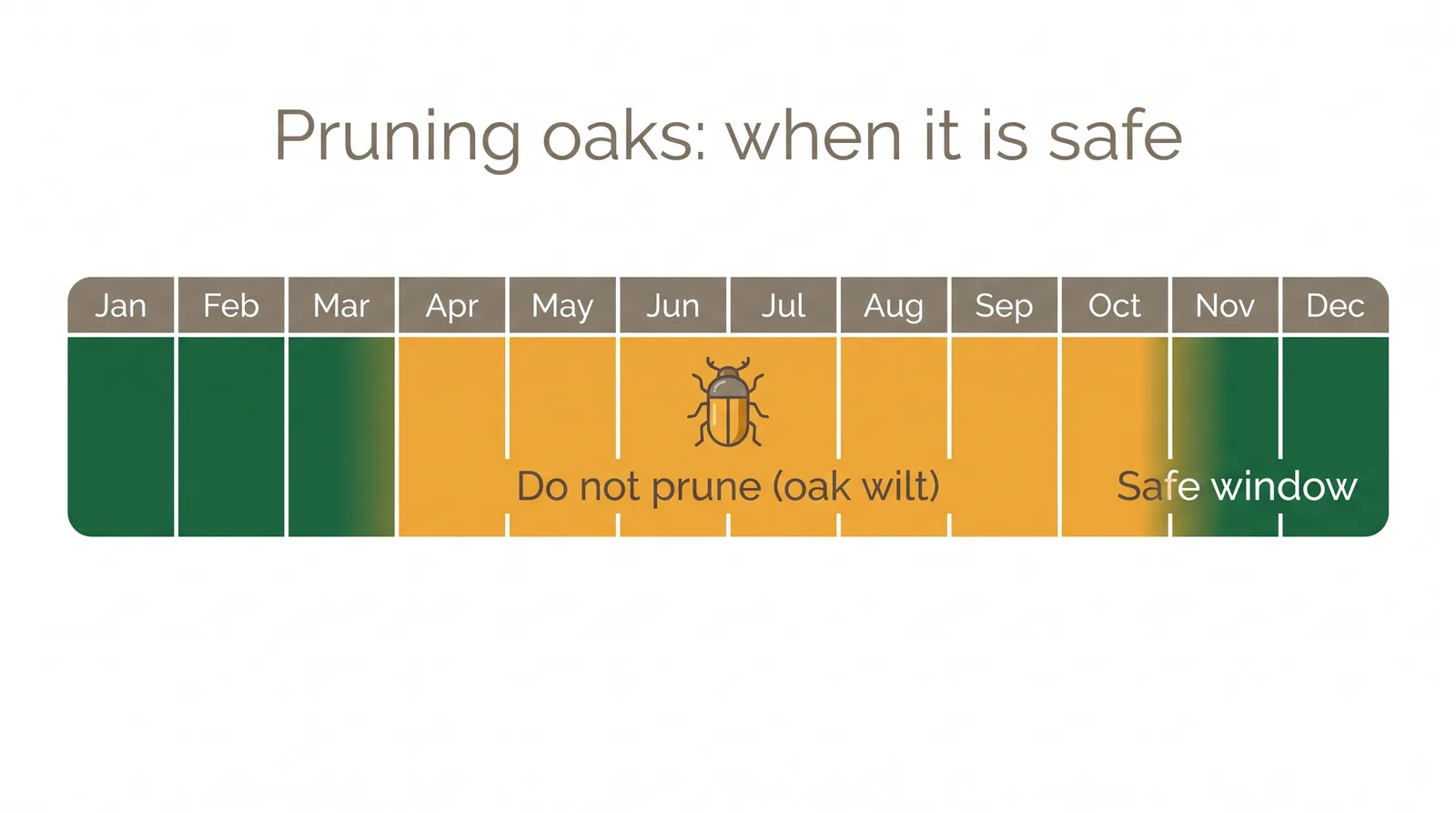
So prune oaks only from late fall through winter, roughly November to March. If a storm or a genuine safety hazard forces a cut during the risky months, seal the wound immediately with a thin layer of wound paint or shellac to make it less attractive to the beetles (Invasive Species Centre). That wound-dressing advice is the opposite of the general rule for most trees, where wound paint is discouraged; oak wilt is the specific case where it helps.
Why do maples and birches bleed, and when should you prune them?
Maples, birches, and walnuts are "bleeder" trees. Cut them in late winter or early spring, just as the sap starts rising, and they weep sap from the wound for days. It looks alarming, but the bleeding does not actually harm the tree.
To avoid the mess, prune these species in the heart of dormancy, December to mid-February, before sap flow begins. If you missed that window, the better move is to wait until the tree is fully leafed out in summer rather than cutting during the heavy sap flow of March and April. A sugar or red maple pruned in deep winter loses almost no sap.
What about elms and ash trees?
Both carry an insect-borne disease risk that overrides the general timing. Elms should not be pruned from April through August, the stretch when the elm bark beetles that spread Dutch elm disease are active; prune elms in the dormant winter instead.
Ash trees face emerald ash borer. An untreated ash is safest pruned in the dormant winter when the borer is inactive, which also avoids attracting it to fresh wounds. Ash wood is regulated in parts of Ontario to slow the borer's spread, so do not haul ash prunings out of your area; check current rules before moving the wood.
When can you prune a tree any time of year?
Whenever a limb is dead, damaged, diseased, or dangerous. Safety and tree health outweigh the seasonal calendar, so a cracked branch over a driveway or a dead limb above a walkway comes off as soon as you can safely get to it, on any species.
The single carve-out is the oak: if you must remove a live oak limb between April and November, seal the cut right away. For anything beyond a small limb you can reach from the ground, a big or hazardous tree is a job for a pro with the right gear, and heavy pruning on a large private tree can also brush up against Toronto's tree protection rules, so it is worth confirming before you start.
Pruning is one part of putting a yard to bed for winter. If you are working through a fall checklist, our guides to when to stop watering your lawn in fall and winterizing a sprinkler system cover the other seasonal shutdowns. To hand the tree work to a vetted pro, compare crews on the landscaping directory for North York, check current rates on the Toronto landscaping cost guide, or request a quote.
Want a certified pro to prune your trees at the right time of year? Request a quote and compare up to three vetted local crews side by side. Your contact details only go to the one you pick.