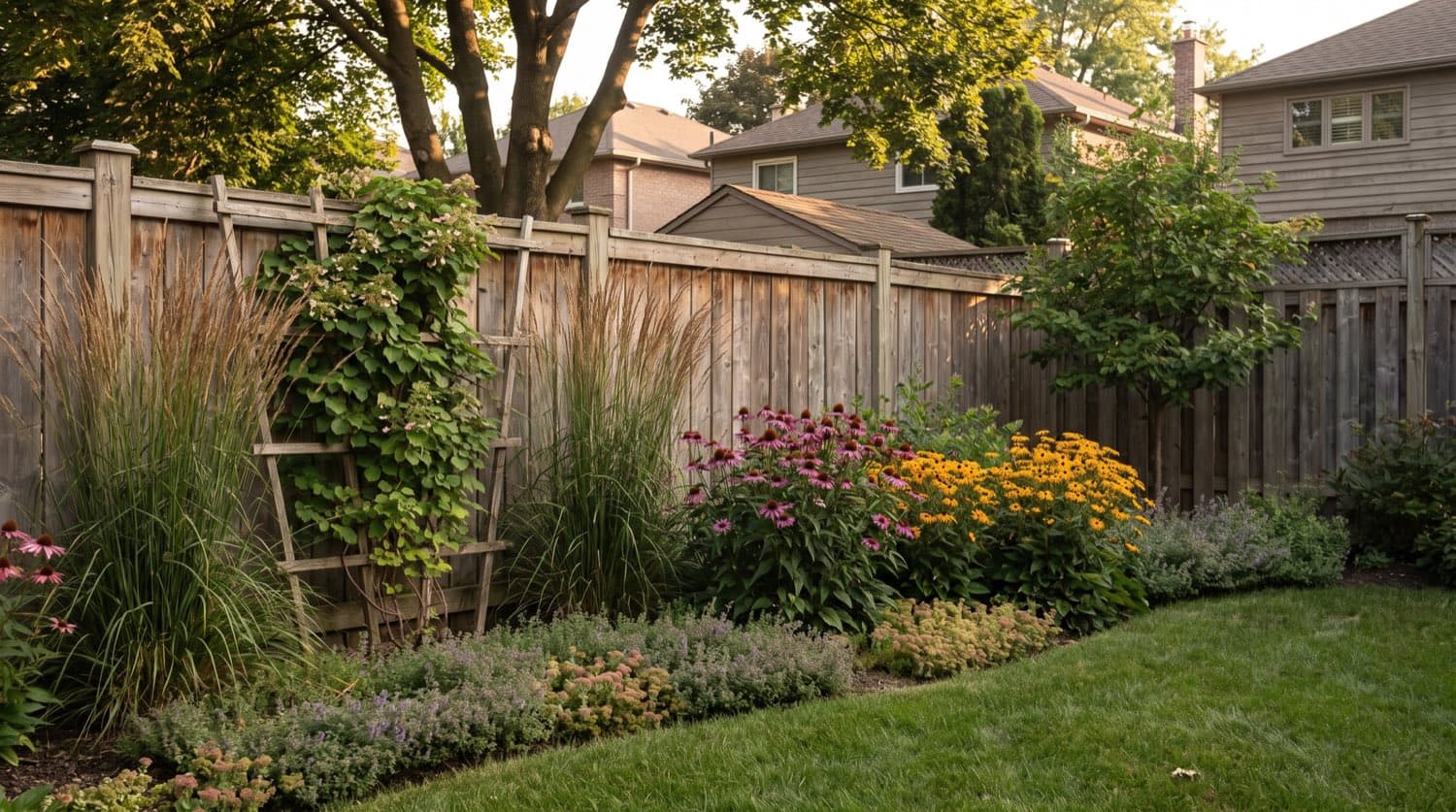
Answer First: The best along-the-fence landscaping layers plants for depth: tall plants or a trellis climber against the fence, mid-height perennials in front, and low groundcover at the edge. Because Toronto caps a rear-yard fence at 2.0 metres, real privacy comes from tall plants and trellises above the fence, not a taller fence. Match plants to the fence's light, sun-tough on a hot south or west fence, shade lovers on a north or east one, and leave a gap to protect the wood.
A bare fence is the biggest missed opportunity in most Toronto backyards. It is already a backdrop; a layered planting turns it into a green wall that adds privacy, depth, and colour to the whole yard.
How to plant a fence line: layer it
The single idea that makes a fence border look professional is layering. A flat row of one plant reads as a hedge; three layers of different heights read as a designed garden.
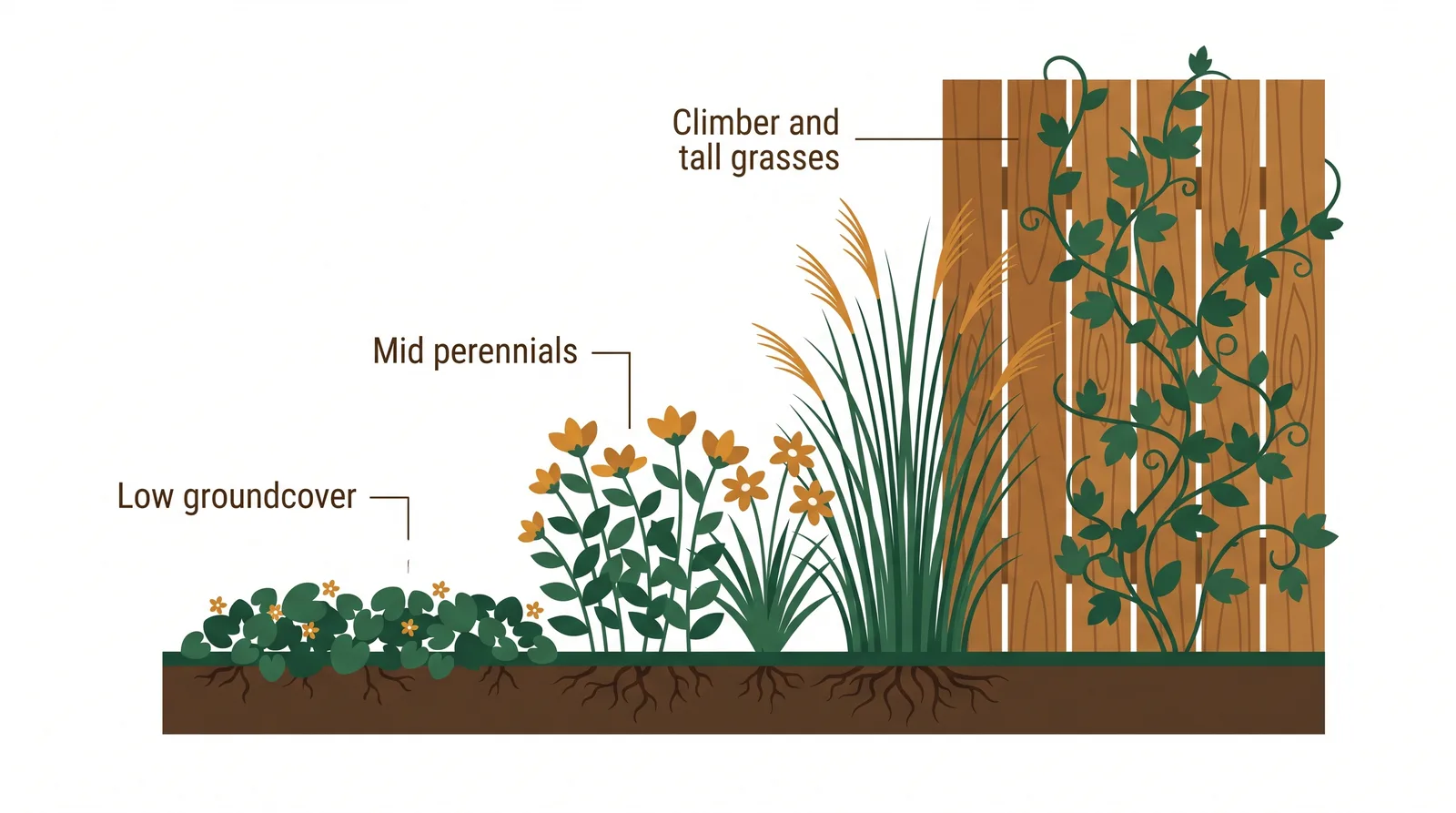
Build it back to front:
- Back layer, against the fence. Tall ornamental grasses, columnar shrubs, or a trellis with a climbing vine to screen the boards and rise above them.
- Middle layer. Mid-height perennials for colour and seasonal interest, in drifts rather than singles.
- Front layer. A low groundcover or edging plant to finish the border and suppress weeds.
This depth is what separates a finished border from a lonely row of plants, and it works in a bed as narrow as a couple of feet.
Quotable: A fence border looks designed when it is layered: tall plants and a climber against the fence, mid-height perennials in front, and a low groundcover at the edge. One flat row just reads as a hedge.
Privacy: plants do what the fence can't
In Toronto you cannot simply build a taller fence for privacy. The fence bylaw (Chapter 447) generally limits a rear or side-yard fence to 2.0 metres, and a front-yard fence within 2.4 metres of the front lot line to 1.2 metres (Toronto Municipal Code Chapter 447). Anything above that has to be green.
That is where tall plants earn their place. Ornamental grasses, narrow columnar trees and shrubs, and a climber on a trellis all raise the screen above the fence line without breaking the bylaw. Layered behind lower plants, they read as a lush backdrop rather than a bid to wall off the neighbours.
From the data: YardQuote tracks 650 landscaping companies across the GTA, and 613 carry three or more Google reviews at an average of 4.77 stars (July 2026). Fence-line borders and privacy plantings are everyday work for most of them, so a well-reviewed crew is easy to line up.
Plant to the fence's light
A fence has two very different climates depending on which way it faces, and planting the wrong side is the most common fence-border mistake. Read the exposure before you pick plants.
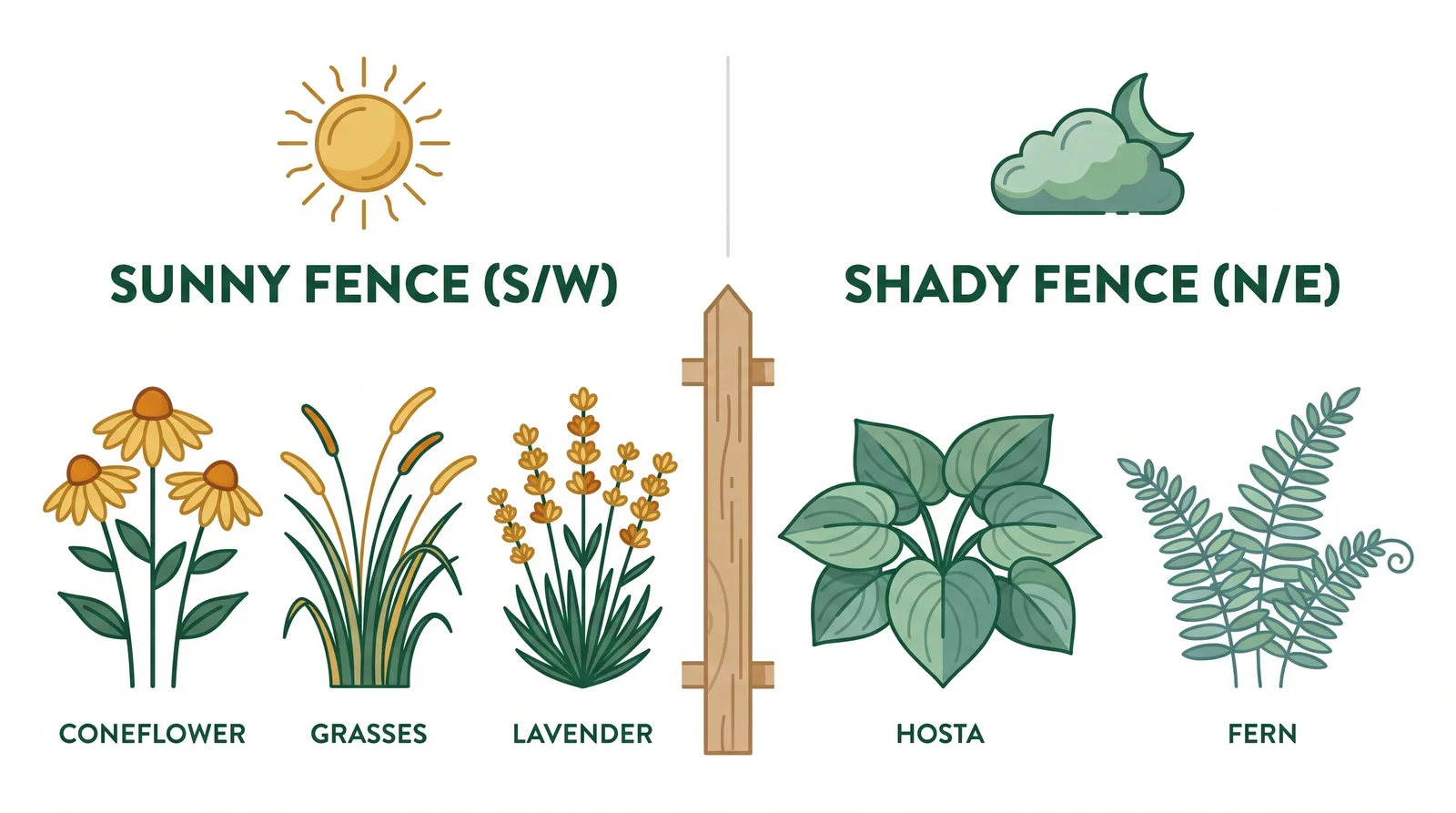
- Sunny fence (south or west facing). Hot and dry, often reflecting heat off the boards. Use drought-tough sun plants, ornamental grasses, coneflower, black-eyed Susan, yarrow, and lavender (Toronto Master Gardeners).
- Shady fence (north or east facing). In shade much of the day. Use shade lovers, hostas, ferns, and native groundcovers like wild ginger and wild geranium.
Matching plants to the exposure is the difference between a border that fills in lush and one that stretches, struggles, and disappoints.
Protect the fence and keep the peace
Two practical habits keep a fence border trouble-free. First, protect the wood: leave a small gap between plants and the boards for airflow, and grow climbers on a trellis set just off the fence rather than directly on it, so trapped moisture does not rot the wood.
Second, mind the property line. A shared division fence is jointly the responsibility of both owners, so keep your plants and their roots on your side and trimmed back from the line. Overhanging growth and spreading roots are a classic neighbour dispute, and the easy fix is choosing plants that stay in their lane.
Layered border — a planting bed designed in tiers of height, tall plants at the back, medium in the middle, low at the front, so it reads with depth instead of as a single flat row.
For plant choices that thrive along a fence, our guides to native plant landscaping and low-maintenance landscaping for Ontario cover tough, layered performers, and the rock and gravel ideas help with narrow side-yard strips. To plan and price a border, see the landscaping cost page and the landscape design cost page, or browse landscaping in North York.
Want to turn a bare fence into a green backdrop? Request a quote and compare up to three vetted local pros side by side. Your contact details only go to the one you pick.