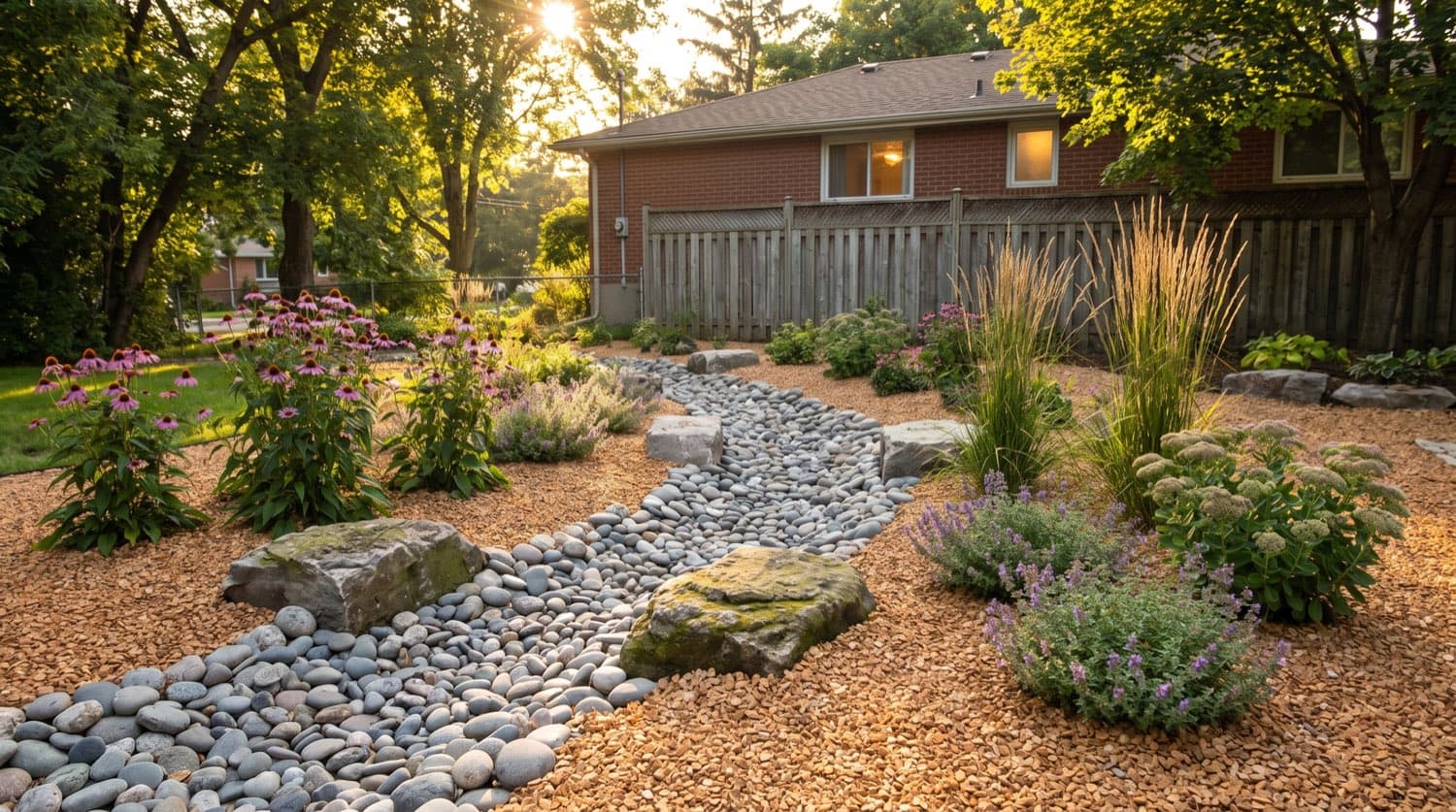
Answer First: The best rock landscaping ideas for Toronto use the right stone for each job: pea gravel for paths, crushed stone for compacted driveways and patios, river rock for dry creek beds and drainage, and boulders or armour stone as focal points. A dry creek bed doubles as a drainage fix on clay soil, and a gravel garden with drought-tolerant plants cuts watering and mowing to almost nothing. Save landscape fabric for pure gravel areas, not planted beds.
Rock landscaping is not just a look. Done right, it fixes the two things Toronto yards fight most: heavy clay that will not drain and lawns that eat every weekend. The trick is choosing the right stone for each job.
Which rock or gravel should you use where?
Match the stone to the task, because the four common types behave very differently. Using river rock where you needed crushed stone, or the reverse, is the most common and expensive mistake.
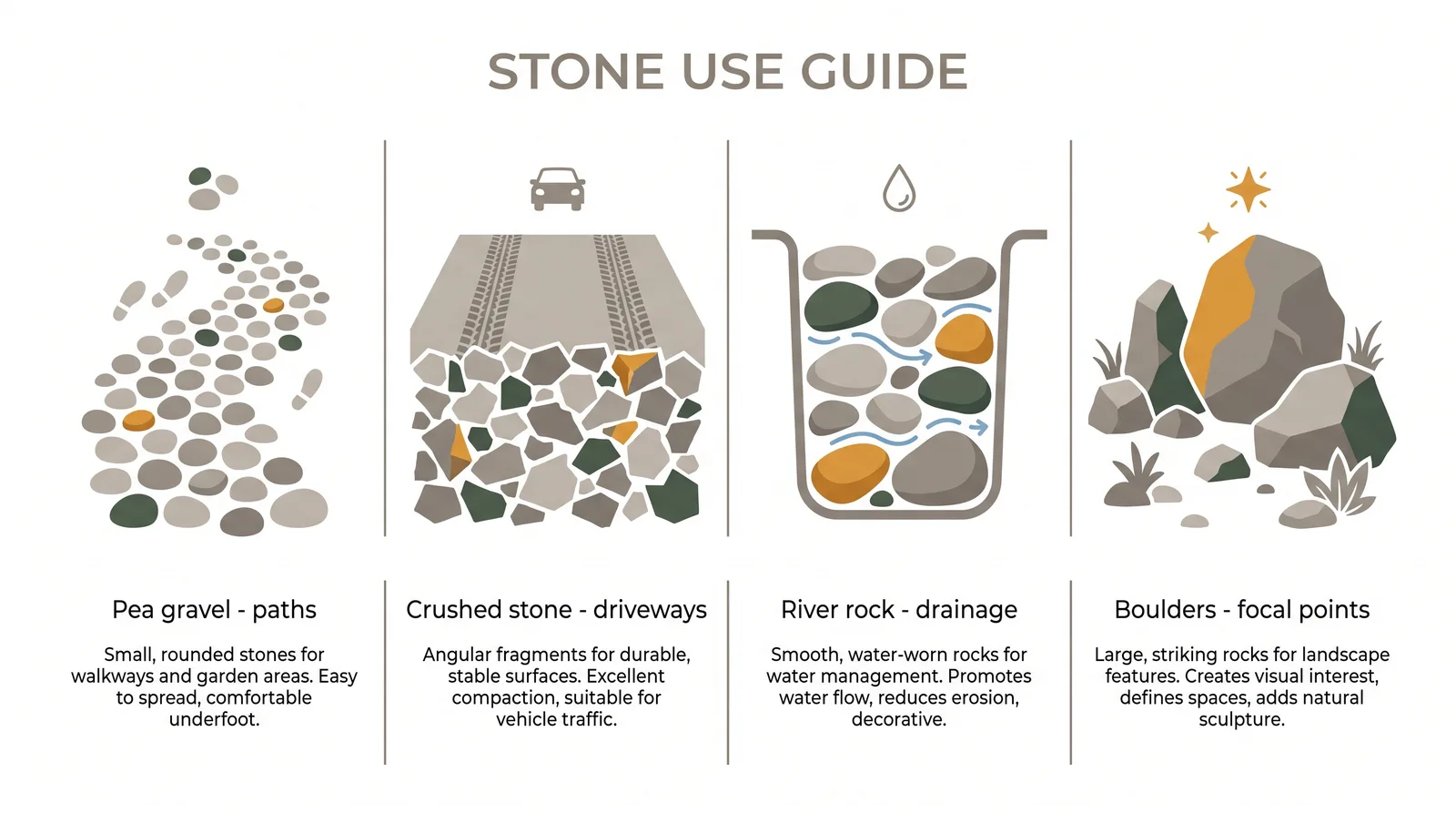
| Stone type | What it is | Best for |
|---|---|---|
| Pea gravel | Small, rounded, pea-sized stones | Paths, gravel mulch under plants, between steppers |
| Crushed stone | Angular rock (about 3/4 inch and smaller) with fines | Driveways, patios, compacted bases |
| River rock | Smooth, rounded stones, one inch and up | Dry creek beds, drainage, borders, water features |
| Boulders / armour stone | Large feature stones | Focal points, low retaining, ravine-edge work |
The dividing line that matters: rounded stone (pea gravel, river rock) stays loose and drains, while angular crushed stone locks together when compacted to form a firm surface. That is why a crushed-stone path holds up and a river-rock path shifts underfoot.
Quotable: Rounded gravel drains and stays loose; angular crushed stone compacts into a firm base. Using the wrong one is why some gravel paths shift underfoot and others stay solid for years.
A dry creek bed that fixes drainage
If water pools in a low corner or runs toward your foundation, a dry creek bed turns that problem into a feature. It is a shallow, rock-lined channel that guides runoff to a spot where it can soak away.
This works especially well in Toronto because clay soil sheds water instead of absorbing it, so runoff has to go somewhere. A dry creek bed graded on a gentle slope carries that water through river rock rather than letting it pool or erode the lawn. Larger stones line the channel, smaller gravel fills between, and the whole thing reads as an intentional design element rather than a drainage repair.
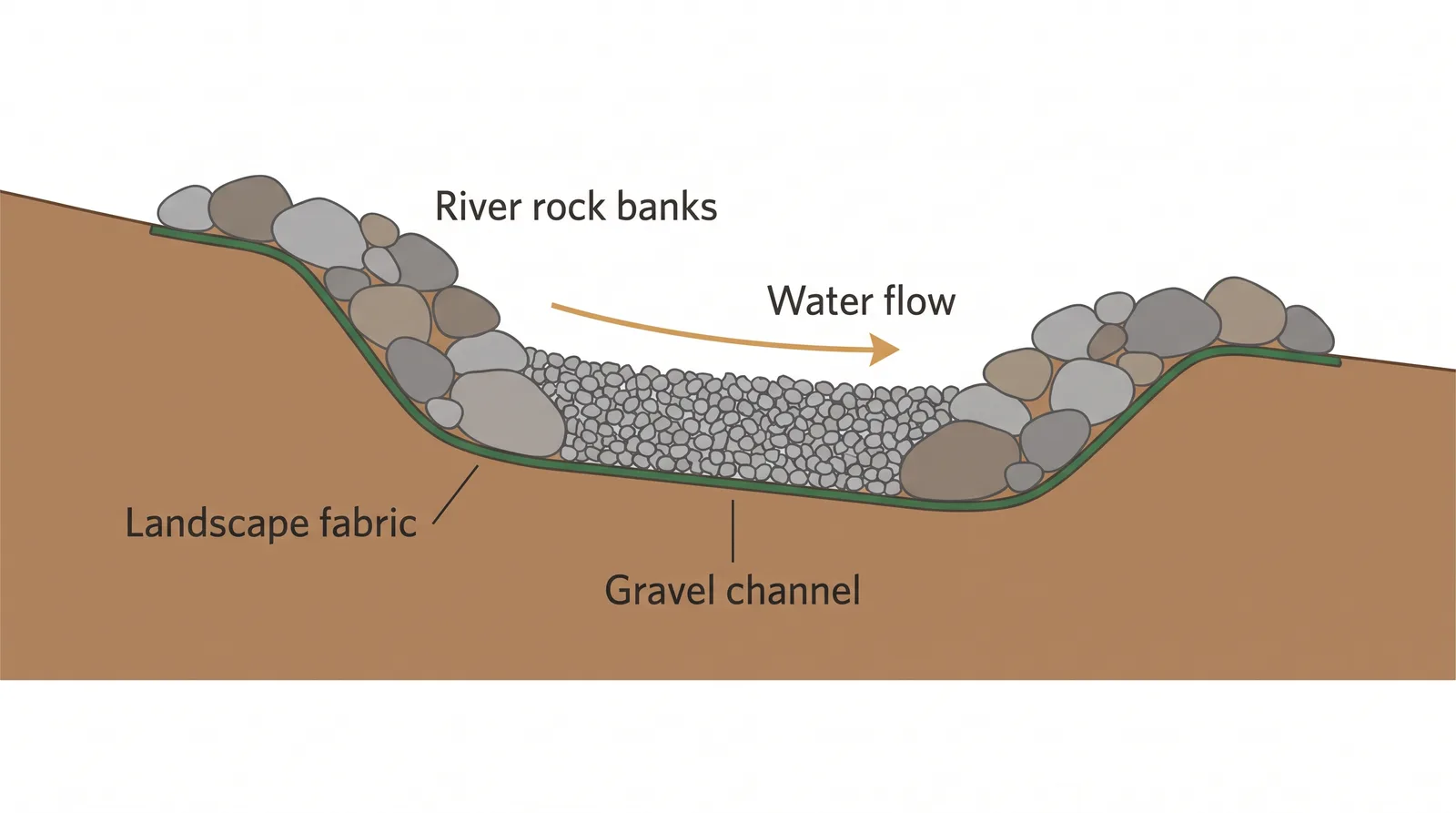
Dry creek bed — a shallow, rock-filled channel built to resemble a natural stream, used to carry rainwater runoff away from problem areas while doubling as a landscape feature.
Gravel as mulch: the low-maintenance win
Gravel is mulch that never rots, and around the right plants it is close to zero-maintenance. Spread over a planting bed, it conserves soil moisture, suppresses weeds, and holds its look for years instead of breaking down each season like wood chips.
For sunny beds, horticulturalists specifically recommend gravel mulch over drought-tolerant perennials (Toronto Master Gardeners). Pair it with Ontario-tough plants like coneflower, yarrow, black-eyed Susan, or native little bluestem grass, and you get a gravel garden that shrugs off dry spells once established. This is the same thinking behind xeriscaping in Ontario, where gravel and drought-tolerant plants replace thirsty lawn.
From the data: YardQuote tracks 650 landscaping companies across the GTA, and 613 carry three or more Google reviews at an average of 4.77 stars (July 2026). Hardscape and gravel work is a core service for most of them, so a well-reviewed crew for a dry creek bed or gravel garden is easy to find.
When to use landscape fabric, and when to skip it
Fabric belongs under bare gravel, not under plants. This is the detail that decides whether a gravel project ages well or turns into a weedy, root-bound mess.
- Use it under a pure gravel path, a driveway base, or a dry creek bed, where a non-woven geotextile fabric suppresses weeds and stops the stone from sinking into the soil.
- Skip it under a gravel garden meant to fill with plants. Fabric blocks self-seeding, breaks down within a few years, and tangles roots, so drought-tolerant beds do better with a deeper gravel layer and no fabric.
The freeze-thaw cycle matters here too. Toronto winters heave stone and shift edging, so gravel areas benefit from a proper edge (steel, stone, or a soldier course) to keep the rock where you put it.
Ideas that work on a Toronto lot
A few combinations punch above their weight on GTA properties:
- Gravel garden replacing a strip of lawn. Drought-tolerant perennials in gravel mulch, along a sunny side yard that never grew good grass anyway.
- Dry creek bed through a wet low spot. Solves drainage in a back corner while looking like a feature.
- Boulder or armour stone focal point. A single large Ontario stone anchors a bed better than a dozen small ones; armour stone also doubles as low retaining on a slope.
- Crushed-stone path. A compacted fine-gravel walkway that stays firm and drains, unlike loose river rock.
For pricing and to compare crews, see the landscaping cost page and, for boulder and armour-stone walls, the retaining wall cost page, or browse landscaping in Scarborough. If your goal is less upkeep overall, our guides to low-maintenance landscaping for Ontario and xeriscaping in Ontario build on these same ideas.
Thinking about rock or gravel for your yard? Request a quote and compare up to three vetted local pros side by side. Your contact details only go to the one you pick.