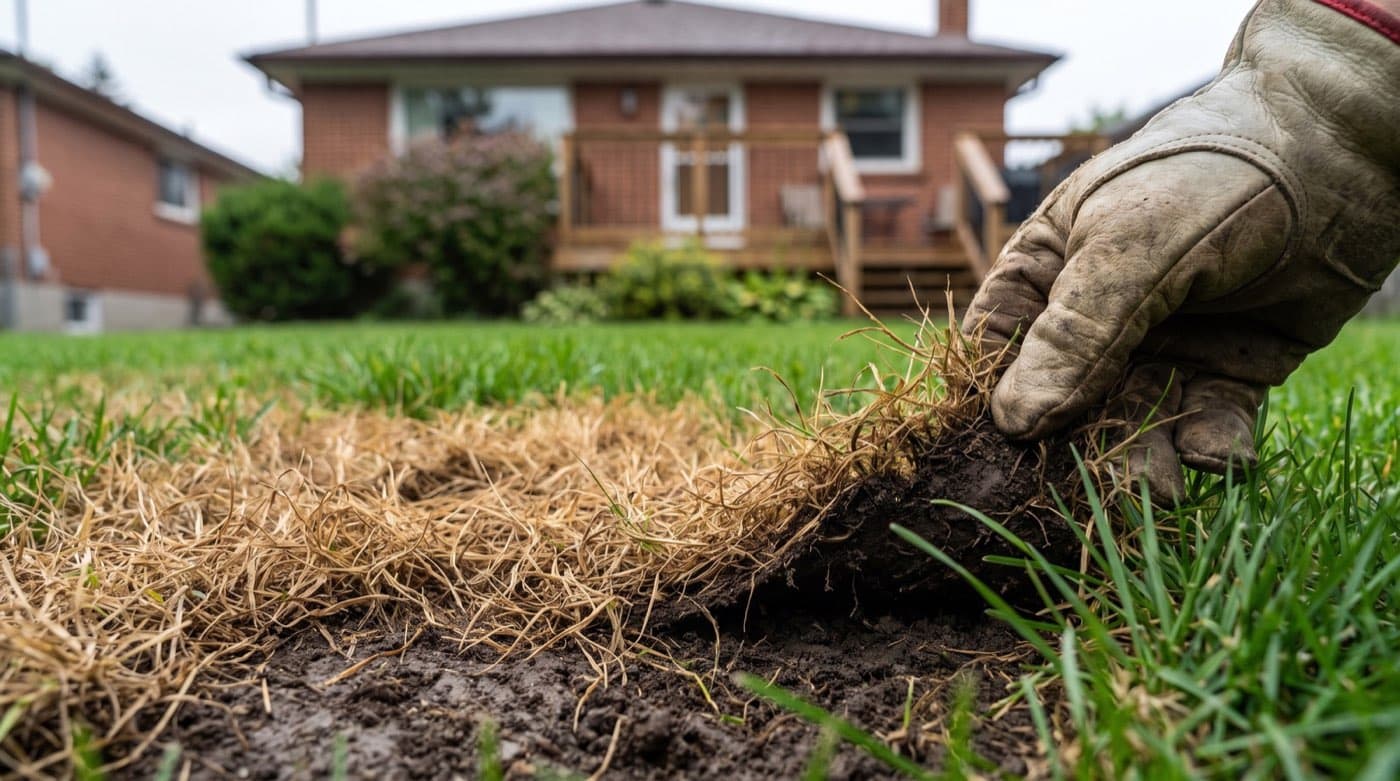
Answer First: A quick tug test tells them apart. If a brown patch of lawn peels back like a loose carpet with almost no roots, you have white grubs eating the roots underneath. If the turf stays firmly anchored, it is more likely chinch bugs, which suck the blades and crowns dry but leave roots intact. Grub damage peaks in fall and spring and attracts digging skunks and raccoons; chinch bug damage peaks in the hot, dry weeks of July and August in the sunniest part of the yard.
Both pests brown out a lawn, and homeowners routinely treat the wrong one and waste a season. The good news is that a Toronto lawn tells you which it is if you know the two tests: how the turf pulls, and when the damage shows. Here is how to read it.
The 10-second test: does the turf lift?
Go to the edge of a brown patch, grab a handful of grass, and pull up. This one move separates the two pests faster than anything else.
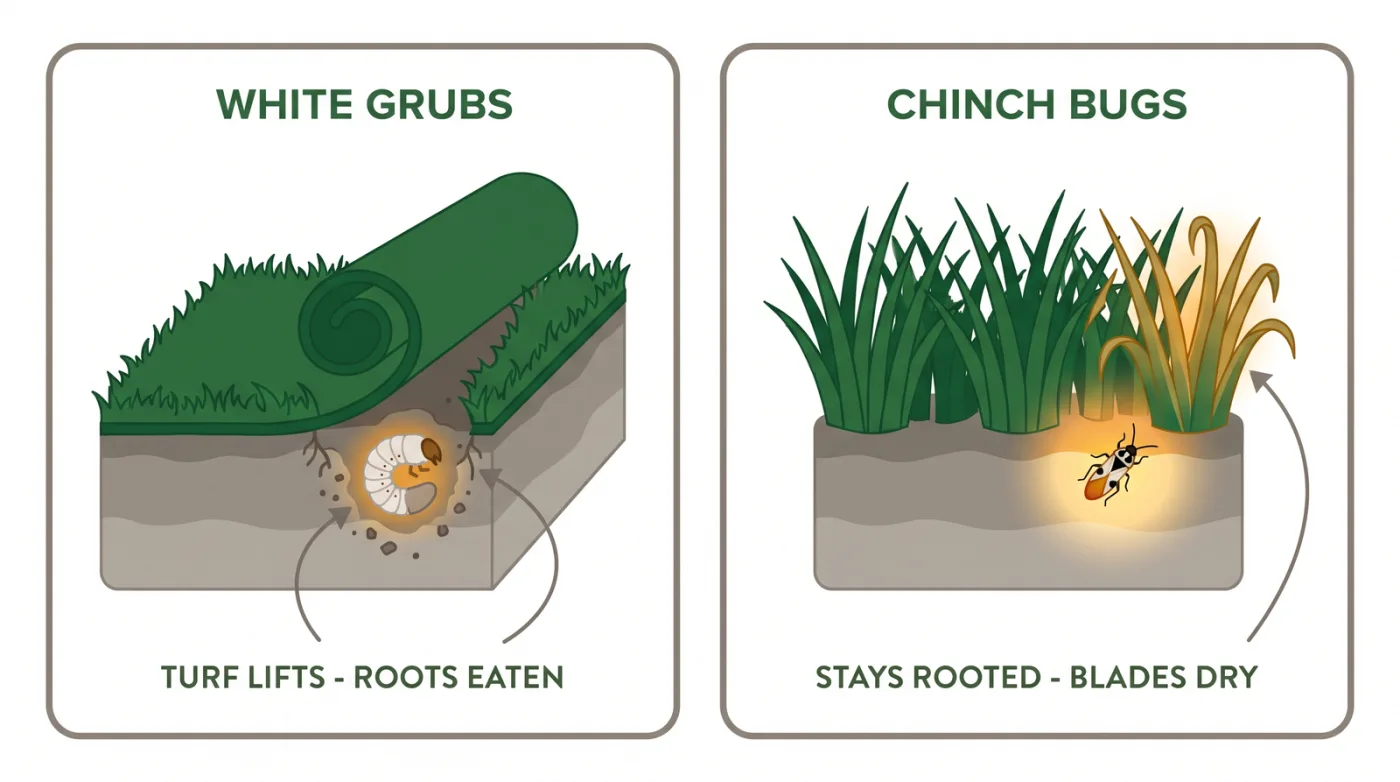
If it lifts like a loose rug, roots and all coming away from the soil, you have white grubs. Grubs are the larvae of beetles, and they eat grass roots, so the turf loses its anchor. If you flip back the sod, you may see the C-shaped white larvae in the top few centimetres of soil.
If the turf stays rooted and firm, chinch bugs are the more likely culprit. Chinch bugs feed on the blades and crowns above the soil, not the roots, so the grass browns but stays attached.
Quotable: The fastest lawn-pest test in Toronto is the tug: if a brown patch peels up like a carpet with no roots, it is grubs; if it stays anchored, it is chinch bugs.
The second test: when did the damage show up?
Timing is the tiebreaker when the tug test is unclear.
White grubs do their worst damage in fall and spring, when the larvae are feeding closest to the surface and growing fast (Ontario). The classic sign is spongy, wilting turf in September and October, then brown patches when the lawn should be greening up in spring.
Chinch bugs peak in the hot, dry weeks of July and August, and they hit the sunniest, driest parts of the lawn first, often near driveways, sidewalks, and south-facing slopes. Their damage looks like drought at first, but the giveaway is that it does not green back up after watering.
What each pest actually is
White grub — the larva of a beetle such as the European chafer or Japanese beetle, a plump, C-shaped, cream-coloured insect that lives in the soil and eats grass roots. It is Ontario's most common serious lawn pest.
Chinch bug — a tiny surface insect, about 3 to 4 mm, black with white wings, that uses piercing mouthparts to suck sap from grass blades and crowns, injecting a toxin that browns the grass. It thrives in heat and does not touch roots.
To confirm chinch bugs, part the grass at the edge of a dying sunny patch on a warm day and look at the thatch line; they cluster there and move when disturbed.
Side by side: grubs vs chinch bugs
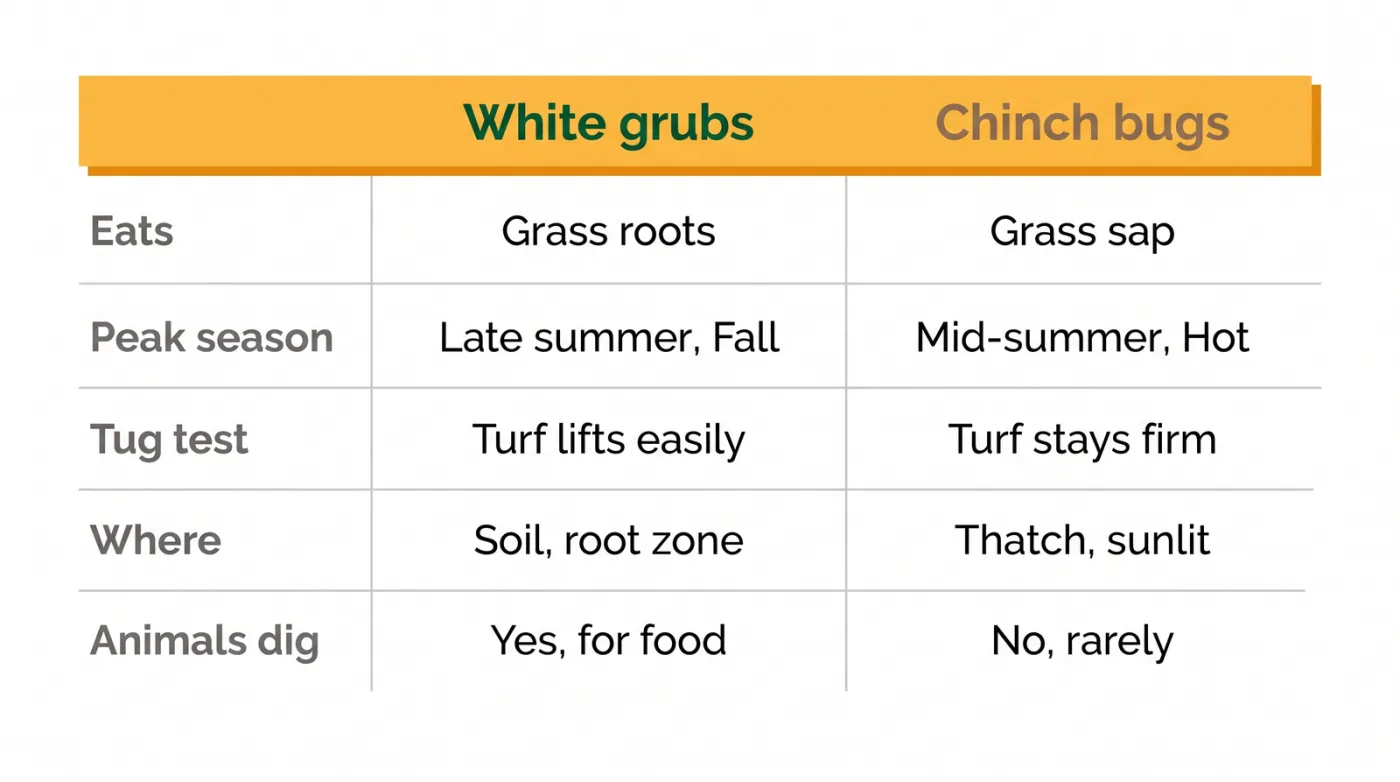
| Clue | White grubs | Chinch bugs |
|---|---|---|
| What they eat | Grass roots (underground) | Blades and crowns (surface) |
| Peak damage | Fall and spring | Hot, dry July and August |
| Tug test | Turf lifts like a carpet | Turf stays rooted |
| Where | Anywhere, often shaded/moist | Sunniest, driest spots |
| Animals digging | Yes, skunks and raccoons | No |
That last row is the shortcut most people miss. If skunks or raccoons are tearing up the lawn overnight, you have grubs, full stop, because animals hunt grubs and ignore chinch bugs. We cover that in why skunks and raccoons dig up Toronto lawns.
How to treat each one in Toronto
Ontario's cosmetic pesticide ban, in force since 2009, prohibits the conventional insecticides most American guides reach for, so the Ontario approach is different (Landscape Ontario).
For grubs: beneficial nematodes are the main tool, microscopic organisms watered into moist soil to attack the larvae. Timing matters, aimed at the newly hatched grubs, and the soil has to stay damp for them to work. A thick, deep-rooted lawn also tolerates far more grubs before it shows damage.
For chinch bugs: there is no legal quick spray, so control is cultural. Reduce thick thatch, water deeply during heat waves to break their preferred hot-dry conditions, and overseed to thicken the turf. A well-watered lawn is genuinely the treatment here, not just prevention.
From the data: YardQuote tracks 249 lawn care companies across the GTA, and 88% of the rated ones hold 4.5 stars or higher (YardQuote tracking, July 2026). A good crew will do the tug test before quoting a treatment; be wary of anyone who prescribes without diagnosing.
Fix the lawn, not just the bug
Whichever pest it is, the repair is the same: control the cause, then rebuild the turf. Rake out the dead grass, overseed or re-sod the bare patches, and keep the new grass watered while it roots. Fall is the strongest repair season in Toronto, which is why the fall lawn care jobs and the right spring lawn care routine do more against pests than any single treatment. A thick lawn is the actual defence.
If the damage is widespread or keeps coming back, it is worth a professional diagnosis. Compare current ranges on the lawn care cost page or browse vetted local pros in the lawn care directory for Scarborough.
Not sure what is eating your lawn? Request a quote and compare up to three vetted local lawn care pros side by side. Your contact details only go to the one you pick, and a good pro diagnoses before they treat.