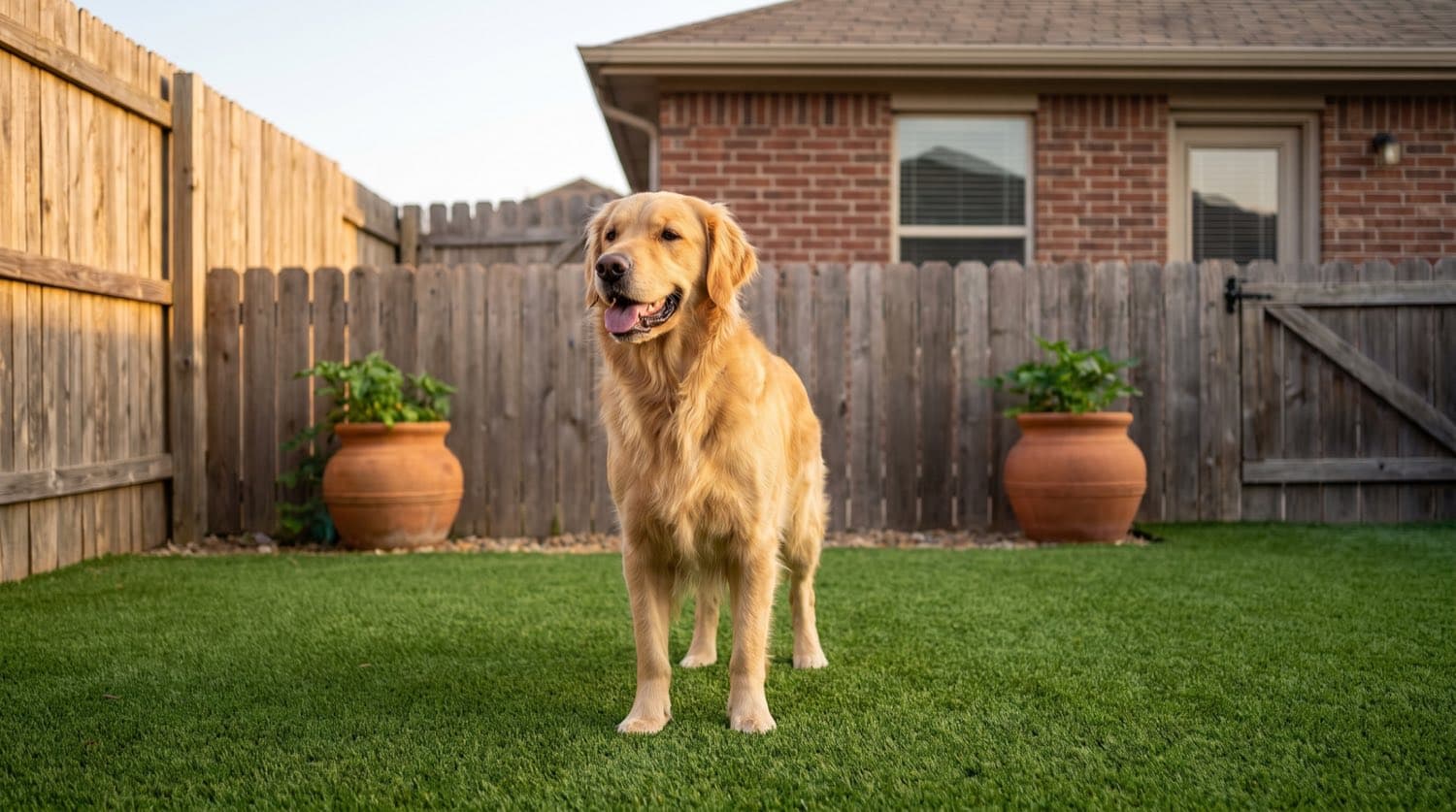
Answer First: Artificial grass works for dogs when it is built as a system: a fully permeable backing over a free-draining crushed-stone base so urine and rain pass straight through, plus a zeolite infill that traps the ammonia causing odour. It is not maintenance-free, you still pick up solids and rinse regularly, and in a sunny yard you have to watch the summer heat, because synthetic turf runs far hotter than grass and can burn paws. Get the drainage and infill right and it beats a muddy, urine-spotted real lawn for a dog.
Dogs are exactly the case where artificial turf can shine, no mud, no dug-up holes, no yellow urine burns, and exactly the case where a cheap installation fails fast and starts to reek. The difference is entirely in the system underneath.
Why is drainage the whole game?
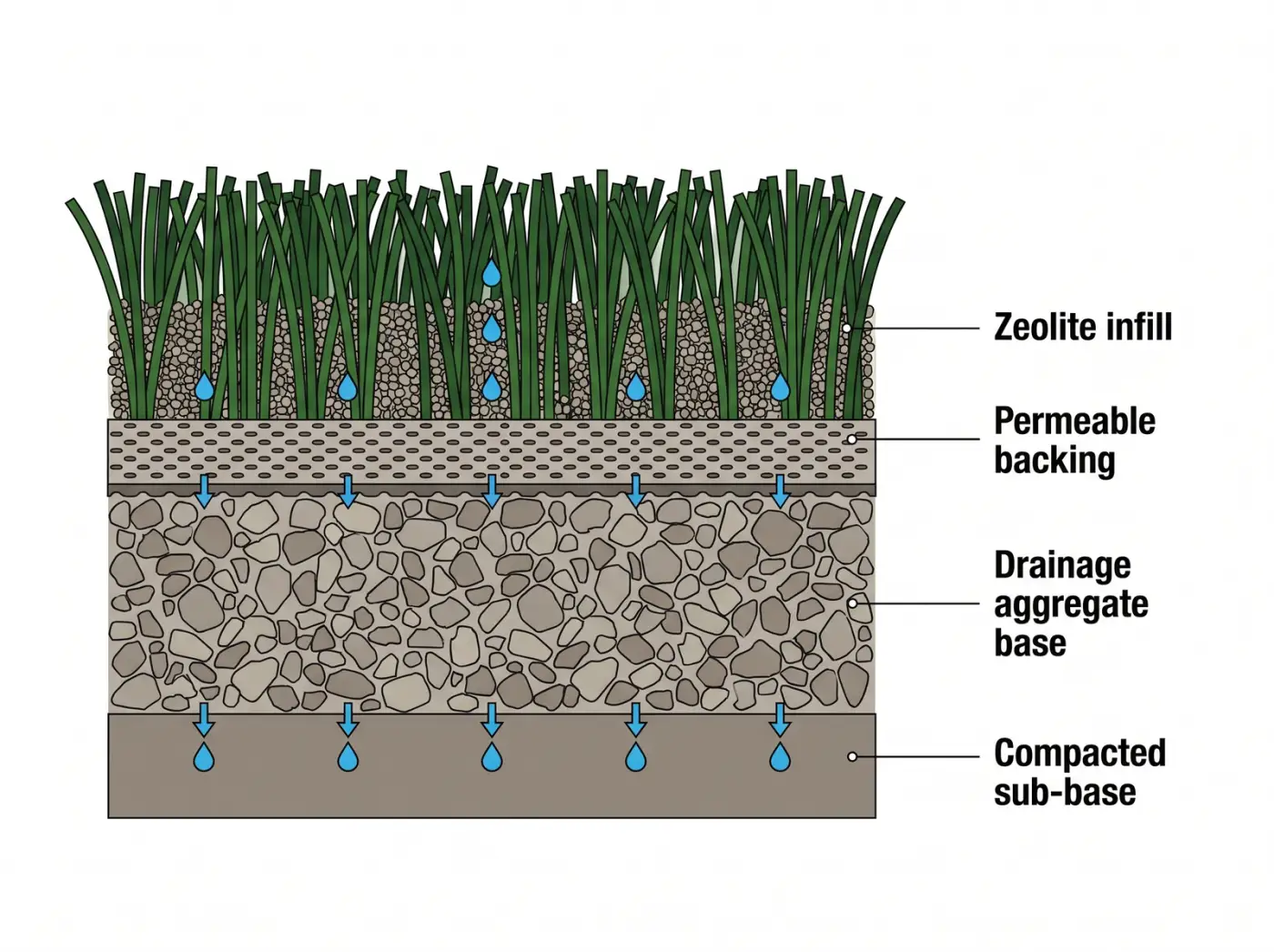
Because a dog's yard has to handle liquid, constantly, and anything that pools will smell. Pet-grade turf uses a fully permeable backing (some are rated to drain hundreds of inches of water per hour) laid over a free-draining crushed-stone base, so urine and rain go straight down into the ground instead of sitting on the surface (Watersavers Turf).
That drainage is what separates a clean dog lawn from a bacterial one. Standing moisture is what grows the bacteria that cause odour, so the faster liquid clears the surface, the cleaner it stays. A turf laid over compacted soil or a solid pad, with nowhere for urine to go, is the single most common reason a dog lawn starts to stink.
Quotable: On a dog lawn, standing moisture is what smells. A fully permeable turf backing over a free-draining aggregate base is what lets urine clear the surface before bacteria can grow on it.
How do you control the urine odour?
The infill does most of the work. The material swept into the turf between the blades is what traps the ammonia in dog urine, and zeolite is the go-to for pets. Zeolite is a natural mineral with a honeycomb structure that absorbs and neutralizes ammonia before it turns into the smell you notice (Watersavers Turf).
The important caveat: zeolite is not permanent. Once its pores fill with ammonia, it stops absorbing and odours return, so it depends on a regular rinse to flush it clean and an occasional top-up. That is why the maintenance routine matters as much as the materials.
Zeolite infill — a natural mineral swept into pet turf whose honeycomb structure traps and neutralizes the ammonia in urine. It works until it saturates, so rinsing to flush it is part of the routine, not optional.
What is the maintenance routine that keeps it fresh?
Simple, but not zero. Pick up solid waste promptly, the same as any lawn, so it does not break down into the turf. Rinse the high-traffic potty areas regularly with water to flush urine through the drainage and refresh the zeolite, more often in summer heat when odours build faster. For stubborn spots, use an enzyme-based cleaner made for pet odour, which breaks down the compounds rather than masking them.
Done consistently, that keeps a dog lawn genuinely odour-free. Skipped, even the best turf system will eventually smell, because the infill saturates and the surface never gets flushed.
Does the base and turf hold up to an active dog?
If it is built right, yes. Dogs run, skid, and dig, so two things matter: a properly excavated and compacted crushed-stone base that resists digging and shifting, and a shorter, denser pile that stands up to traffic rather than matting flat. A quality pet turf is designed to take claws and repeated running without pulling apart at the seams.
This base is the same principle that keeps any hardscape stable, the reason we harp on compacted bases in why interlocking sinks. Cut the base short and a dog will find the weak spot.
What about summer heat on a dog's paws?
This is the real warning. Synthetic turf runs much hotter than grass in the sun, university research puts it at roughly 20 to 30°C hotter than a natural lawn in direct summer sun (Penn State), which is hot enough to be uncomfortable or unsafe for paws on a bright afternoon.
Manage it the way you would hot pavement: shade the area if you can, rinse it down to cool the surface briefly before letting the dog out at midday, and use the back-of-your-hand test, if you cannot hold your hand on the turf for several seconds, it is too hot for the dog. This heat trade-off is the biggest downside of turf in a Canadian summer, covered more fully in is artificial grass worth it in Canada's climate.
One Toronto note: a dog-friendly turf lawn belongs in the backyard, since the City does not count artificial turf as front-yard soft landscaping. If you are weighing installing it yourself, read can you lay artificial turf over grass first.
From the data: YardQuote tracks 650 landscaping companies across the GTA, many of which install pet-specific turf systems (YardQuote tracking, July 2026). Ask any installer specifically about drainage rate and infill, not just the grass, because that is what determines whether a dog lawn stays clean.
Want a dog lawn done right the first time? Request a quote and compare up to three vetted local pros side by side, or browse the landscaping directory for Scarborough. Your contact details only go to the one you pick.