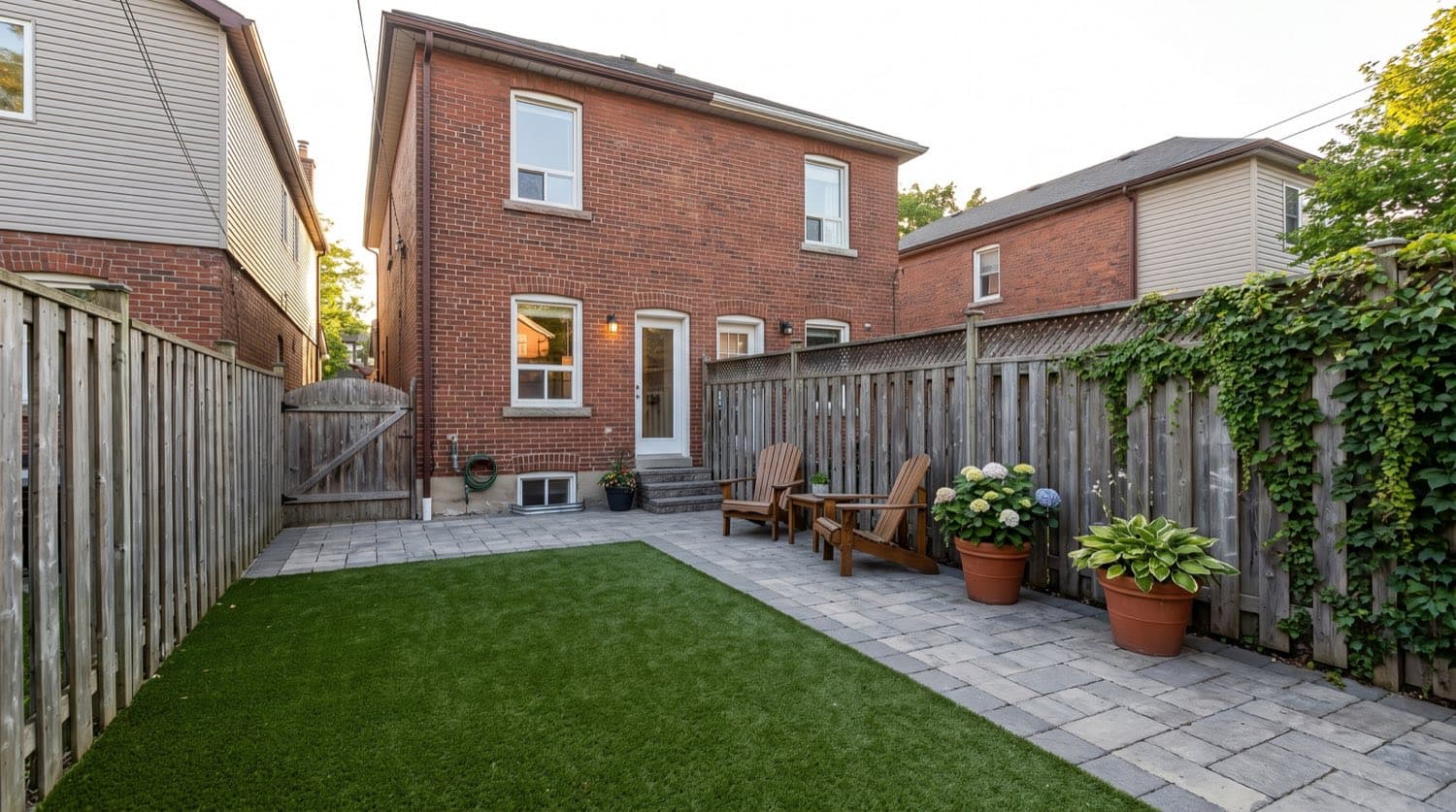
Answer First: Artificial grass can be worth it for the right yard, no mowing, no watering, no pesticides, and it stays green where real grass struggles, but Canada's climate cuts both ways. In direct summer sun, synthetic turf can run 20 to 30°C hotter than a natural lawn (university turf research), and it needs salt-free, careful winter care. In Toronto it is also restricted: the City does not count it as soft landscaping, so it cannot go in the front yard where landscaping is required. It fits small, shaded, or high-traffic backyards far better than a big open lawn.
Artificial grass gets sold as a maintenance-free miracle. It is not that, and it is not a scam either. It is a trade: you swap mowing and watering for heat, winter quirks, and a hard city rule. Whether that trade is worth it comes down entirely to your specific yard.
What are the real advantages of artificial grass?
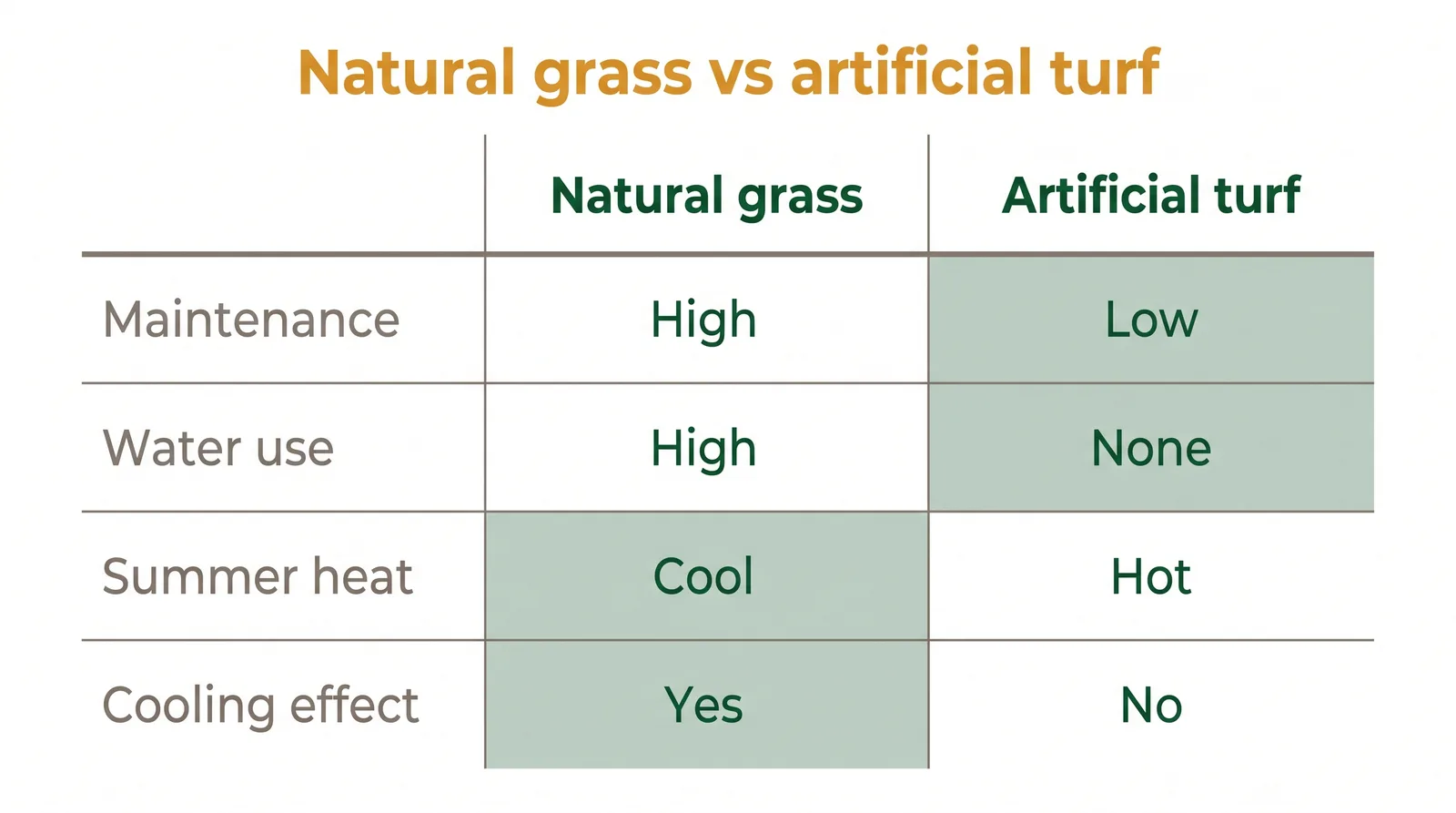
The upsides are real and they are about time and inputs. Artificial turf needs no mowing, no watering, no fertilizer, and no pesticides, which in Ontario matters because the cosmetic pesticide rules already limit what you can put on a real lawn. It stays uniformly green through drought and heavy use, and it holds up in the two places natural grass reliably fails: deep shade under a tree or fence, and high-traffic paths that wear to mud.
For water-conscious homeowners, skipping a summer of lawn watering is a genuine saving, and there is no seasonal reseeding or patching. If your goal is a tidy green surface in a spot where grass simply will not grow, turf delivers that.
Quotable: Artificial grass earns its keep in the two places real grass fails: deep shade where nothing grows, and high-traffic paths that wear to mud. Everywhere else, the trade-offs get harder to justify.
What are the downsides in Canada's climate?
Two seasons, two problems. In summer, synthetic turf gets hot, much hotter than grass. University turf research finds surface temperatures can run roughly 20 to 30°C (35 to 55°F) above natural grass in direct sun, and watering it cools the surface only for minutes before it rebounds (Penn State Sports Surface Research Center). Natural grass actively cools the air around it; artificial turf does the opposite and adds to the urban heat island (UC ANR). On a sunny July afternoon, a turf lawn can be too hot to walk on barefoot.
In winter, the turf itself survives frost and snow fine, but the care rules flip. You cannot use de-icing salt, which clogs the drainage backing, or metal shovels, which tear the fibres; a plastic shovel, stiff broom, or leaf blower is the safe way to clear it. There is also the longer arc: artificial turf has a finite lifespan and eventually has to be removed and disposed of, and it does nothing for soil, pollinators, or drainage the way a living lawn does.
Soft landscaping — ground that supports plant growth and lets water soak into the soil, like grass, gardens, or mulch. Artificial turf is not soft landscaping because it does neither, which is the crux of Toronto's rule below.
The Toronto rule you have to know first
Before you price anything, know that Toronto restricts where artificial turf can go. The City does not consider artificial turf to be soft landscaping, because it does not support vegetation or let water infiltrate the ground, so it is treated as a hard surface (City of Toronto).
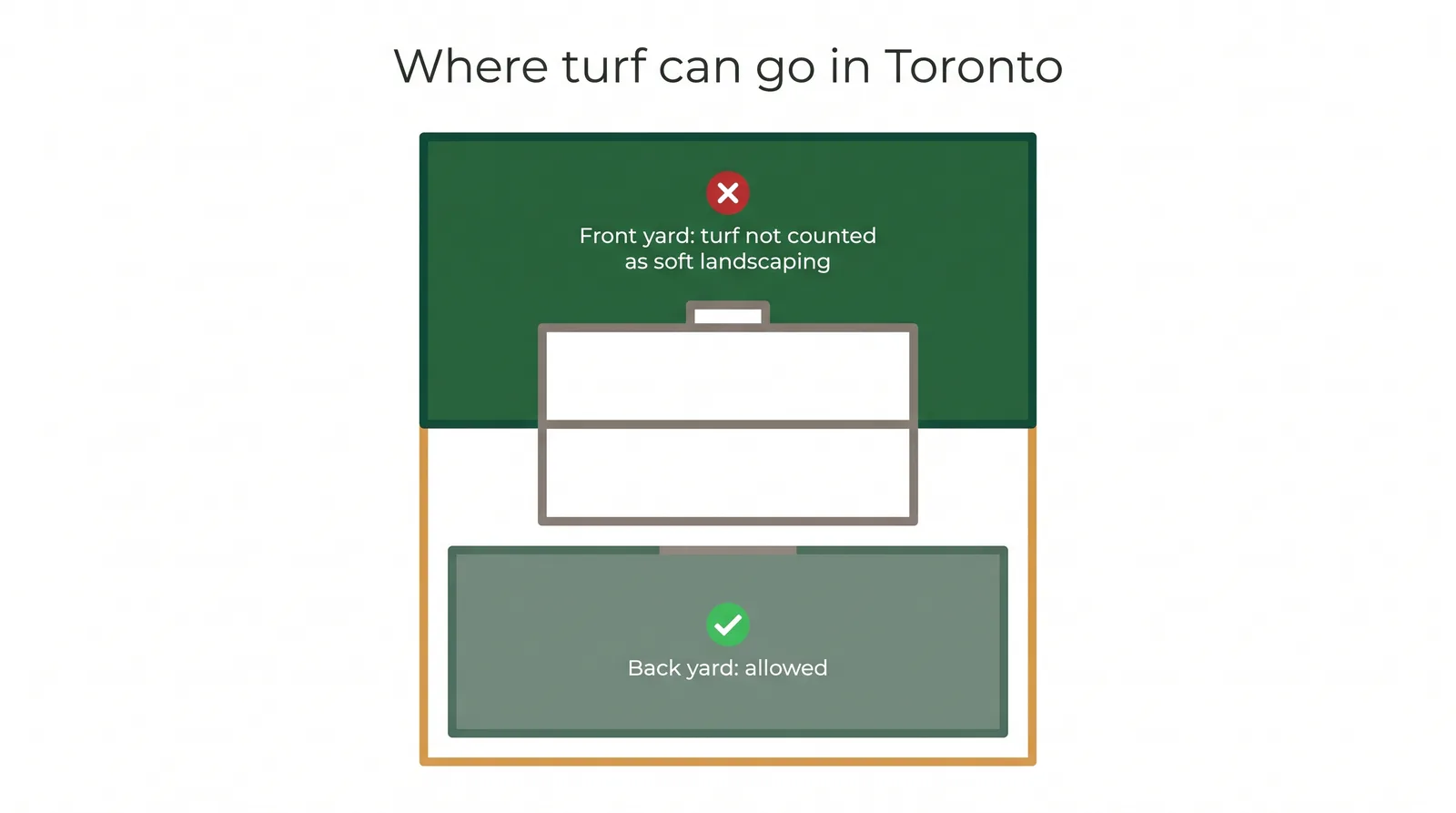
The practical effect is that you cannot use artificial turf to meet the front-yard soft-landscaping requirement, and a non-compliant front-yard installation can be ordered removed, with the bylaw enforced when a neighbour complains to 311. Backyards are not governed by that soft-landscaping rule, which is why turf in Toronto almost always belongs in the back. This is also why front-yard designs lean on real plantings, as our front walkway ideas guide covers.
So who is artificial grass actually worth it for?
Match it to the situation, not the marketing. It is genuinely worth considering for a shaded backyard where grass will not grow, a small high-traffic area or dog run, a low-maintenance rental or condo courtyard, or a rooftop or balcony with no soil. In those spots the maintenance savings are real and the heat matters less.
It is a poor fit for a large, sunny front lawn (where Toronto bans it anyway), for anyone bothered by a hot surface in summer, or for a homeowner who wants the environmental benefits of a living lawn. If your real problem is a lawn that struggles, it is often cheaper and cooler to fix the soil and overseed first; our guides to fixing bare spots under trees and picking the right seed cover that path. And if you are set on turf for pets, read artificial grass for dogs before you buy.
From the data: YardQuote tracks 650 landscaping companies across the GTA, many of which install both natural and synthetic lawns (YardQuote tracking, July 2026). A pro who will honestly tell you when real grass is the better call, not just sell you turf, is the one worth getting a quote from.
Weighing turf against a real lawn for your yard? Request a quote and compare up to three vetted local pros side by side, or browse the landscaping directory for North York. Your contact details only go to the one you pick.