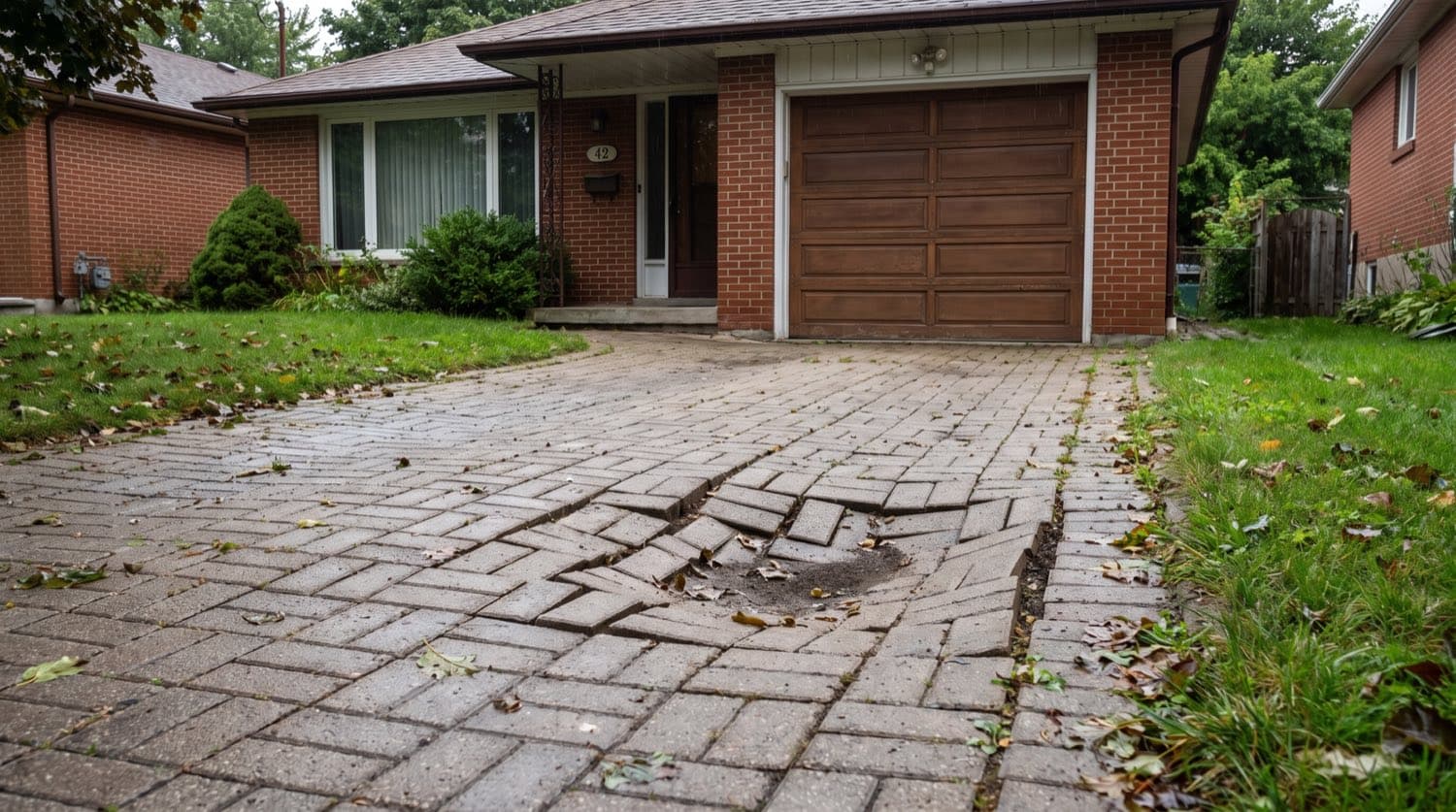
Answer First: Interlocking sinks because of the base underneath it, not the pavers themselves. A base that was built too shallow or poorly compacted settles under load, and Toronto's freeze-thaw cycles heave it up and drop it every winter. A proper base is 6 to 10 inches of compacted gravel for a patio and up to 18 inches for a driveway, built in thin layers and topped with about an inch of bedding sand. Fixing a sunken section runs roughly $8 to $25 per square foot, but building the base right the first time is the only real fix.
A sunken paver driveway looks like a paver problem. It almost never is. The stones you see are just the top layer of a system, and when they dip, tilt, or heave, they are reporting on the gravel and soil you cannot see.
Why does interlocking sink or heave?
Because the base under it failed, and freeze-thaw exposed it. When a crew lays pavers over a base that is too shallow or was not compacted properly, the gravel keeps settling under the weight of cars and foot traffic, and the surface dips wherever the load is heaviest. That is the sinking.
The heaving is Toronto's climate. Water trapped in an under-built or poorly drained base freezes, expands, and lifts the pavers, then drops them when it thaws, over and over through winter. A base built on soft clay with no geotextile fabric to separate it settles unevenly on top of that. The pavers themselves are fine; they are just riding a base that moves.
Quotable: Interlocking does not sink because of the pavers. It sinks because the gravel base was too shallow or poorly compacted, and Toronto's freeze-thaw cycles heave whatever water the base fails to drain.
What does a proper interlocking base look like?
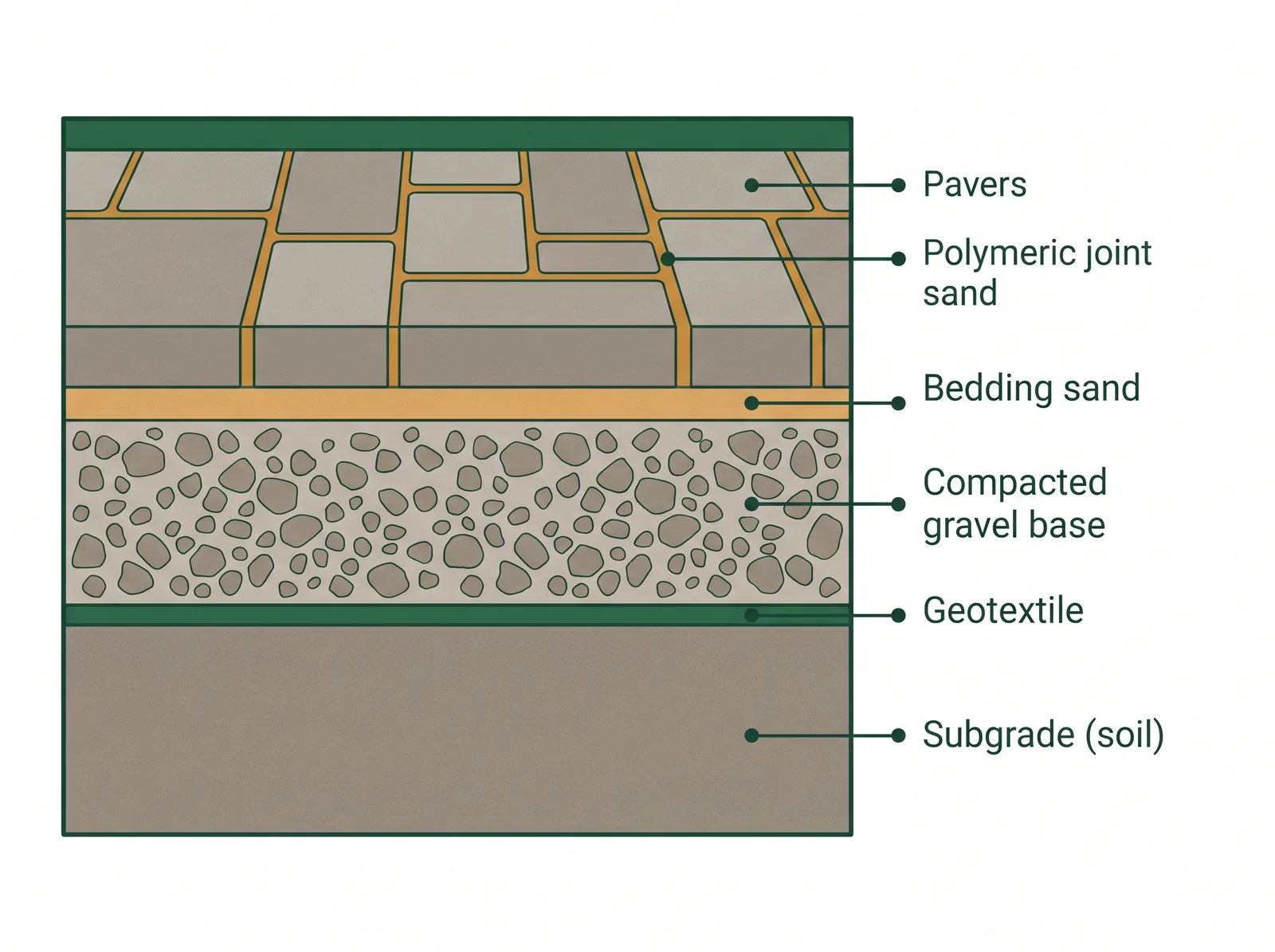
It is a layered system, and every layer has a job. From the bottom up: the native soil (subgrade), a geotextile fabric over soft or clay soil to keep the base from mixing into it, a thick compacted granular base that carries the load, about an inch of bedding sand for setting the pavers, the pavers, and polymeric sand swept into the joints to lock them.
Compacted granular base — the layer of crushed gravel, built up and compacted in thin lifts, that actually carries the weight above it. It is the single most important part of an interlocking installation, and the one a cheap quote quietly shortchanges.
Polymeric sand — a fine sand mixed with binders that hardens in the joints between pavers, which is what stops weeds, ants, and washout from opening the joints over time.
The order and quality of these layers is what separates a driveway that stays flat for decades from one that dips in three years.
How deep should the base be?
Deep enough for the load, and deeper for vehicles. Industry practice puts a patio or walkway base at 6 to 10 inches of compacted granular, and a driveway base up to about 18 inches because it carries vehicle weight (Action Home Services examples; matched to GTA practice). Driveways also use thicker 80mm pavers versus the 50 to 60mm used on patios.
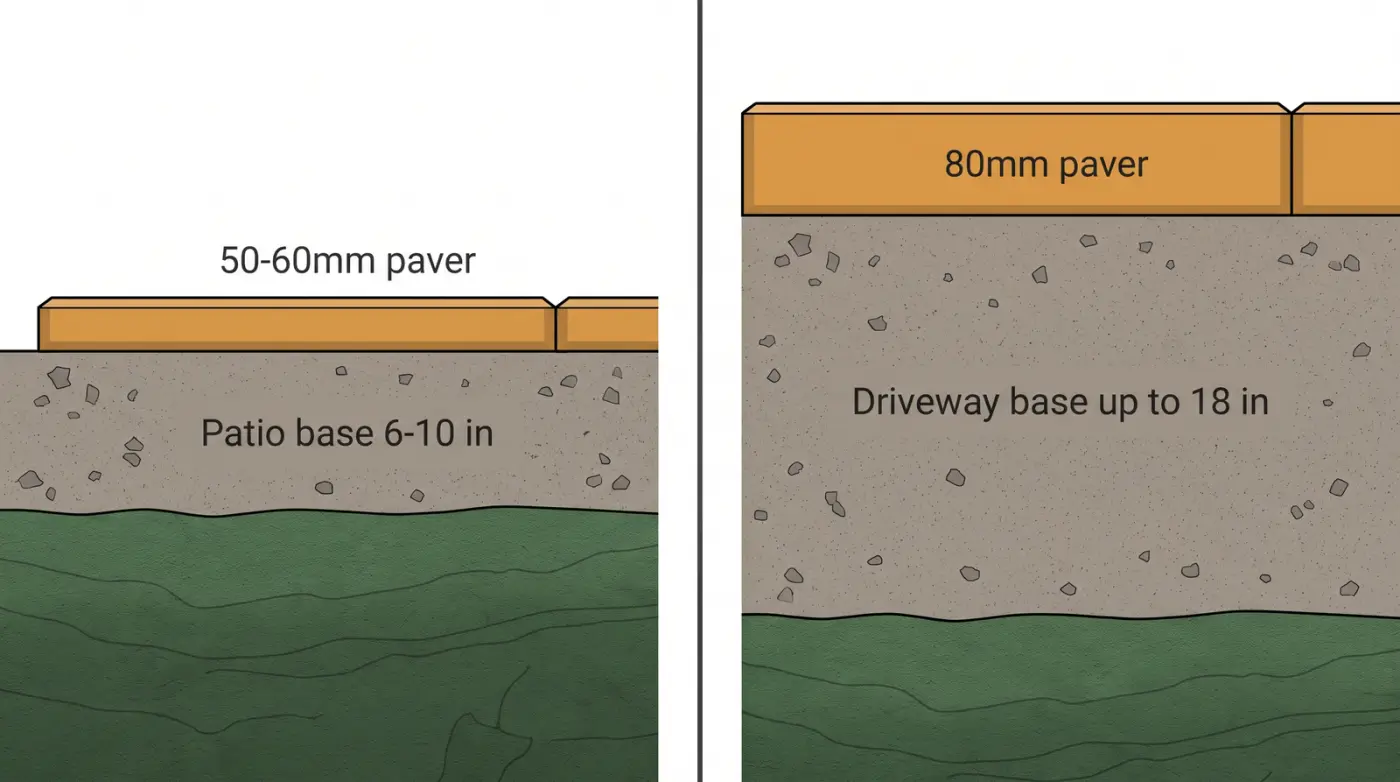
The base also has to be built correctly, not just deep. It goes down in thin layers with each one compacted, not dumped and levelled in a single pass, because only thin lifts compact all the way through.
Why does compaction matter so much?
Because loose gravel settles and compacted gravel does not. Industry installation guidance calls for the base compacted to a high, consistent density, roughly 98% for areas carrying vehicles, and finished level to within about 3/8 inch over 10 feet (ICPI/CMHA). A base that misses that tolerance cannot be fixed by adding extra bedding sand on top; the paver layer just mirrors the dip.
This is exactly the step a rushed or underpriced crew skips, because compacting properly in thin lifts takes time and the right plate compactor. You cannot see it once the pavers are down, which is precisely why it is where corners get cut.
Quotable: Industry guidance calls for an interlocking base compacted to about 98% density for vehicle areas and level to within roughly 3/8 inch over 10 feet. A base that misses that cannot be rescued with extra sand on top.
The cheap-quote trap
The base is invisible in the finished driveway, so it is the easiest place for a low bid to save money, and the most expensive place for you to lose it. A new fully excavated and compacted base adds roughly $5 to $6 per square foot over reusing a sound existing one, which on a 1,000 square foot driveway is $5,000 to $6,000 (Action Home Services examples). A quote that comes in far under the others usually got there by cutting base depth, compaction, or the geotextile.
This is why comparing interlocking quotes on the bottom line misleads you, the same trap we cover in why Toronto landscaping quotes vary. Ask every contractor to write down the base depth, the compaction method, and whether a geotextile is included, then compare those lines. You can see current installed ranges on the interlocking cost guide for Toronto.
From the data: YardQuote tracks 503 interlocking contractors across the GTA. Of the 464 with three or more reviews, the average rating is 4.75 and 83% hold 4.5 stars or higher (YardQuote tracking, July 2026). A base done right is not rare; you just have to pick the crew that quotes it honestly.
What does it cost to fix sunken interlocking?
Less than replacing it, if the pavers are still sound. Re-leveling a sunken section runs about $8 to $22 per square foot, and a full lift-and-relay, where the crew removes the pavers, rebuilds and re-compacts the base, and reinstalls the same stones, runs $15 to $25, versus $18 to $35 and up for a brand-new installation. Restoration typically costs 50 to 60% less than replacement, though you should expect an $800 to $1,200 minimum call-out even for a small repair area.
The takeaway is the same either way: the base is the job. Whether you are building new or fixing a dip, the money and the longevity both live in the layer you never see. If you are also weighing protection against Toronto road salt, our guide to sealing interlocking pavers covers that maintenance side, and for design see front walkway ideas for Toronto. To compare vetted installers, browse the interlocking directory for North York or request a quote.
Want a base done right the first time? Request a quote and compare up to three vetted local interlocking pros side by side, on the same base spec, so the numbers actually mean something. Your contact details only go to the one you pick.