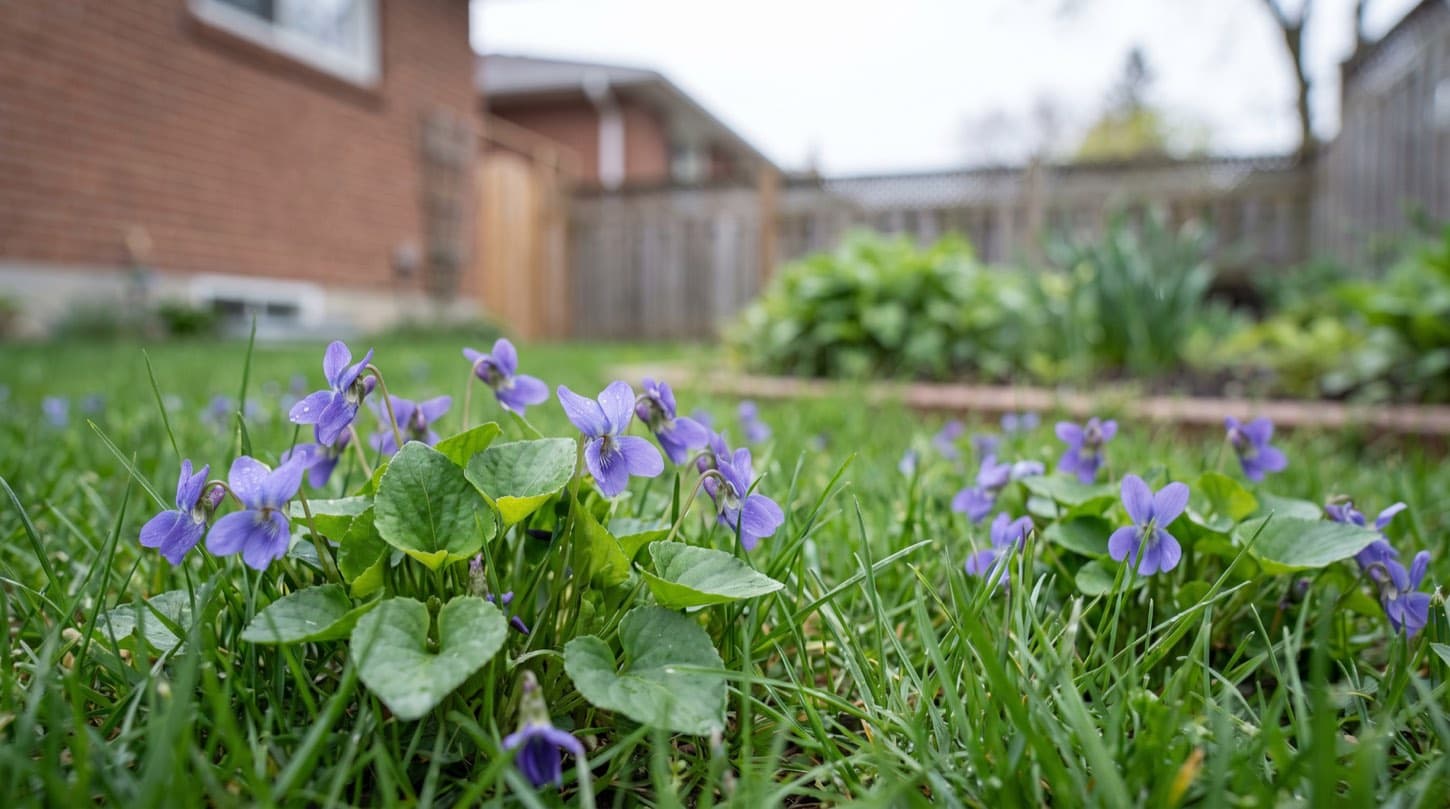
Answer First: In Ontario, wild violets are nearly impossible to spray out of a lawn, because the herbicides that actually control them — triclopyr and 2,4-D — are banned for cosmetic lawn use. That reframes the whole question. Your real choice is to dig them out, rhizome and all, or to keep them as the native spring wildflower they are. Hand-pulling the leaves does nothing; the plant regrows from underground stems.
Every spring, purple flowers spread through a patch of Toronto lawn and the search history fills with "how to kill wild violets." Here's the honest answer most articles skip: in Ontario, the standard advice doesn't apply, so the first real decision is whether to fight them at all.
Why can't I just spray wild violets in Ontario?
Because the chemicals that work are illegal for this use here. Across the border, every turf guide says the same thing — reach for triclopyr. Purdue's turf specialists confirm triclopyr-based products give the best control, and even then it takes repeat applications over multiple seasons.
The catch is that Ontario's pesticide rules ban 2,4-D, glyphosate, and other conventional herbicides for cosmetic lawn use. Triclopyr isn't on the province's Allowable List of low-risk ingredients either. The products left to a homeowner — soap, corn gluten meal, borax, sulphur, and similar — do not reliably kill an established wild violet.
Quotable: The one herbicide that reliably controls wild violet, triclopyr, is not permitted for cosmetic lawn use in Ontario. For a Toronto homeowner, spraying your way out of a violet patch is not an option — the real choice is dig or embrace.
So this isn't a "best weed killer" article. In Ontario it's a genuine keep-or-kill decision, and both answers are legitimate.
What do wild violets even look like?
Know what you have before you decide. Wild violet (Viola) is a low, clumping perennial with heart-shaped leaves, pointed at the tip with rounded teeth along the edges, and spring flowers that are usually purple-blue, sometimes white or yellow depending on the species. The leaves often cup slightly into a funnel shape.
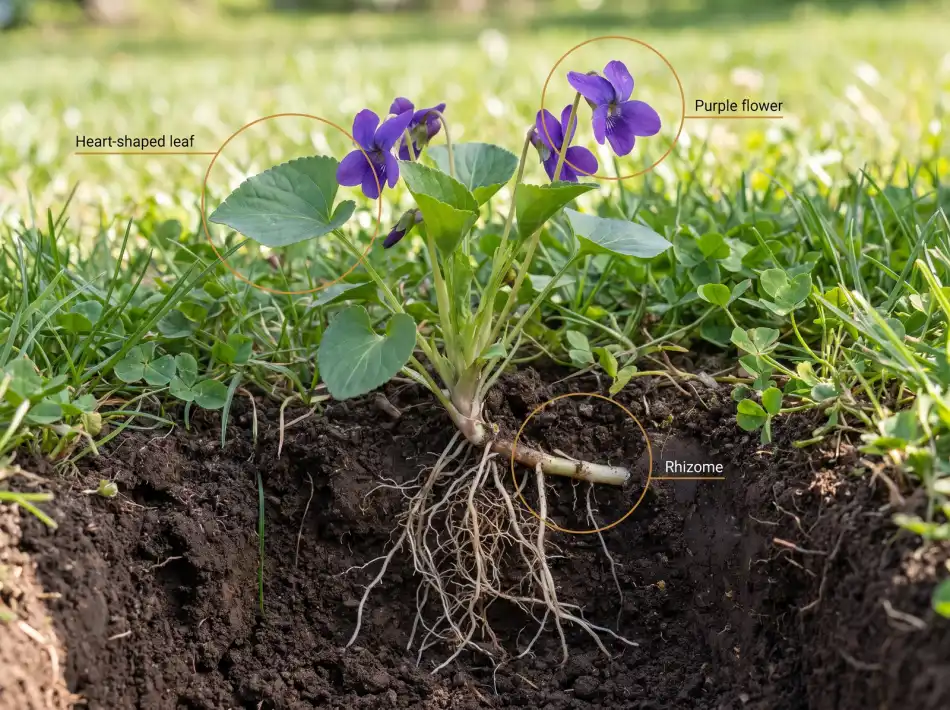
Below ground is the part that matters. All wild violets grow from short, thick rhizomes — Purdue describes them as about the size of your pinky finger — that store energy, survive winter, and resprout if any piece is left in the soil. They also drop seed. That two-front spread, rhizome plus seed, is why they shrug off casual control.
The case for keeping them
It's stronger than lawn-obsessed advice admits. Wild violet is native to eastern North America, including Ontario, so it belongs here in a way turfgrass doesn't. It flowers early, feeding pollinators when little else is blooming, and it's a host plant for several fritillary butterflies. The flowers and young leaves are even edible.
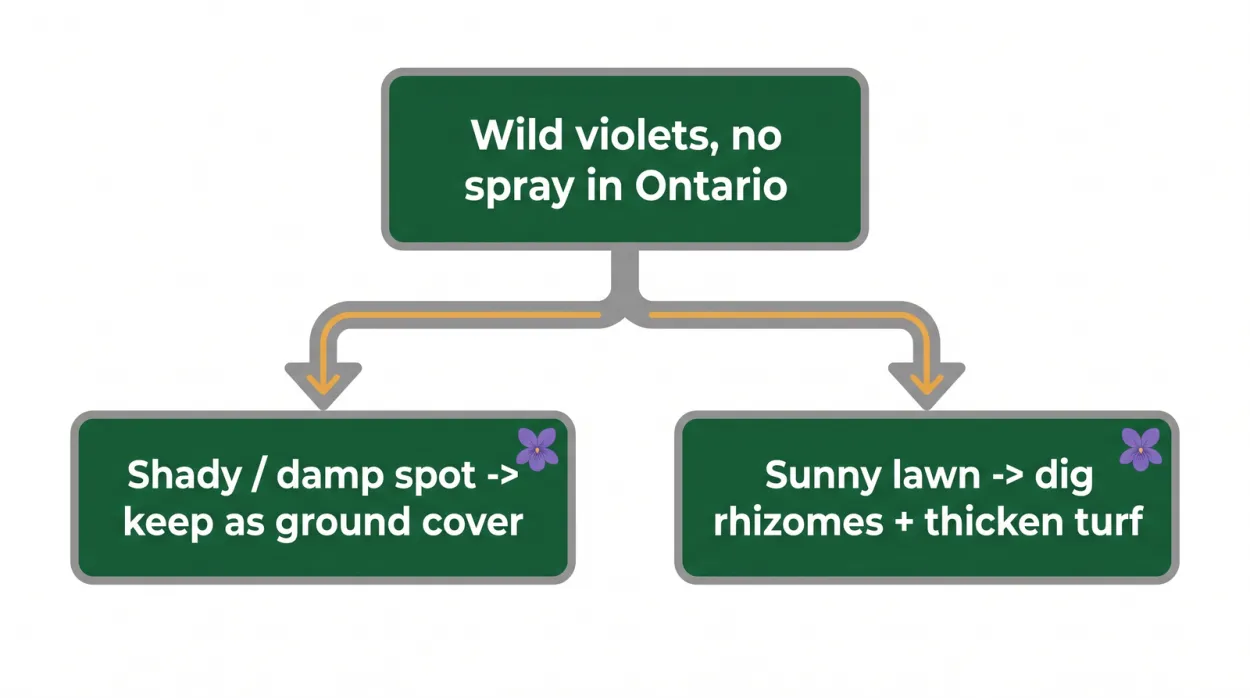
Practically, violets thrive in the damp, shady spots where grass struggles anyway — under trees, along a north fence line. In those exact places, a spreading violet ground cover is arguably a better outcome than the thin, muddy turf it's replacing. Given that you can't legally spray them in Ontario, "learn to love them" is not a cop-out; it's often the sensible verdict.
From the data: Of the 249 lawn-care companies YardQuote tracks across the GTA, the honest ones will tell a homeowner up front that a violet patch in dry shade is a losing battle to fully clear by hand — and that a dense, well-chosen lawn everywhere else does more good than chasing every violet.
The case for removing them — and how, without herbicides
If violets are overrunning a sunny lawn you want to keep as turf, removal is legitimate too. It just means digging and patience, not spraying.
The removal playbook that actually works here:
- Dig, don't pull. Use a narrow trowel or weeding knife to lift the entire rhizome mass while the soil is moist. Pulling the leaves alone is pointless — the plant regrows from the roots.
- Get the whole patch, then come back. You will miss rhizome fragments; plan a second and third pass over the season as they resprout.
- Thicken the turf. Purdue notes that frequent mowing and dense, well-adapted grass slow violet spread, even though they won't erase an established stand. Overseed the cleared area fast so violets don't just refill it.
- Limit new seedlings. A corn-gluten-meal pre-emergent, which is allowed in Ontario, can suppress new violet seed germination — but it does nothing to existing plants.
Because violets favour shade, the lasting fix is often choosing the right grass for the spot. Our guide to shade grass for Toronto yards covers what actually competes there, and if you're rethinking the lawn entirely, a clover lawn is another low-spray option worth weighing. You can compare local rates on the lawn care cost page or browse lawn care companies near you.
Torn between clearing the violets and reseeding? Request a quote and compare up to three vetted local pros side by side — your contact details only go to the one you pick.