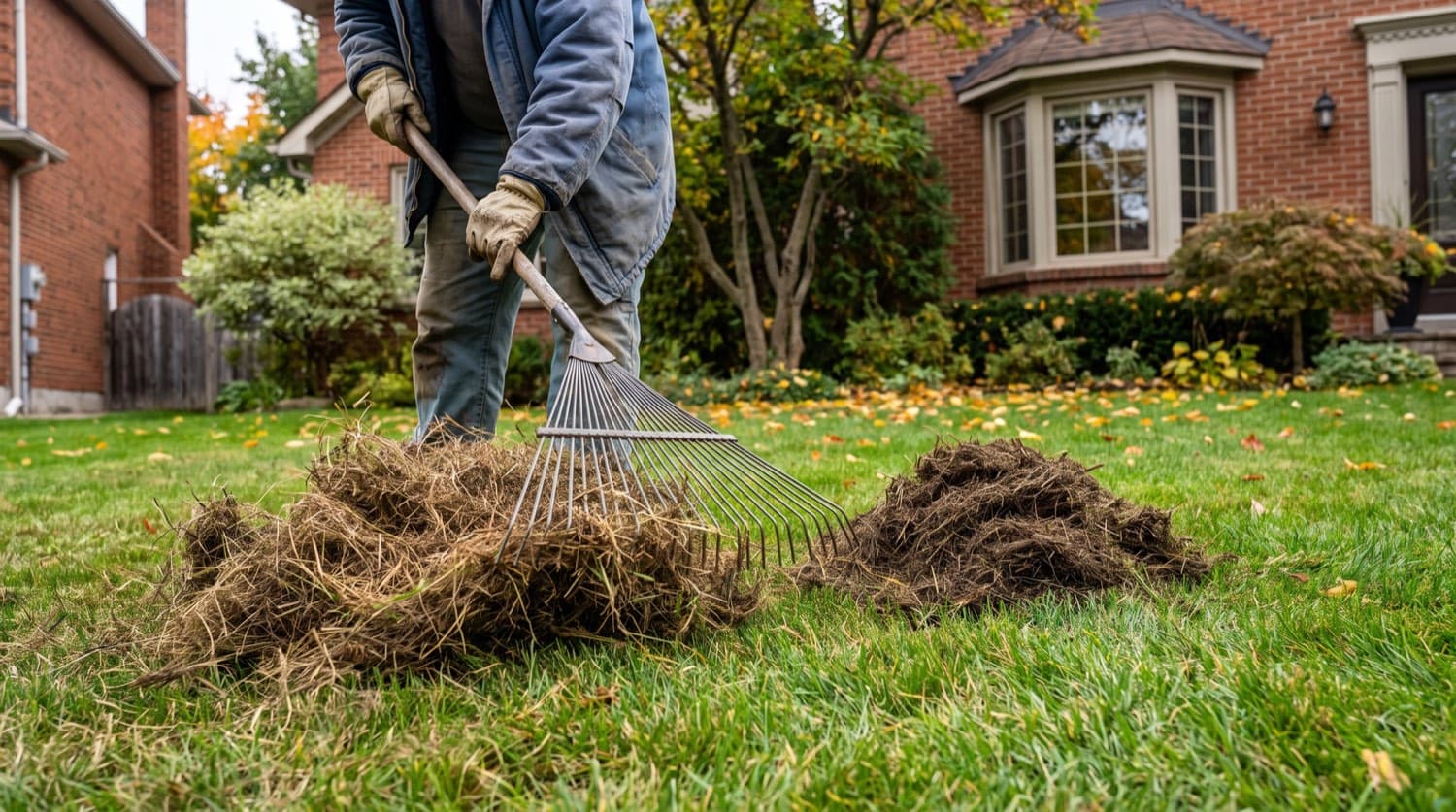
Answer First: Dethatching, or power raking, mechanically strips out the thatch layer, the mat of dead and living grass stems and roots sitting between the blades and the soil. You only need it once thatch passes about half an inch, and you truly dethatch at around an inch (UMN Extension). Most healthy Toronto lawns never get there, so paying roughly $100 to $295 for a dethatching visit is often wasted money. For a thin thatch layer, core aeration does more good with far less stress.
Dethatching has a marketing problem: it sounds like routine maintenance, so people book it every spring. For most lawns it is the opposite of routine. It is a drastic fix for a specific problem your lawn probably does not have, and the honest first step is to measure before you spend.
What is dethatching?
Dethatching is mechanically tearing out the thatch layer. First, the term it fixes: thatch is the spongy mat of dead and living grass stems, crowns, and roots that accumulates between the green blades and the soil surface. A dethatcher, sometimes called a power rake, uses stiff vertical blades or tines to rip that mat loose so you can rake it off the lawn.
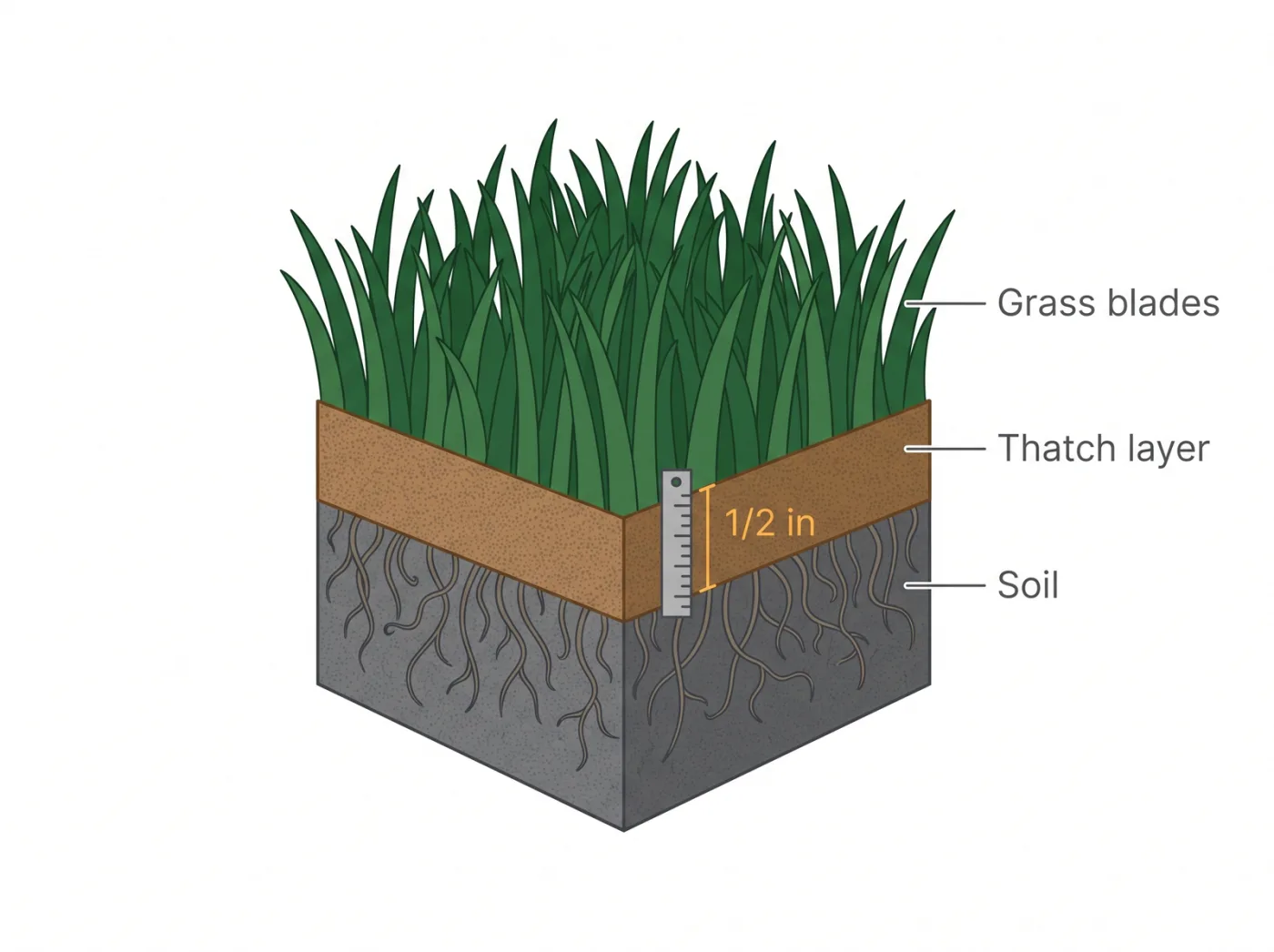
The key thing to understand is that a thin thatch layer is good for the lawn. Half an inch or less helps hold steady soil moisture and temperature (UMN Extension). Thatch only becomes a problem when it gets thick enough to stop water and air from reaching the roots. Dethatching is the cure for that, not a tune-up you owe your lawn every year.
Quotable: A half-inch or less of thatch is healthy and helps the lawn hold moisture. Dethatching is a drastic fix for thick thatch, not annual maintenance every lawn needs.
How much thatch is too much?
Half an inch is the line. At or below half an inch, thatch is not a problem and needs no action (UMN Extension, Penn State Extension). Once it exceeds half an inch you start managing it, and once it reaches roughly an inch, dethatching is warranted.
Checking is easy and free. Cut a small wedge of turf with a spade, or pull a soil plug, and look at the brown spongy band between the green grass and the dark soil. Measure it. Three signs your thatch is too thick:
- The brown layer measures close to an inch or more.
- The lawn feels spongy or springy when you walk on it.
- Water beads and runs off instead of soaking in, and the lawn dries out fast.
If none of those are true, put the chequebook away.
When dethatching is a waste of money
When your thatch is thin, which describes most well-maintained Toronto lawns. Dethatching is aggressive: it tears through the turf and stresses healthy grass. Doing that to a lawn with half an inch or less of thatch is all cost and no benefit.
And it is real money. In the GTA, dethatching or power raking runs about $100 to $295 per visit (YardQuote tracking of GTA lawn-care pricing, July 2026). Spending that on a lawn that does not need it, every spring out of habit, is one of the more common ways homeowners overpay for lawn care. If your lawn is not spongy and water soaks in normally, you are paying to injure it.
Quotable: Dethatching runs about $100 to $295 a visit in the GTA. Paying it every spring for a lawn with thin thatch is money spent to stress healthy grass.
When dethatching actually helps
When thatch is genuinely thick, near an inch or more, it earns its keep. At that point the mat blocks water, air, and fertilizer from reaching the soil, roots grow into the thatch instead of the ground, and the lawn gets shallow-rooted and drought-prone. Removing that layer lets water and nutrients back in and lets the grass root into real soil again. Lawns that most often need it are older, heavily fertilized, or vigorous spreading types that build thatch faster.
For most homeowners this comes up every two to three years at most, not every season.
Dethatch or aerate? Usually aerate
This is the decision that saves the most money. Core aeration pulls small plugs of soil from the lawn, which relieves compaction, improves water and air movement, and stimulates the microbes that decompose thatch naturally (MSU Extension). It is far gentler than dethatching and fixes the more common problem, compacted soil, at the same time.
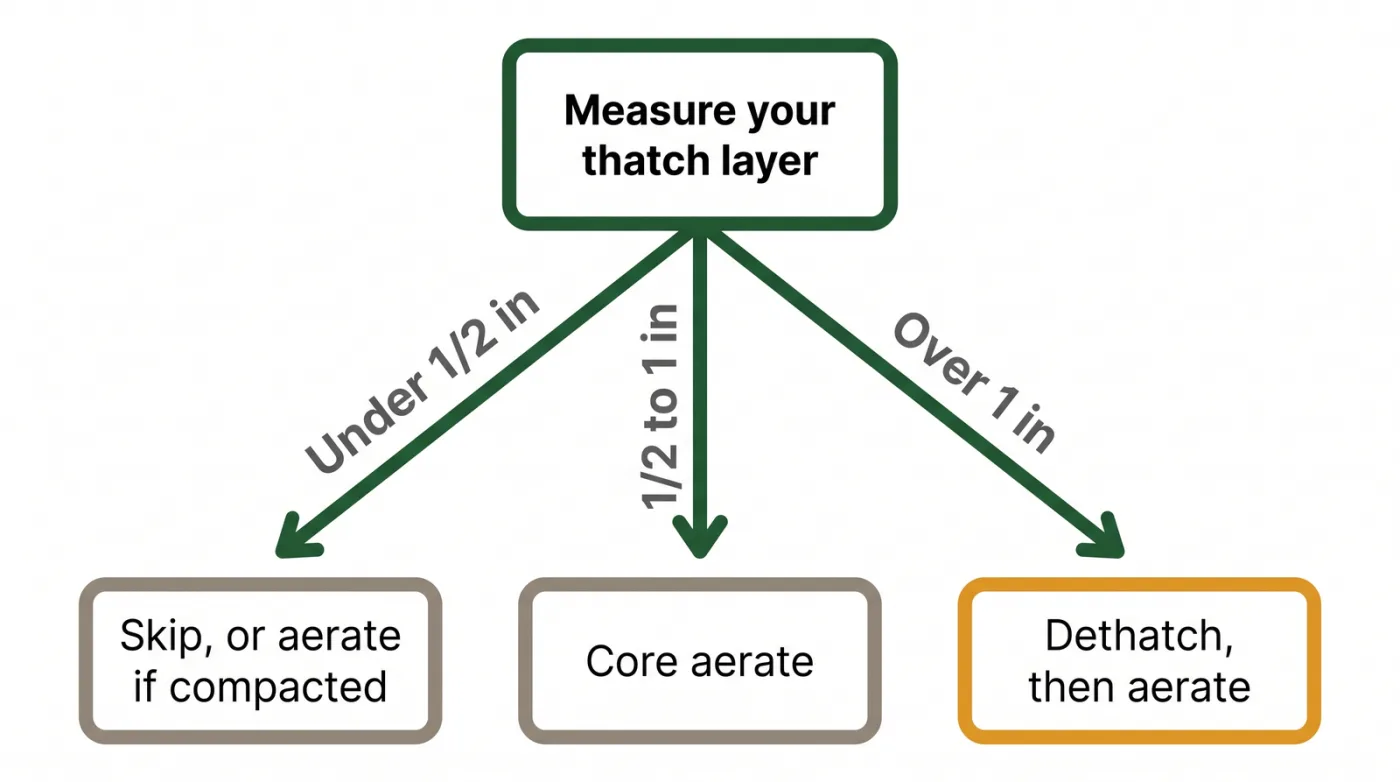
The simple rule: if you are dealing with thin thatch, compacted soil, or you want to overseed, aeration is the better bet. Reserve dethatching for a genuinely thick mat. If a lawn has both problems, dethatch first so the aerator can reach the real soil surface, then aerate. Core aeration runs about $70 to $200 in the GTA, and an aeration-plus-overseeding combo about $150 to $300 (YardQuote tracking), often better value than dethatching for the typical lawn.
When to do it in Toronto
Late summer to early fall. Remove thatch during cool weather with adequate soil moisture, which reduces the risk of injuring the grass while it recovers (Penn State Extension). That window also lines up with the cool-season growing season and pairs naturally with overseeding and the fall feeding. Skip it in summer heat or on a dormant lawn.
From the data: Of the 249 lawn-care companies YardQuote tracks across the GTA, 220 carry three or more Google reviews, the average rating is 4.75, and 88% of rated companies hold 4.5 stars or higher (YardQuote tracking, July 2026). A good crew will tell you when your lawn does not need dethatching, rather than upsell it.
If you would rather have a pro measure and recommend, compare rates on the lawn care cost page or browse rated crews on the North York lawn care directory. Dethatching often pairs with topdressing, covered in our step-by-step topdressing guide, and both feed into leveling a bumpy lawn.
Want a straight answer on whether your lawn needs dethatching at all? Request a quote and compare up to three rated GTA lawn-care pros side by side. Your contact details only go to the one you pick.