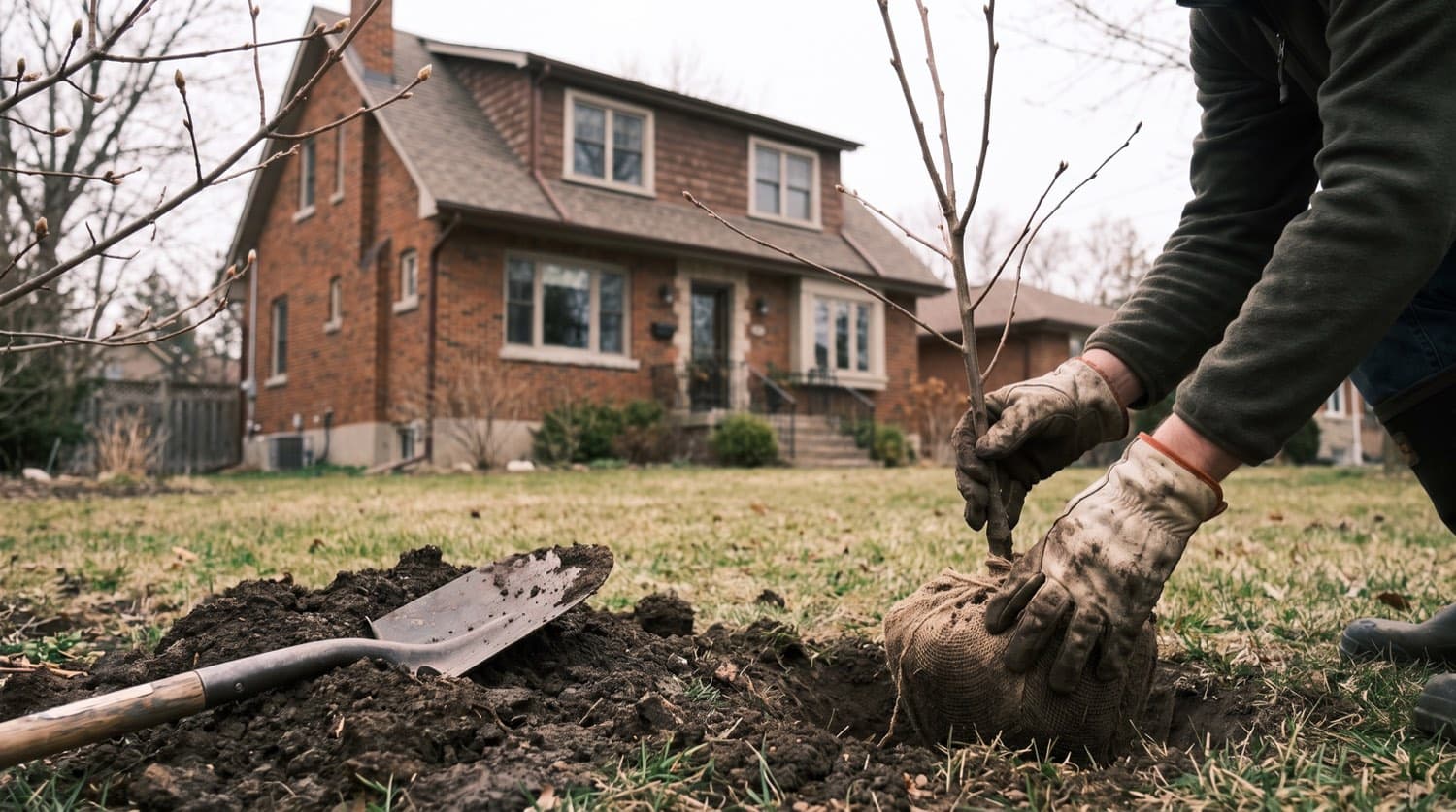
Answer First: Yes, most young trees can be moved, and the smaller the trunk, the better the odds. Move the tree while it is dormant, in early spring before buds open or late fall after leaf drop, and dig a root ball about 10 to 12 inches wide for every inch of trunk thickness. Trees over roughly 2 to 3 inches of trunk caliper need a professional with a tree spade, and in Toronto, disturbing a large protected tree can require a permit.
"Can I move this tree?" almost always has the same answer: yes, if it is small enough and you time it right. The reason transplants fail is rarely the moving itself. It is digging too small a root ball, doing it in summer, or planting it too deep. Get those three right and a young tree hardly notices the trip across the yard.
Can a tree actually be moved?
Most can, but size decides everything. A young tree carries a root system you can realistically dig and lift by hand up to about 2 inches of trunk caliper (trunk thickness measured a short way above the ground). Past that, the root ball needed to keep it alive gets too big and heavy for two people, and you are into tree-spade territory, a truck-mounted machine an arborist or nursery operates.
The other cost of size is recovery time. A moved tree re-grows its lost roots slowly, roughly one year of recovery for every inch of trunk diameter (Iowa State Extension). A 1-inch sapling shrugs it off in a season; a 4-inch tree sulks for years. That math is why moving a big mature tree is usually not worth it, and why the honest advice is often to plant a new small one instead.
Quotable: Recovery from a transplant runs about a year per inch of trunk diameter. A small tree moves easily; a big one spends years just rebuilding the roots it lost.
When to transplant
While the tree is dormant. The two windows are early spring, before the buds break, and late fall, after the leaves drop (Iowa State, Utah State Extension). A dormant tree has little or no canopy pulling water, so losing part of its roots is far easier to survive. Early spring is usually best, because the roots then grow all season into warming soil.
The wrong time is summer, in full leaf and heat, when the tree is demanding the most water right as you cut away the roots that supply it. That combination is what puts a tree into severe transplant shock.
How big a root ball do you need?
This is the number that decides survival: about 10 to 12 inches of root-ball width for every inch of trunk caliper (Iowa State Extension). Ten times is the minimum; twelve times is the target when you want the best odds.
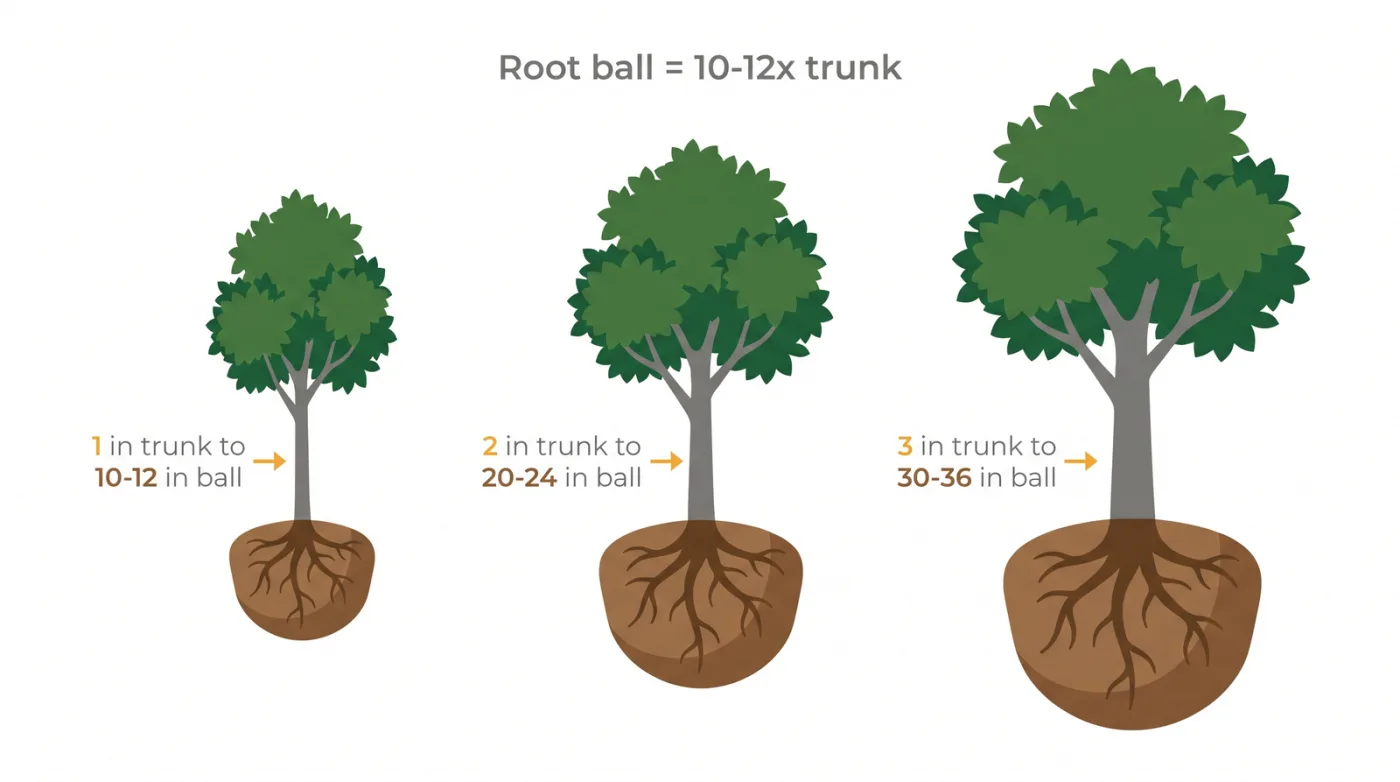
Run the numbers before you dig:
- 1-inch trunk: 10 to 12 inch root ball.
- 2-inch trunk: 20 to 24 inch root ball (about the practical DIY limit).
- 3-inch trunk: 30 to 36 inch root ball (tree-spade territory).
A ball that size is heavy, so measure honestly. If the required ball is bigger than you can lift onto a tarp and drag, the tree is too big to move by hand.
Quotable: Size the root ball to about 10 to 12 inches of width for every inch of trunk thickness. A 2-inch trunk needs a 20 to 24 inch ball; dig smaller and the tree can't pull enough water to survive the move.
How to transplant a small tree
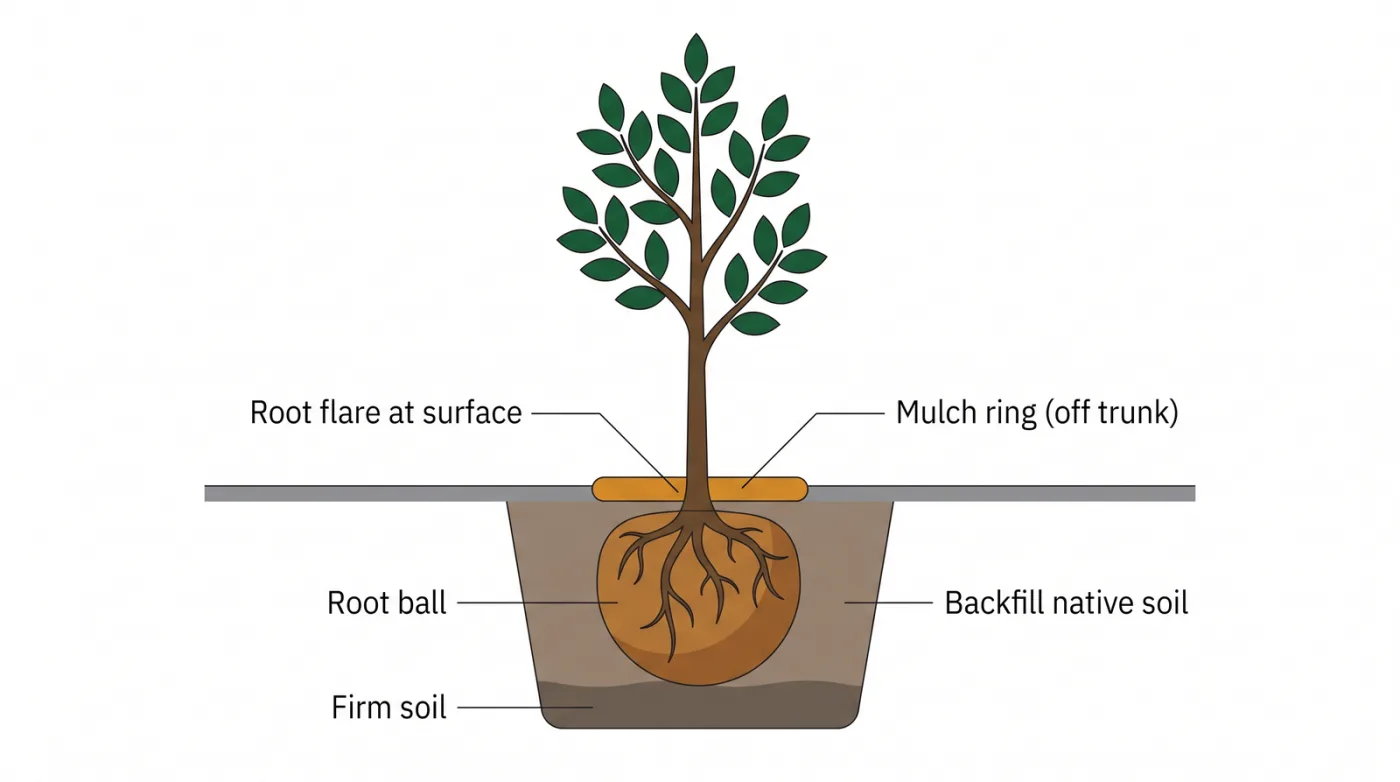
- Water the tree well a day before, so the soil holds together around the roots.
- Dig the new hole first, as deep as the root ball and two to three times as wide, with firm soil left under the centre so the tree will not sink.
- Dig the root ball to the 10-to-12-times width, cutting cleanly around and under it, and slide it onto a tarp to move it.
- Set it at the same depth it grew before, with the root flare (where trunk widens into roots) at the surface. Planting too deep is a top killer of transplanted trees.
- Backfill with the native soil, firm it gently to remove air pockets, and water it in.
- Mulch a wide ring two to three inches deep, kept back from the trunk, and stake only if the tree will not stand on its own.
Help it survive the shock
The move is done; now the tree is rebuilding roots. Water it deeply and regularly for the first two to three years, the same care a newly planted tree needs. Do not pile on fertilizer at planting, and resist pruning the canopy back "to balance the roots," because the tree needs its leaves to recover. Patience is the treatment; expect a slow first year.
The Toronto rule before you dig
One local check first. A healthy private tree 30 cm or more in trunk diameter is protected under Toronto's tree bylaw, and injuring or destroying one, which a failed transplant can do, may require a permit (City of Toronto). Moving a small sapling around your own yard is fine. Disturbing a large protected tree, or touching a City street tree, is not something to do without checking with 311 first.
From the data: Of the 650 landscaping companies YardQuote tracks across the GTA, 613 carry three or more Google reviews, the average rating is 4.77, and 86% of rated companies hold 4.5 stars or higher (YardQuote tracking, July 2026). Many offer tree planting and moving; installed tree planting runs about $150 to $500 per tree in the GTA.
For anything past a hand-dug root ball, compare rates on the landscaping cost page or browse rated crews on the North York landscaping directory. Once the tree is in, keep it healthy with our guide on pruning basics, and if you need a replacement, see how to get free trees from the City of Toronto.
Want a pro with a tree spade for a move too big to dig by hand? Request a quote and compare up to three rated GTA pros side by side. Your contact details only go to the one you pick.