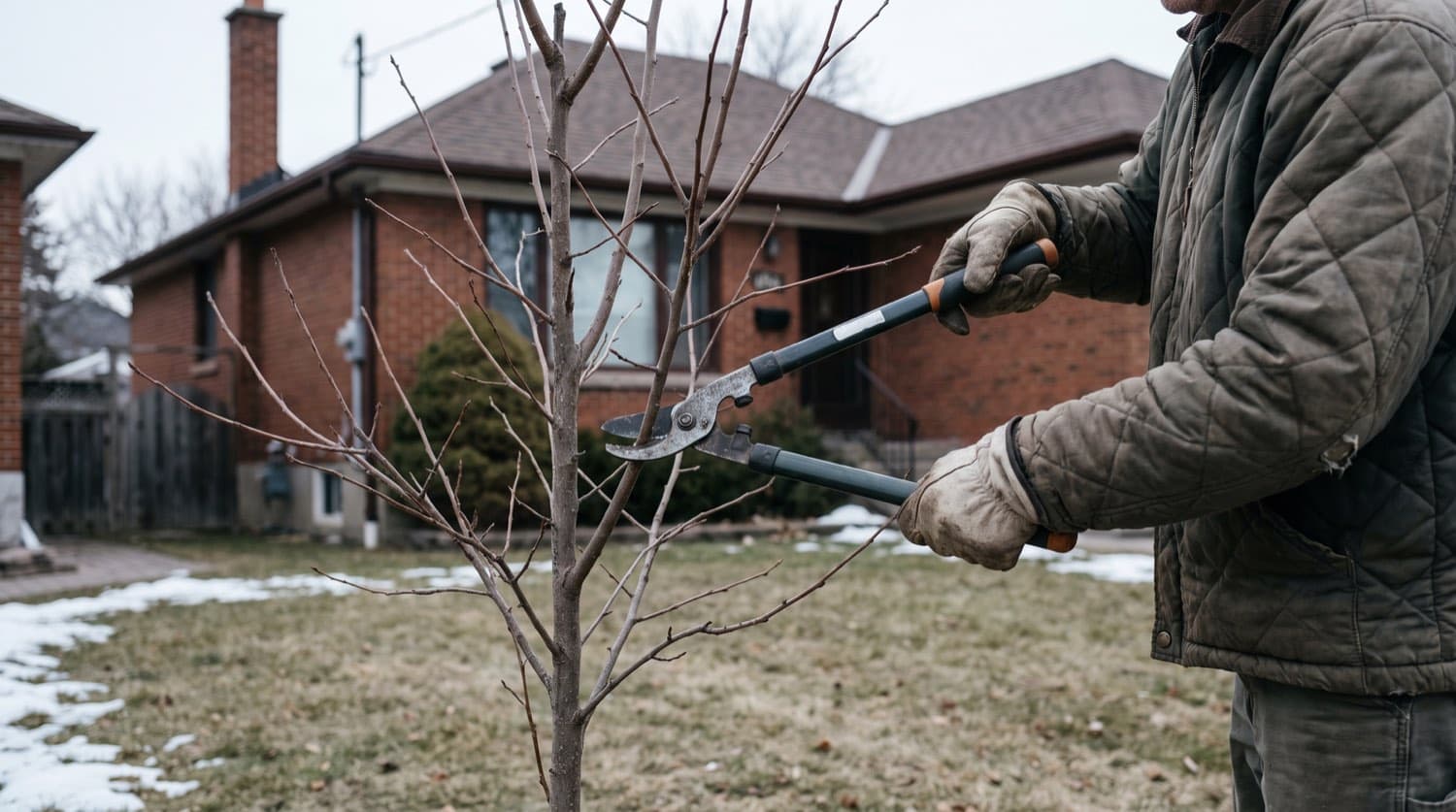
Answer First: Pruning is the selective removal of branches to improve a tree's health, structure, and safety, not a haircut for size. The basics most homeowners get wrong: prune in the dormant season (late winter to early spring) for most trees, cut just outside the branch collar rather than flush or leaving a stub, use the three-cut method on any branch too heavy to hold, and never top a tree. Keep total removal under about a quarter of the canopy in a year.
Bad pruning is worse than no pruning. A tree left alone usually survives; a topped or flush-cut tree carries the damage for the rest of its life. The good news is that the handful of rules that separate helpful pruning from harmful pruning are simple, and most homeowner mistakes come down to breaking just three of them.
What is pruning, and why do it?
Pruning is removing specific branches on purpose to shape a tree or improve its health. The legitimate reasons are few and clear: take out dead, diseased, or damaged wood; remove branches that cross and rub; open a young tree to good structure so it grows strong; and clear limbs that block a path or sightline. That is the whole list. Pruning to shrink a tree that is simply too big for its spot is where people get into trouble.
Everything else in this guide is about doing those cuts without hurting the tree, because the tree cannot heal a bad cut the way skin heals. It can only seal the wound over, and only if you cut in the right place at the right time.
Quotable: Trees do not heal wounds, they seal them. That is why where and when you cut matters more than how much you cut.
When should you prune?
For most trees, late winter to early spring, while the tree is dormant. Wounds close fastest then, the tree is under the least stress, and with the leaves gone you can actually see the structure you are shaping (NMSU Extension). A few timing rules beyond the default:
- Dead, damaged, or hazardous branches: any time of year. Safety does not wait for a season.
- Spring-flowering shrubs (lilac, forsythia): right after they finish blooming, or you cut off next year's flowers.
- Oaks and elms: dormant season only. Pruning them during the growing season raises the risk of spreading serious diseases through fresh wounds.
- Avoid heavy pruning in early fall, when cuts close slowly and some decay fungi are active.
Mistake 1: topping the tree
Topping, cutting the main limbs back to stubs to make a tree shorter, is the single most damaging thing homeowners do. It forces a flush of weakly attached shoots called epicormic sprouts that snap easily, it opens big wounds the tree cannot seal, and it permanently wrecks the tree's structure (Portland.gov). A topped tree is not a smaller healthy tree; it is a hazard in the making.
If a tree is genuinely too large for its space, the fix is a proper crown reduction by a certified arborist, which shortens limbs back to suitable side branches, not a topping. Often the honest answer is that the wrong tree was planted in the wrong spot, and the better long-term move is to replace it.
Quotable: Topping does not make a tree smaller, it makes it dangerous. The weak sprouts that regrow are more likely to fail than the limbs you cut off.
Mistake 2: cutting in the wrong place
The second mistake is the cut itself. Every branch meets the trunk at a slightly swollen ring called the branch collar, which holds the tree's natural defenses against decay. The rule is to cut just outside that collar, leaving it intact.
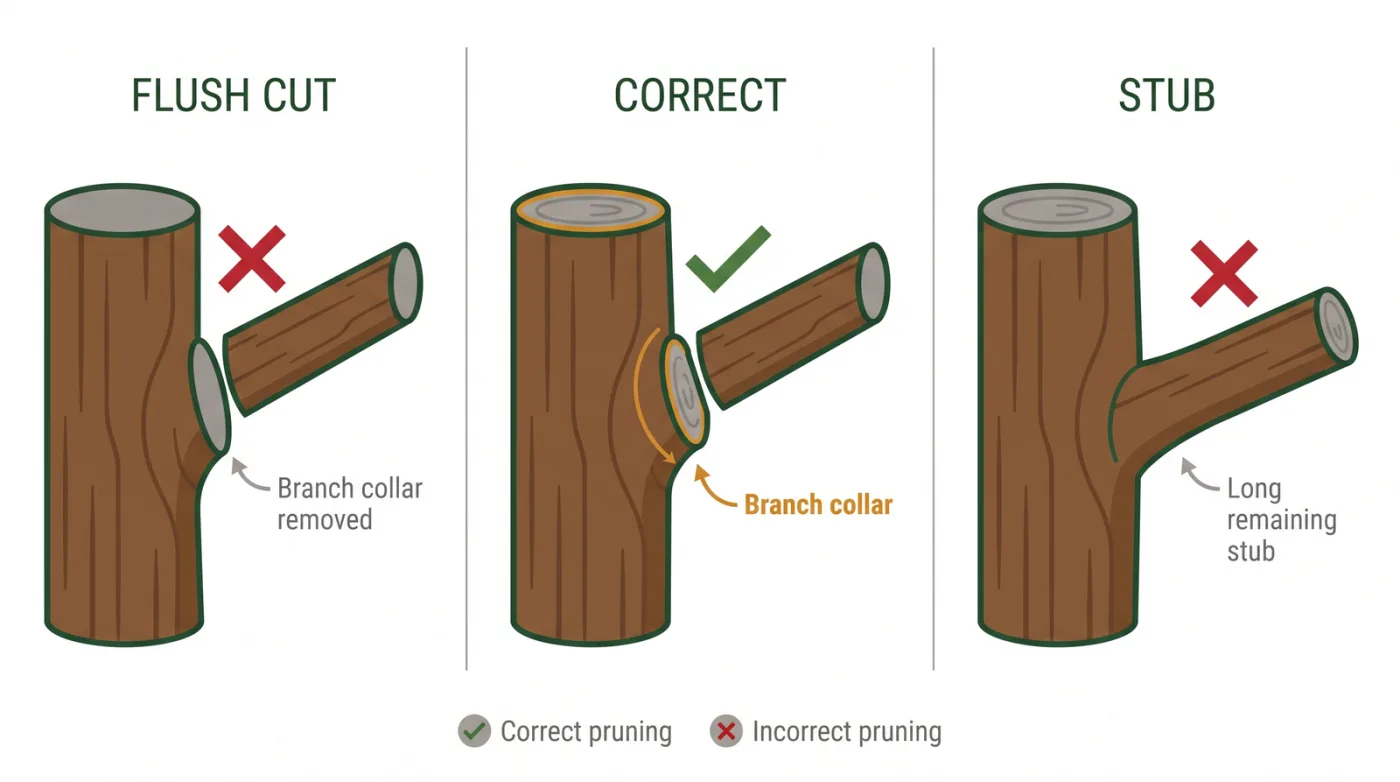
Two ways people get this wrong: a flush cut slices the collar off against the trunk and opens a wound the tree cannot close, and a stub left too long dies back and invites rot inward. Cut just outside the collar and the tree seals the wound on its own.
For any branch too heavy to hold with one hand, use the three-cut method so the falling branch does not tear the bark down the trunk:
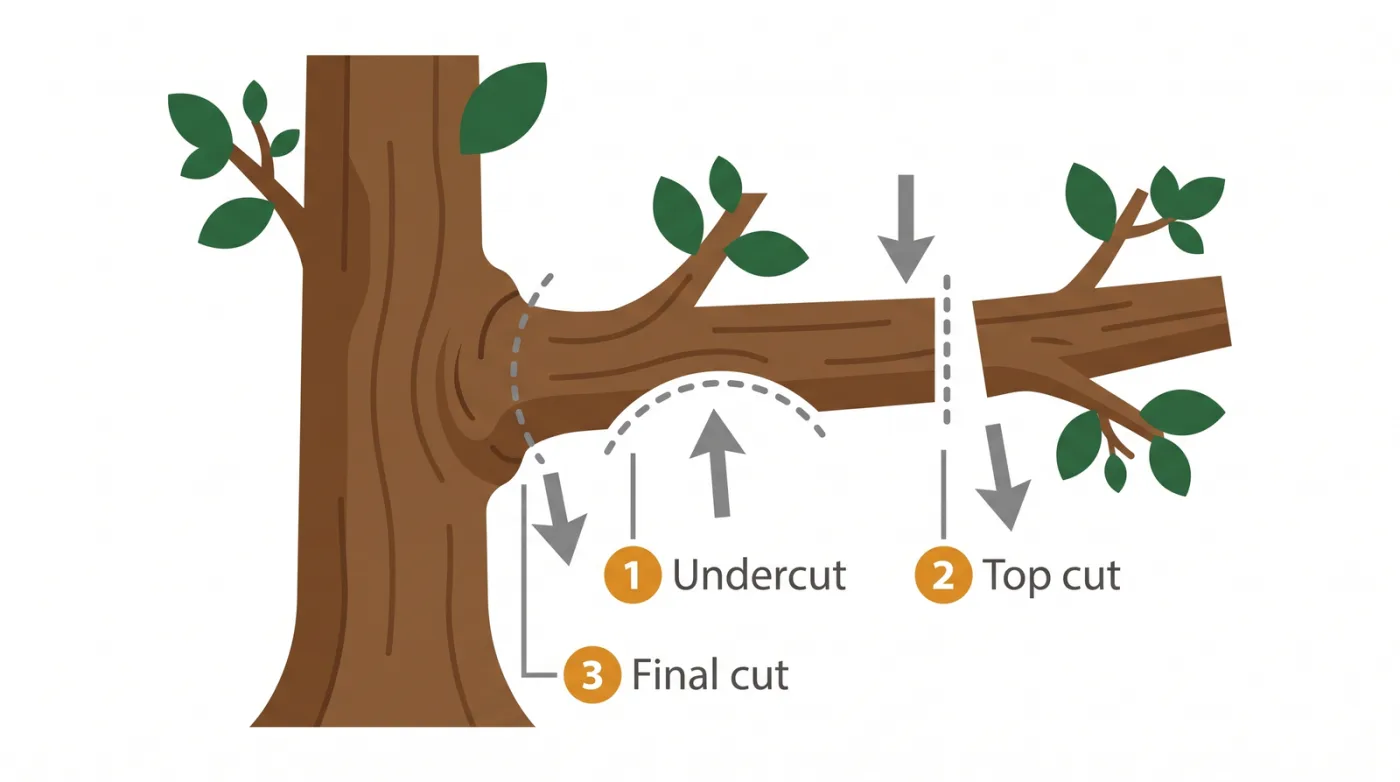
- Undercut: saw partway up into the underside of the branch, 15 to 30 cm out from the trunk.
- Top cut: a few centimetres beyond the undercut, cut down through the top until the branch drops. The undercut stops the bark from tearing.
- Final cut: remove the remaining light stub just outside the branch collar.
Mistake 3: over-pruning
The third mistake is taking too much. Keep total removal under about a quarter of the live canopy in one year, and less on a mature tree (NMSU Extension). The leaves are how the tree makes food; strip too many and it responds with stressed, weak regrowth. Avoid "lion-tailing," stripping out all the interior growth and leaving tufts at the ends, which weakens limbs. If a tree needs more work than a quarter of its canopy, spread it across several seasons.
When to call an arborist, and hands off the City's trees
Some pruning is not a homeowner job. Anything high in the canopy, near power lines, or requiring you to leave the ground belongs to a certified arborist with the right gear and insurance. Big structural cuts on a mature tree do too.
There is also a Toronto rule to know. The City maintains the trees on the road allowance, so the street tree in front of your house is not yours to prune; contact 311 for its care (City of Toronto). And a healthy private tree 30 cm or more in trunk diameter is protected under the city's tree bylaw, so major work on a big backyard tree can require a permit. When in doubt, ask before you cut.
From the data: Of the 650 landscaping companies YardQuote tracks across the GTA, 613 carry three or more Google reviews, the average rating is 4.77, and 86% of rated companies hold 4.5 stars or higher (YardQuote tracking, July 2026). Many offer pruning and tree work alongside general landscaping.
If a job is beyond a hand pruner and a dormant afternoon, compare rates on the landscaping cost page or browse rated crews on the North York landscaping directory. Pruning pairs with the other tree basics in our guides on transplanting a tree and getting free trees from the City of Toronto.
Want a certified pro for the cuts you should not make yourself? Request a quote and compare up to three rated GTA pros side by side. Your contact details only go to the one you pick.