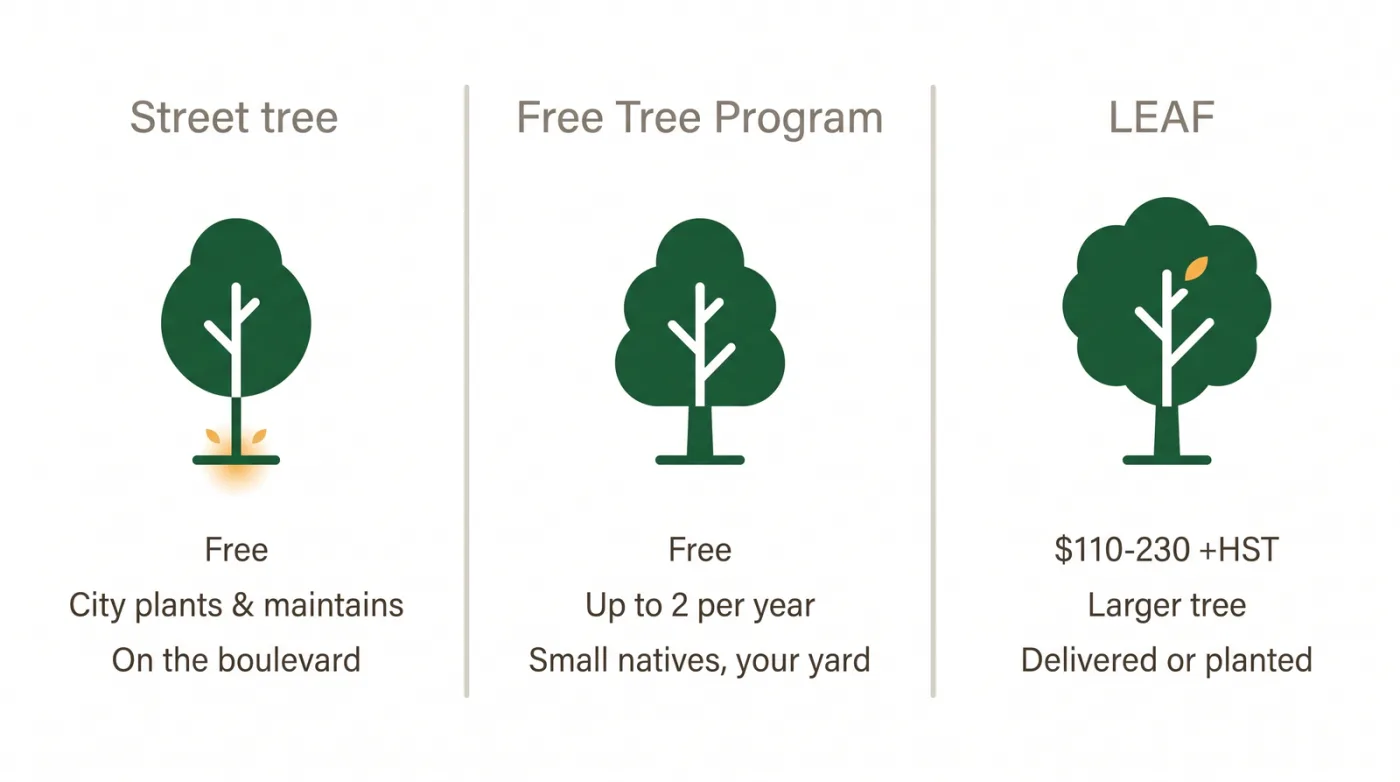
Answer First: Toronto residents have three ways to get a low-cost or free tree. Request a free street tree on the City road allowance through 311 or online, and the City plants and maintains it. Preregister for the Toronto Free Tree Program to get up to two free native trees or shrubs per household each spring and fall for your own yard. Or use LEAF's subsidized backyard program for a larger tree at $110 to $180 do-it-yourself, or $160 to $230 full-service, per tree plus HST. Whichever you pick, you water the new tree for its first two to three years.
Toronto gives away more trees than most residents realize, through a few different programs that are easy to mix up. One plants a tree on the boulevard for free and maintains it forever. Another hands you small native trees for your own yard. A third plants a bigger tree for a modest fee. Here is exactly how each works and how to apply.
The three ways to get a tree in Toronto
| Program | What you get | Cost | Where it goes |
|---|---|---|---|
| Street tree request | City picks species, plants and maintains it | Free | City road allowance (boulevard) |
| Toronto Free Tree Program | Up to 2 native trees/shrubs per household, each spring and fall | Free | Your own yard |
| LEAF backyard planting | Larger native tree, delivered or fully planted | $110 to $230 per tree + HST | Your own yard |
Source: City of Toronto, LEAF (2026). The right one depends on where you want the tree and how big you want it to start.
Quotable: Toronto's street-tree program plants and maintains a tree on the boulevard for free; the Free Tree Program gives you up to two native trees or shrubs a year for your own yard. They are separate programs with separate sign-ups.
Option 1: A free street tree on the City road allowance
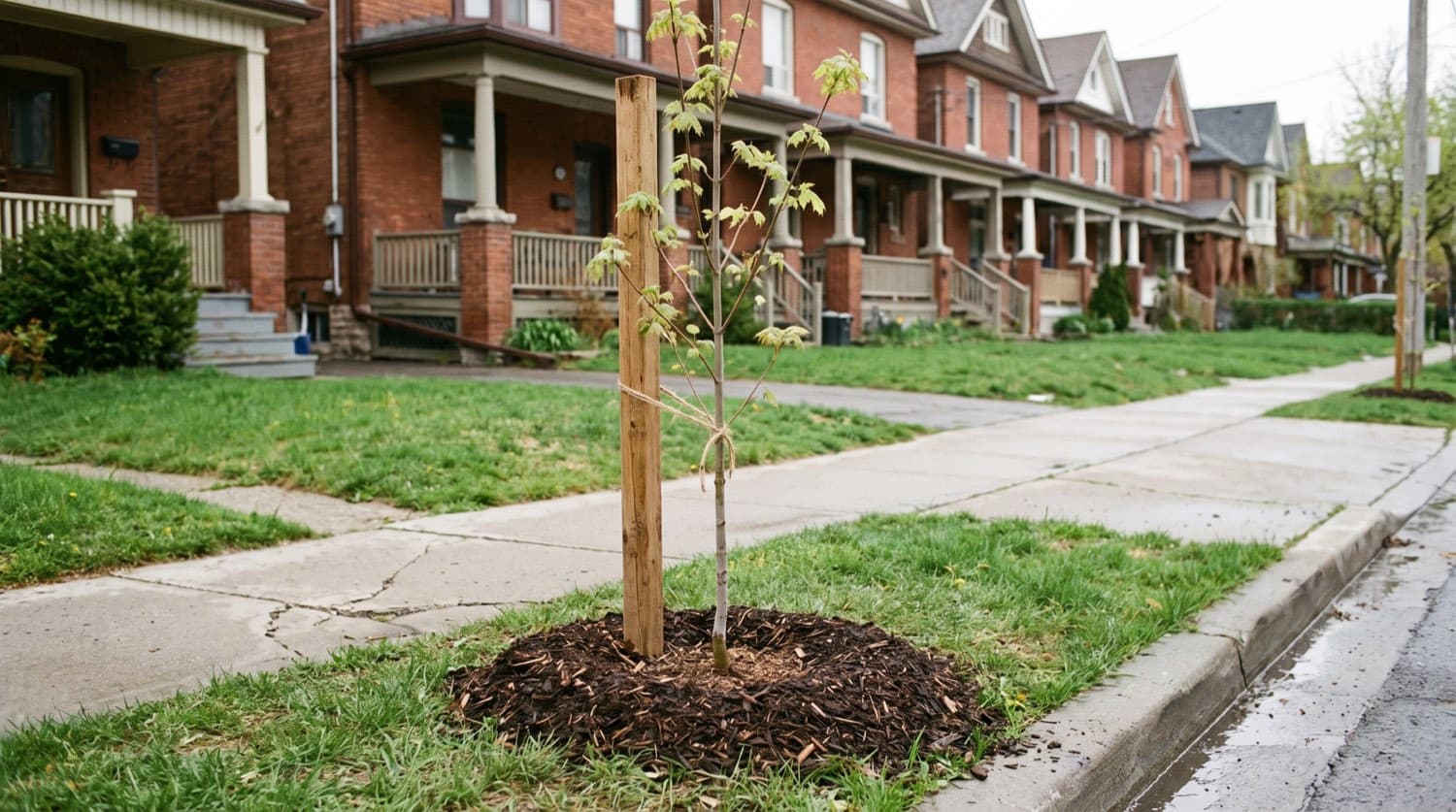
If you want a tree on the strip between the sidewalk and the curb in front of your home, the City will plant one at no cost. Submit a street tree planting request to 311, by phone or online (City of Toronto).
Here is what happens next. City staff visit the site and choose an appropriate species based on the available space, soil, sunlight, and nearby utilities and wires. Planting takes place in spring or fall. If your address is selected, you receive a hand-delivered Notice of Planned Tree Planting. The City then maintains that tree, including inspection and pruning, because it sits on City property. Your one job is to water it for the first two to three years while it establishes.
One catch worth knowing: because the City selects the species and location, you do not fully choose the tree. If you have concerns or want to cancel a planned planting, you must contact 311 within three weeks of the planned planting date.
Option 2: Free native trees for your own yard
For a tree or shrub in your actual yard, the free route is the Toronto Free Tree Program (formerly the Community Canopy Program). It provides up to two free native trees or shrubs per household, each spring and fall, that you plant on your own front, side, or back yard (City of Toronto).
These are starter plants: 1- or 2-gallon pots, about 1 to 4 feet tall. They are small deliberately, because young natives establish faster, so the trade-off is quantity and native variety over instant size. Spring 2026 offerings have included Serviceberry, Sugar Maple, Swamp White Oak, White Spruce, Witch Hazel, Hackberry, Grey Dogwood, Arrowwood, Fragrant Sumac, and Purple Flowering Raspberry. Preregistration is required, and spots go by season, so sign up early.
Quotable: The Toronto Free Tree Program gives up to two free native trees or shrubs per household each spring and fall, in 1- to 4-foot sizes, for your own yard. Preregistration is required and it runs by season.
Option 3: A bigger backyard tree through LEAF, subsidized
If you want a larger tree planted properly and are willing to pay a modest amount, the City partners with LEAF (Local Enhancement and Appreciation of Forests) on a subsidized backyard planting program (LEAF).
Two options here:
- Do-it-yourself: $110 to $180 per tree plus HST. A virtual consultation with a LEAF arborist, plus delivery of your tree and mulch.
- Full-service: $160 to $230 per tree plus HST. An in-person site consultation, delivery, planting, and mulching all done for you.
LEAF's trees are bigger than the free program's, 5- to 8-foot native deciduous or 2- to 4-foot native evergreen, so this is the route when you want size and a professional planting without paying full nursery-plus-installation prices. There is also a Neighbourhood Planting Program that gives free native trees and shrubs to eligible community groups for giveaway events, worth knowing if your street or residents' association wants to plant together.
Which one should you choose?
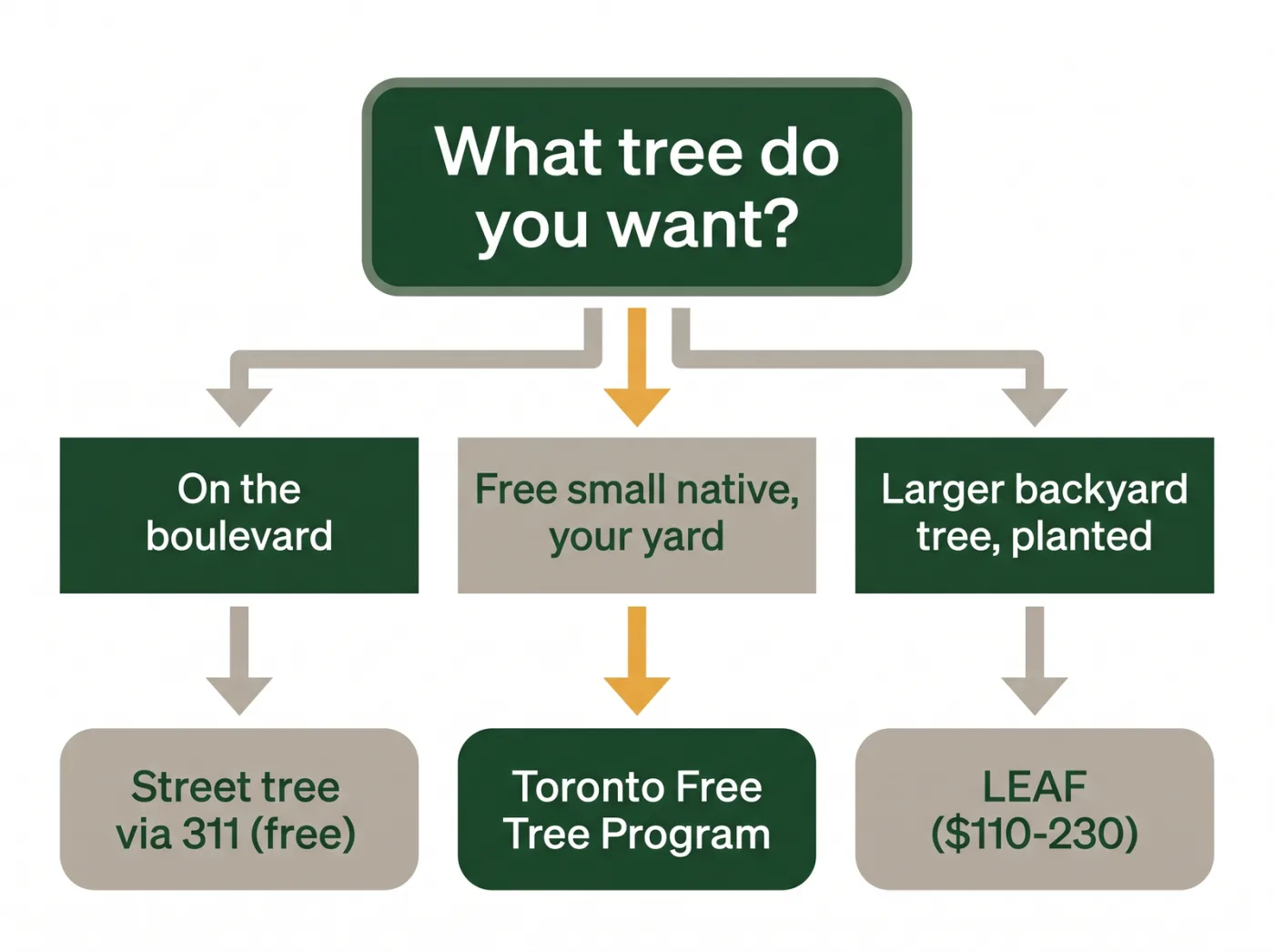
- Want a tree on the boulevard, planted and maintained for free? Request a street tree through 311.
- Want free native trees or shrubs for your own yard, and happy to plant small starters yourself? Use the Toronto Free Tree Program.
- Want a larger backyard tree planted properly and will pay a subsidized fee? Use LEAF.
After you get the tree: keep it alive
A free tree is only free if it survives. The single most important thing is water: soak the root zone deeply and regularly for the first two to three years, especially through dry GTA summers. Mulch a wide ring but keep it off the trunk, and resist the urge to prune much early on. When it does need shaping, follow our guide on pruning basics, and if you ever need to relocate it, see transplanting a tree.
From the data: Of the 650 landscaping companies YardQuote tracks across the GTA, 613 carry three or more Google reviews, the average rating is 4.77, and 86% of rated companies hold 4.5 stars or higher (YardQuote tracking, July 2026). If you want a large tree sooner than these programs offer, installed tree planting runs about $150 to $500 per tree.
For a bigger or faster tree than the free programs supply, compare rates on the landscaping cost page or browse rated planters on the North York landscaping directory.
Want a pro to plant and establish a larger tree for you? Request a quote and compare up to three rated GTA pros side by side. Your contact details only go to the one you pick.