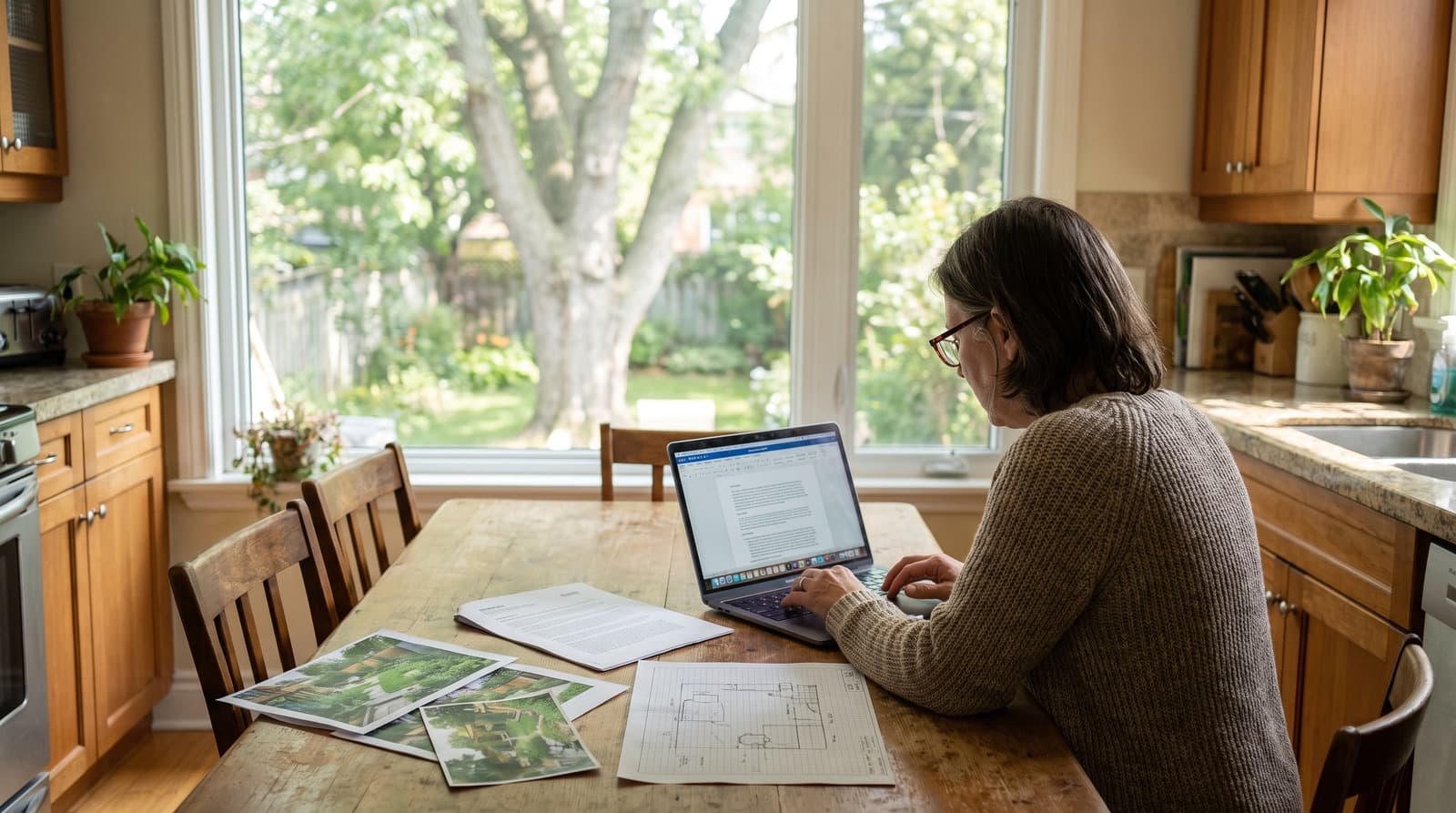
Answer First: To remove a private tree 30 cm or wider in Toronto, you apply to Urban Forestry for a permit to injure or remove trees, online or in person, with an application fee, an arborist report, a replanting plan, photos, and a scale site plan showing every tree 30 cm or more within 6 metres. The City reviews it, may visit the site, then issues a written decision. The permit fee is modest at $142.31 per private tree ($425.75 if the removal is construction-related); the arborist report and any replanting are where the rest of the money goes.
If you have already confirmed your tree is a protected private tree, this is the part that follows: the paperwork, the order it goes in, and what each piece actually costs. If you are still not sure whether the tree is yours or the City's, start with our guide to private vs City tree rules first, because the application below only applies to private trees.
Step by step: the private tree removal application
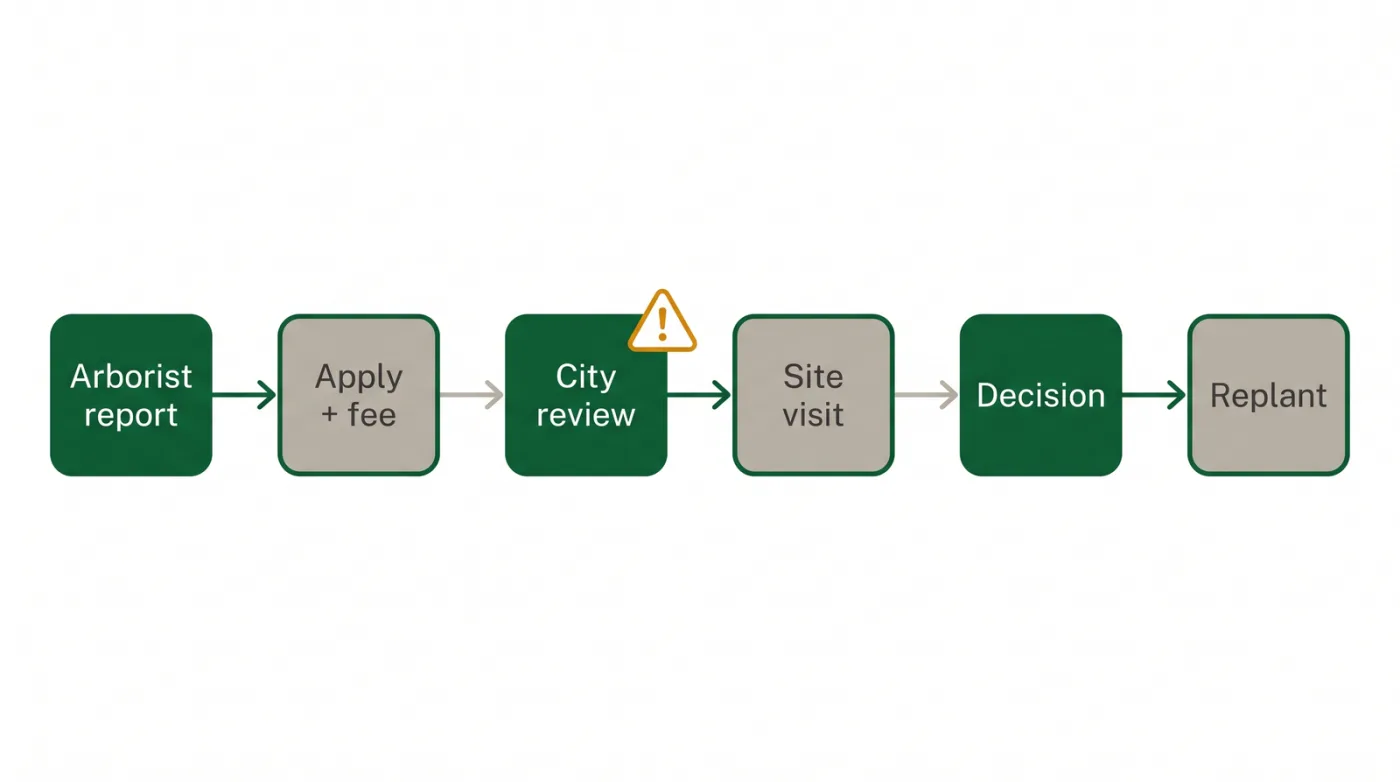
The process runs in a set order, and skipping ahead is what stalls people. Here is the full sequence from Urban Forestry.
- Confirm the tree is a protected private tree. It must be on your property and measure 30 cm or more in diameter at 1.4 m above the ground. A City tree instead goes to 311.
- Hire a certified arborist and get the report. The arborist documents the tree's condition, species, and size, plus protection measures for nearby trees. This is the document the City leans on most.
- Prepare the replanting plan. Show where each replacement tree goes, its species, and a minimum 50 mm caliper size.
- Assemble the site plan and photos. A scale site plan marks existing and proposed structures and every tree 30 cm or wider within 6 metres of the work, plus clear colour photos of the whole tree and any problem areas.
- Submit the application and fee. Apply online through the City form or in person at a service counter, with the application fee.
- City review. Staff check for completeness and notify you of anything missing. Incomplete files are the usual delay.
- Site visit. City staff may inspect the tree before deciding.
- Written decision. The City approves or denies in writing.
- Sign the Undertaking and Release, then post the permit. Install tree protection hoarding if construction is involved, and post the permit visibly at least one day before work starts.
- Do the work, replant, and notify the City. Complete the removal, plant the replacement trees or pay cash-in-lieu, and tell the City the work is done.
What documents do you actually need?
Five things carry the application. Get them ready before you open the form, because a half-filled submission just bounces back.
- Application fee — paid when you submit, by online payment, certified cheque, or money order.
- Arborist report — condition, species, size, and protection plan, from a certified arborist you hire.
- Landscape and replanting plan — location, species, and minimum 50 mm caliper for each replacement tree.
- Clear colour photos — the entire tree and any problem areas such as decay or damage.
- Scale site plan — existing and proposed structures, and every tree 30 cm or wider within 6 metres of the work.
Quotable: A Toronto private tree removal application is not just a form and a fee. The City may require an arborist report, a replanting plan, photos, and a scale site plan showing every tree 30 cm or wider within 6 metres of the work.
What does it really cost?
This is where the sticker price and the real price separate. The City permit fee is set and modest; the arborist report and any replanting are the variable costs around it.
| Cost line | Who sets it | Amount |
|---|---|---|
| City application fee, private tree (non-construction) | City of Toronto | $142.31 per tree (2026) |
| City application fee, private tree (construction-related) | City of Toronto | $425.75 per tree (2026) |
| Arborist report | Private certified arborist you hire | Varies; quoted by the arborist, not the City |
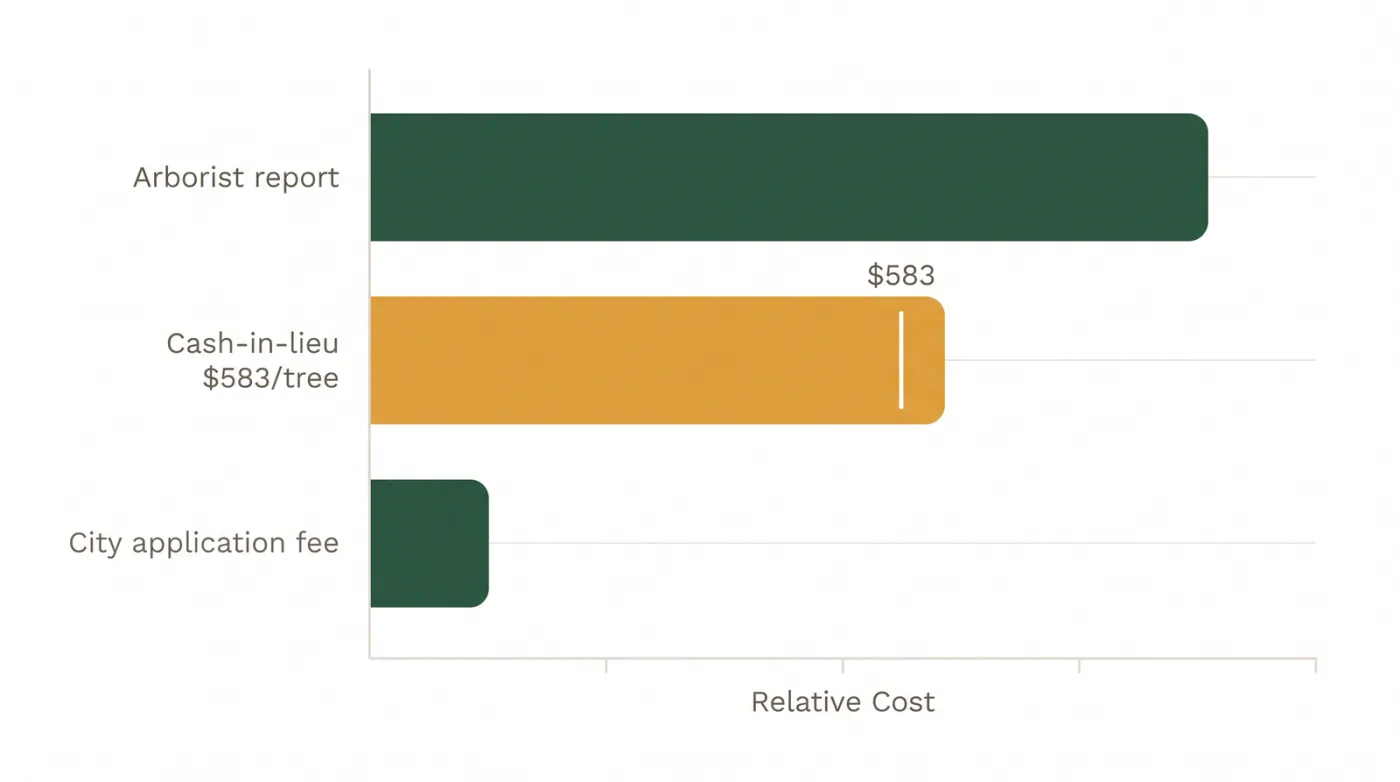
| Replanting or cash-in-lieu | City of Toronto | Replant at 50 mm caliper, or pay $583 per tree where there is no room |
The permit fee itself is now published on the City's 2026 fee schedule: $142.31 per private tree for a standard removal, rising to $425.75 per tree when the removal is tied to a construction project (City of Toronto application form). A shared boundary tree runs $297.08 per tree for a non-construction removal, and a City-owned tree application is $425.75 per tree. These are updated periodically, so confirm the current figure on the live form before you pay.
The other hard City figure is the cash-in-lieu of replanting: $583 per tree, charged when your lot has no space for the required replacement. On a small downtown lot with nowhere to replant, that $583 is a real line in your budget on top of the removal itself. The arborist report is quoted by the arborist you hire, which is why two homeowners can pay very different totals for what looks like the same permit. For the full fee breakdown, see our guide to Toronto tree removal permit cost.
From the data: Of the 650 landscaping companies we track in the GTA, the ones that quote a "tree removal" line rarely fold the permit, arborist report, and replanting into the headline number. Ask whether those three are in the quote or extra, the same normalize-first habit that keeps landscaping quotes comparable.
What holds applications up?
Almost always, missing paperwork. The City reviews for completeness and notifies you of gaps, and each round trip adds days. A vague arborist report, a site plan that omits a neighbouring 30 cm tree, or photos that do not show the problem all send the file back.
Because there is no instant approval and a site visit may be scheduled, the safe move is to apply well ahead of any hard start date. If a landscaping or interlocking build depends on the tree coming down first, the permit timeline, not the crew's calendar, is your real constraint.
Quotable: There is no same-day tree permit in Toronto. Apply weeks ahead of any construction start, because a site visit and a completeness review both take time, and a missing document restarts the clock.
After approval: the steps people forget
Approval is not the finish line. You sign an Undertaking and Release, and if construction is involved you install tree protection hoarding around the trees that stay. Then you post the permit visibly at least one day before work begins, so a bylaw officer or neighbour can see the job is authorized.
When the work is finished, you notify the City and complete the replanting, minimum 50 mm caliper per replacement, or pay the $583 cash-in-lieu where there is no room. Skipping the replanting condition is itself a bylaw problem, so treat it as part of the job, not an optional extra.
Line up the surrounding work while you wait
A tree permit rarely travels alone. If the tree is coming down to make room for a patio, a regrade, or a full yard redesign, use the review window to price that work so the crew is ready when the permit clears. You can compare vetted local pros through the landscaping directory for Scarborough or check current ranges on the costs hub before you commit.
Want the whole project priced honestly, tree and all? Request a quote and compare up to three vetted local pros side by side. Your contact details only go to the one you pick, and a good pro will tell you which costs are theirs and which are the City's.