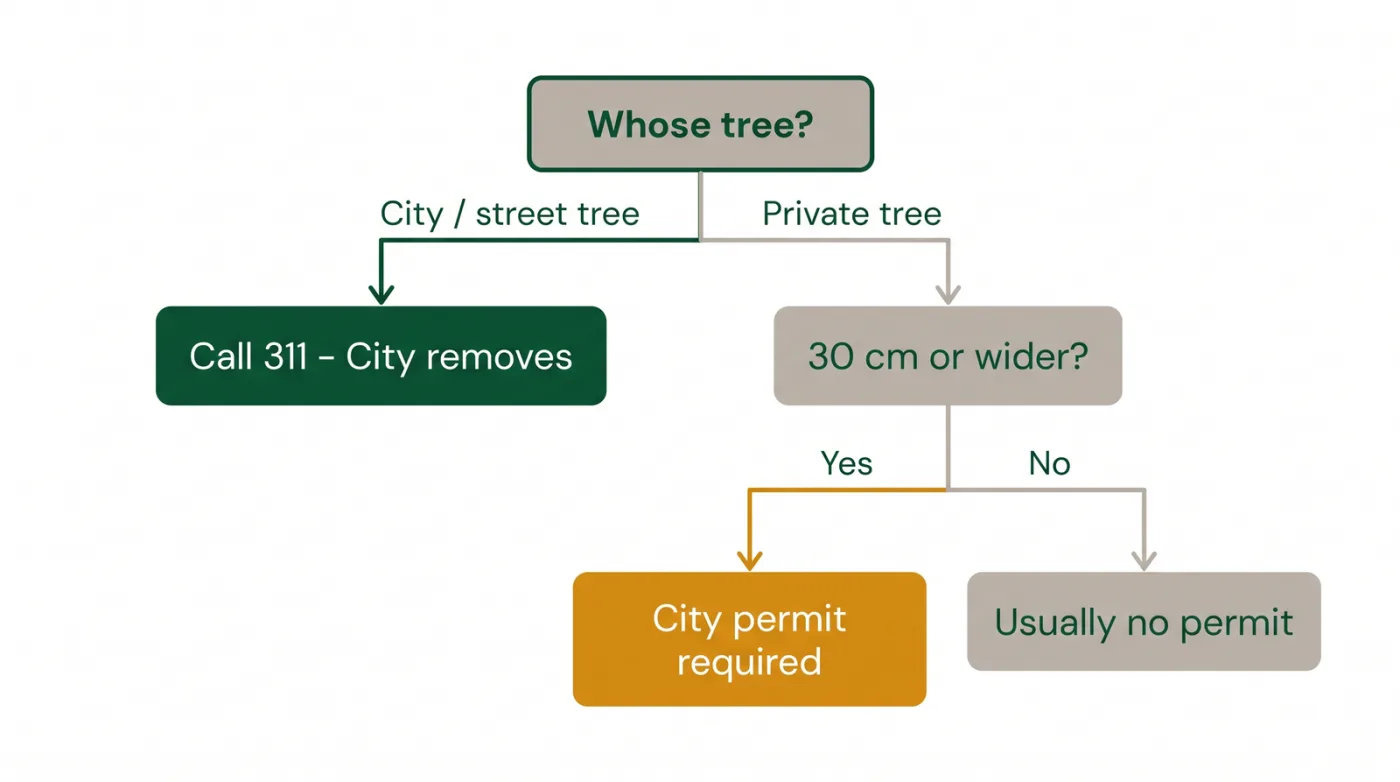
Answer First: In Toronto, a private tree measuring 30 cm or more in diameter needs a City permit before you cut, injure, or remove it, under Municipal Code Chapter 813. A City-owned or street tree you cannot remove at all, only Urban Forestry can, and you request work through 311. So before you call anyone, answer two questions: who owns the tree, and how wide is it? Those two facts decide everything else.
Most Toronto homeowners find this out the hard way, usually after a landscaper points at a big maple and asks whether they have a permit. The tree is on your land, so it feels like your decision. Under the bylaw it often is not. Here is how to sort out which rules apply to your tree before a job stalls or a fine lands.
Is the tree yours or the City's?
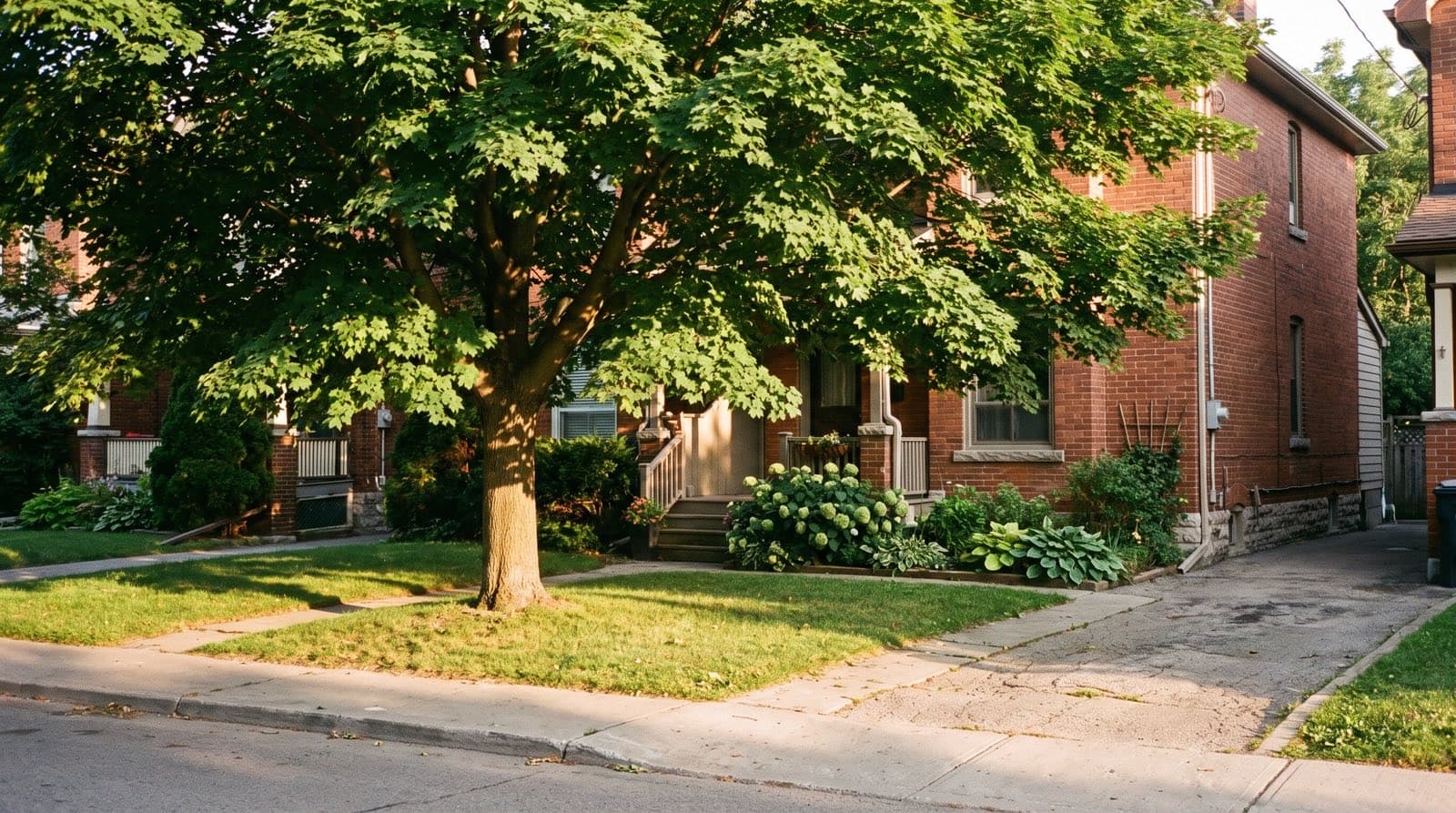
Ownership is decided by where the trunk grows, not by who rakes the leaves. A tree on your property is a private tree. A tree on the City road allowance, City parkland, or any other City land is a City tree, even when it stands directly in front of your house and you have watered it for years.
The road allowance is the part that trips people up. In most Toronto neighbourhoods the City owns a strip of land running several feet in from the curb, which is why the tree between the sidewalk and the street is almost always a City tree. Your property line frequently sits well behind your front hedge.
Quotable: A tree growing on the boulevard in front of your Toronto house is almost always a City-owned street tree, not yours, even though it is on the strip you mow. Only Urban Forestry can remove or prune it.
If you are not certain where your land ends, do not guess. The City states plainly that it is the applicant's responsibility to determine property boundaries and tree ownership before any work begins. A property survey settles it, and a wrong guess on a City tree is a bylaw offence.
What counts as a protected private tree?
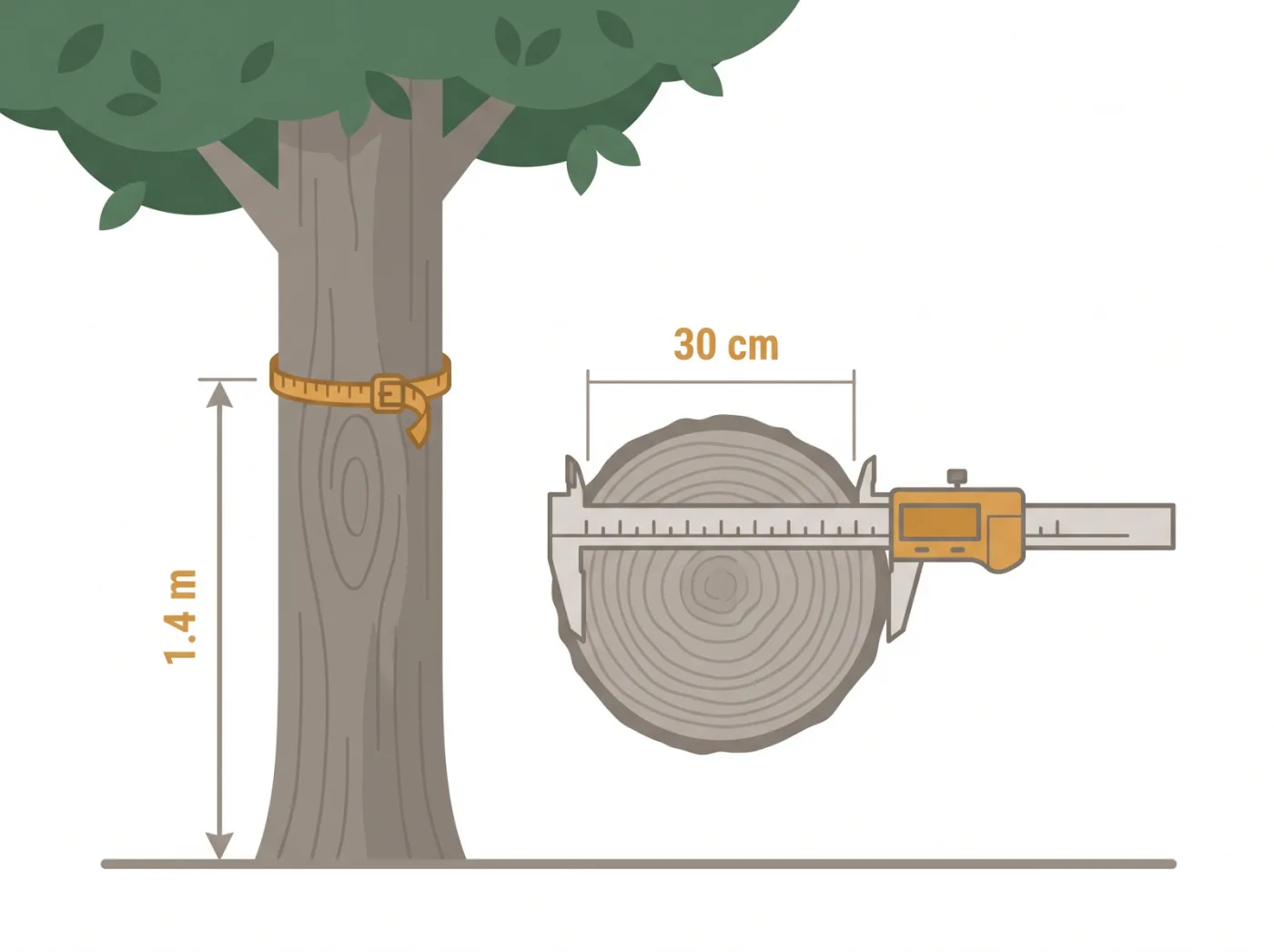
A private tree is protected once it measures 30 cm or more in diameter, measured at 1.4 m above the ground. That threshold comes straight from Toronto's Private Tree Bylaw, part of Municipal Code Chapter 813, and it applies to your front yard and back yard equally.
Diameter at breast height (DBH) — the width of the trunk measured 1.4 m (about 4.5 feet) up from the ground, which is roughly chest height on most adults. The bylaw uses this height on purpose, because trunks flare out near the base and a base measurement would overstate the real size.
The 30 cm figure is a circumference of about 94 cm, so a trunk you cannot quite wrap both hands around is usually in permit territory. If your tree is close to the line, measure carefully at the right height before assuming you are clear.
From the data: Across the 650 landscaping companies we track in the GTA, not one can legally shortcut this rule. The Chapter 813 permit binds the property and the tree, not the contractor, so hiring a bigger firm does not change whether your tree needs a City sign-off.
Private tree vs City tree: what the rules actually require
The two categories are governed differently, and mixing them up is the most common and most expensive mistake. This is the side-by-side.
| Private tree (30 cm or more) | City / street tree | |
|---|---|---|
| Who decides | You apply, City approves | City only |
| Permit needed to remove | Yes, before any work | Not available to residents |
| Permit fee | $142.31 per tree ($425.75 if construction-related) | Not applicable to residents |
| Who does the work | Your own arborist or crew | Urban Forestry |
| How to request | Tree removal permit application | 311 service request |
| Replanting | Usually required, or $583 cash-in-lieu | City handles |
| Penalty for unpermitted removal | $500 to $100,000 per tree | Same bylaw exposure |
For a City tree, there is no homeowner permit to apply for. If the tree is dead, dangerous, or you want it pruned, you report it to 311 and Urban Forestry assesses it. A private company that agrees to cut a City tree is exposing both of you to a bylaw charge.
For a private tree, the City application fee is $142.31 per tree for a standard removal, rising to $425.75 per tree when the removal is tied to a construction project (2026 City fee schedule). The permit is the cheap part; the arborist report, the removal, and any replanting cost far more, which we break down in the Toronto tree removal permit cost guide.
For a private tree at or above 30 cm, the path is a permit application to the City before a saw touches the trunk. A tree under 30 cm on your own land can usually come down without a City permit, though a ravine lot changes that, covered below.
What about a tree right on the property line?
A tree straddling the boundary between two private lots is a shared, or "boundary," tree, and neither neighbour can remove it alone. Ontario's Forestry Act treats a boundary tree as common property, so you need your neighbour's consent as well as a City permit if the tree is 30 cm or more. This is worth settling in writing before you plan a fence, patio, or addition that a shared tree sits in the way of.
If the dispute is with the tree rather than the neighbour, resist the urge to "trim your side" quietly. Significantly injuring a protected tree, including heavy root cutting for a footing or a driveway, counts as a bylaw offence the same as removal.
Do ravine and heritage rules add another layer?
Yes, on some lots. If your property is inside a regulated ravine or near a protected natural feature, the City's ravine protection rules apply on top of the tree bylaw, and even small trees and shrubs can be protected. TRCA-regulated areas can add a separate approval. If you live near a valley, river, or wooded slope, treat every tree as potentially protected until the City confirms otherwise.
Heritage designations and conservation districts can also carry tree conditions. None of this changes the two starting questions, ownership and size, but it can turn a tree you thought was exempt into one that needs sign-off.
What does breaking the rule cost?
More than most people expect, because the penalty is charged per tree. Under Municipal Code Chapter 813, an unpermitted removal or injury carries a minimum fine of $500 and a maximum of $100,000 per tree, and the City can order replanting on top of the fine.
Quotable: Toronto fines for removing a protected tree without a permit run from $500 to $100,000 per tree under Chapter 813, and the penalty is charged per tree, so clearing three protected trees is three separate exposures.
The practical takeaway is that the permit, which is far cheaper than the fine, is not the part to skip to save time. A tree question that surfaces mid-project on a landscaping or interlocking job is a scheduling problem, not a reason to cut first and ask later.
Getting the tree question sorted before you build
Trees are usually the first thing a real backyard project runs into and the last thing homeowners plan for. If you are pricing a patio, a deck, or a full yard redesign, confirm the tree ownership and size up front, because a protected tree near the work changes both the permit path and the quote. That is also why landscaping bids for the same yard can land so far apart, which we break down in why Toronto landscaping quotes vary.
Once you know a private tree is coming down, the next step is the paperwork and the real costs, which we walk through in the Toronto tree removal application guide. You can also browse vetted local pros for the surrounding work through the landscaping directory for North York or check current ranges on the costs hub.
Planning a project a big tree sits in the middle of? Request a quote and compare up to three vetted local pros side by side. Your contact details only go to the one you pick, and a good pro will flag the permit before the price.