Answer First: A City of Toronto permit to remove a protected private tree costs $142.31 per tree for a standard removal, or $425.75 per tree when the removal is tied to construction (2026 City fee schedule). You need one for any private tree measuring 30 cm or more across the trunk at 1.4 m up, and removing a protected tree without a permit is an offence carrying a $500 to $100,000 fine per tree.
Most homeowners searching this expect a big number and are surprised: the permit itself is under $150. The expensive part is everything around it, the arborist, the removal, the mandatory replanting, and the risk if you skip the paperwork.
How much does a tree removal permit cost in Toronto?
The City charges a flat application fee per tree, and the amount depends on two things: who owns the tree, and whether the removal is part of a construction project. These are the current figures straight from the City's own application form.
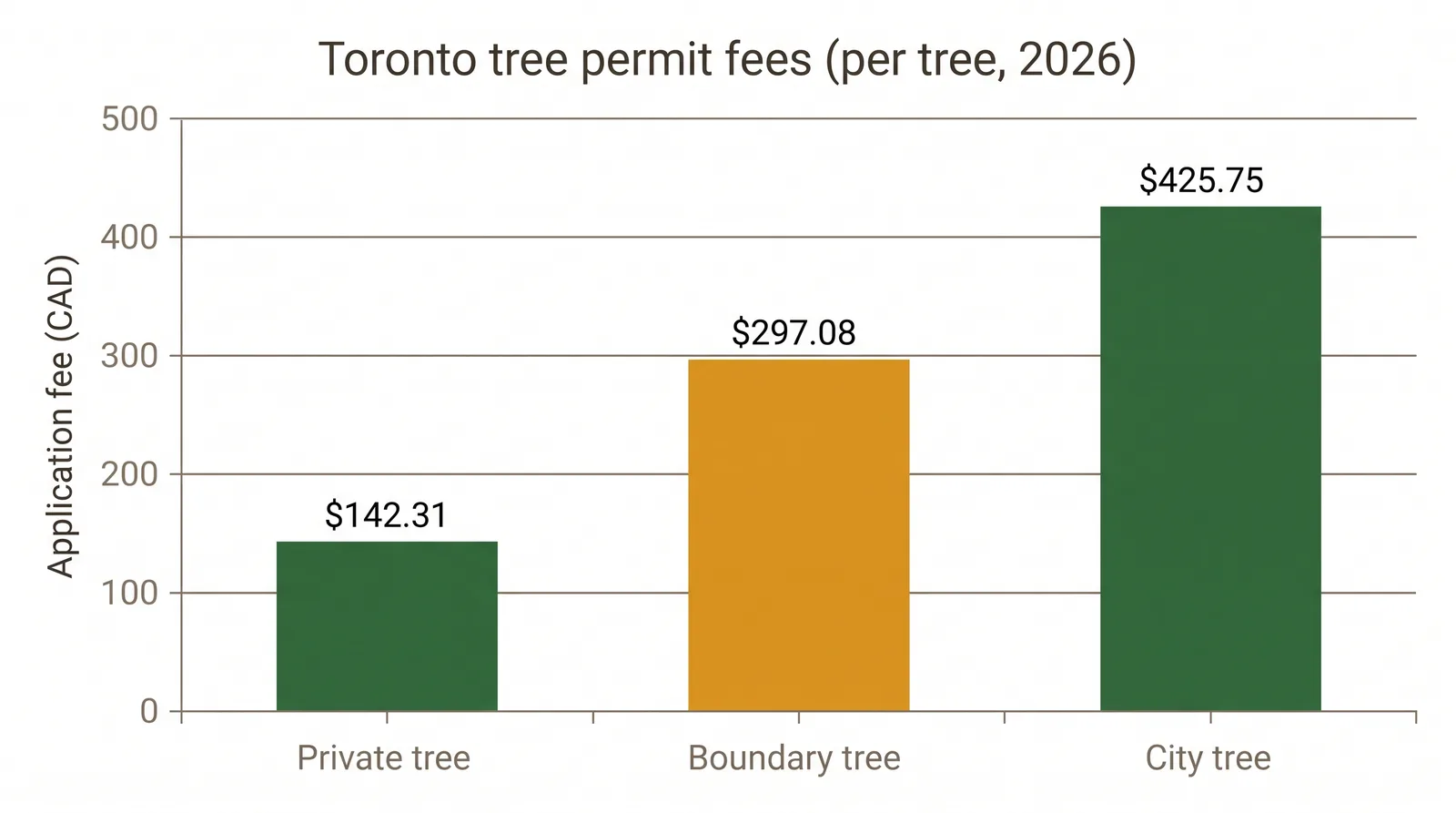
| Tree type | Non-construction removal | Construction-related removal |
|---|---|---|
| Private tree (yours) | $142.31 per tree | $425.75 per tree |
| Boundary / neighbour tree | $297.08 per tree | $891.30 per tree |
| City-owned tree | $425.75 per tree | $425.75 per tree |
"Non-construction" means you want the tree gone for its own sake, dead, diseased, or in the way. "Construction-related" means the removal clears the way for a building project, an addition, a pool, a new garage, and the City prices those higher because they trigger more review. Every one of these fees is non-refundable, so a rejected application still costs you the money.
Quotable: In Toronto the tree-permit application fee is $142.31 per private tree for a standard removal and $425.75 per tree when tied to construction (2026 City fee schedule). The fee is non-refundable even if the permit is denied.
Which trees actually need a permit?
The bylaw is stricter than most homeowners expect, and the trigger is trunk size, not height or age.
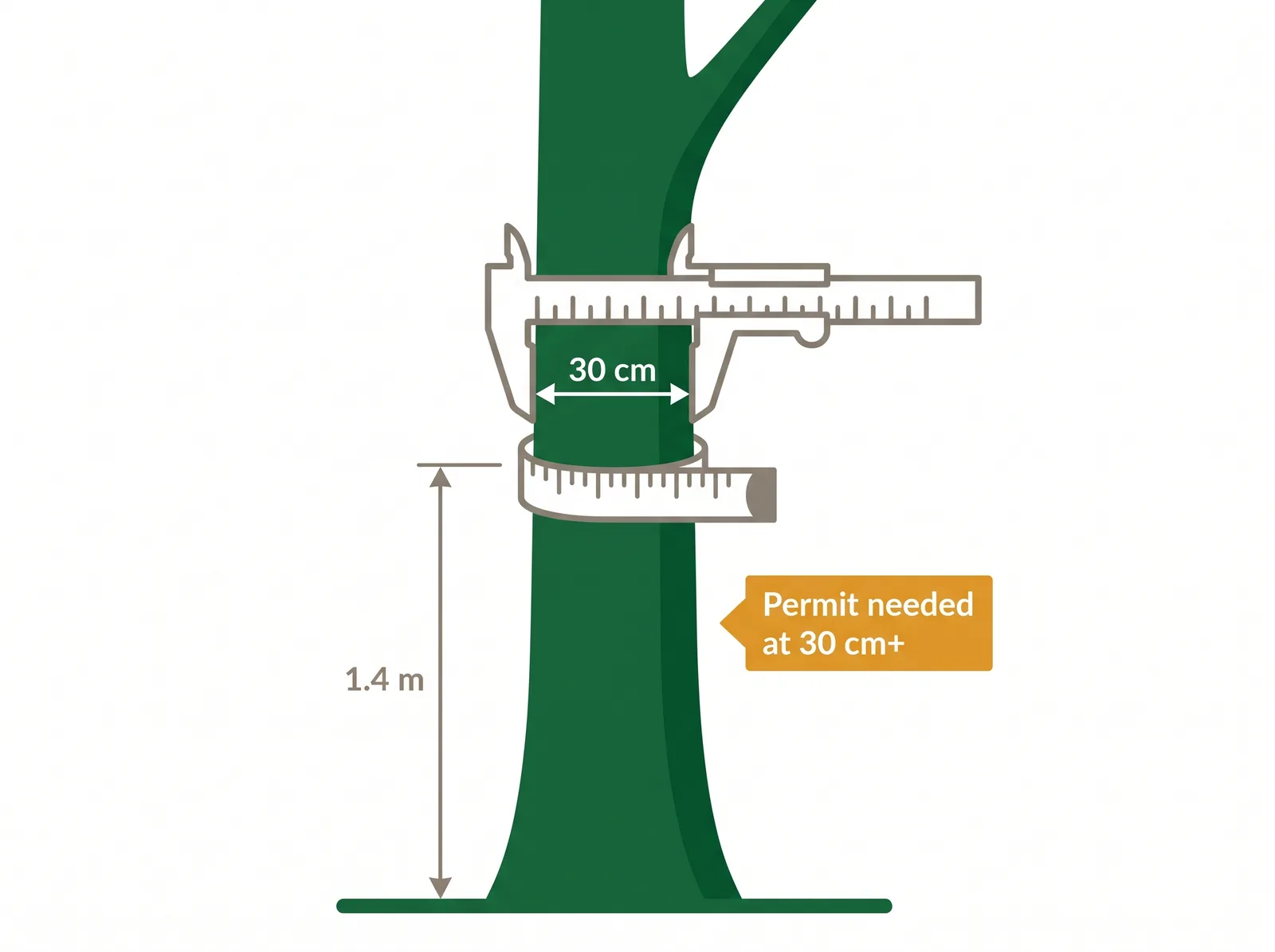
DBH (diameter at breast height) — the width of the trunk measured 1.4 metres up from the ground, which is the standard the City uses to decide whether a tree is protected. A private tree with a DBH of 30 cm or more is protected under Toronto's private tree bylaw and cannot be removed or badly injured without a permit.
Thirty centimetres across is smaller than it sounds. A trunk you can just about wrap two hands around is often already over the threshold. Before you assume a backyard tree is fair game, measure it properly at 1.4 m.
Two categories are protected regardless of size:
- City street trees. Any tree on the City road allowance, the strip between the sidewalk and the curb, and often a metre or two into what looks like your front lawn, is City-owned. Harming or removing one of any size without authorization is prohibited.
- Ravine and natural-feature trees. Lots inside a ravine, valley, or the Ravine and Natural Feature Protection area fall under a separate bylaw. Trees there are protected at any size, and so is grading and fill.
From the data: Toronto's tree rules touch far more suburban lots than people expect, because a healthy 20-year-old maple on a North York or Etobicoke frontage is routinely past the 30 cm mark. Of the landscaping companies we track across the GTA, the ones that quote tree work almost always build the permit step into their scope, precisely because unpermitted removals are enforced.
Do I need a permit? A quick decision path
Run your tree through these questions before you call anyone.
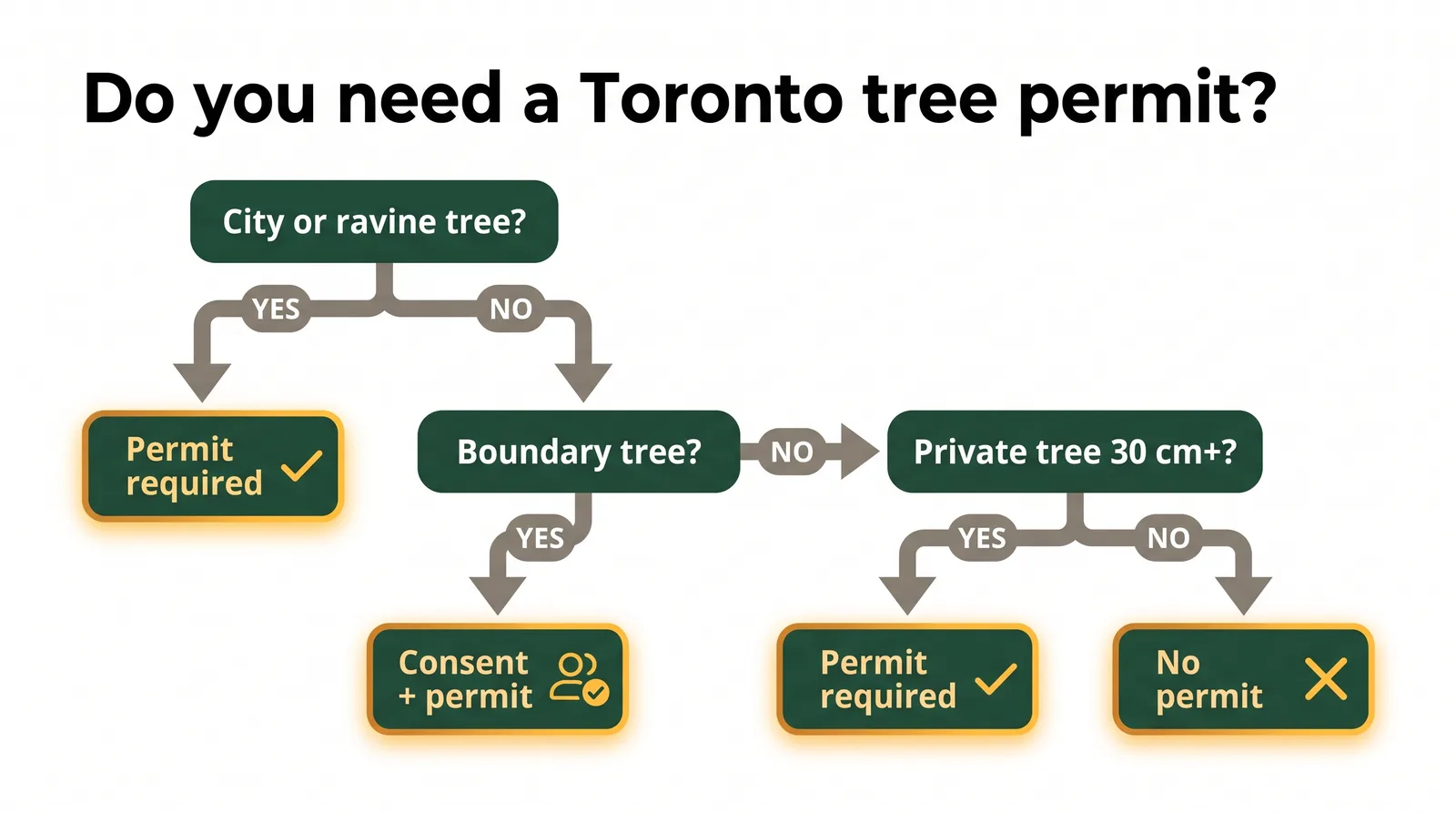
- Is the tree on the City allowance or in a ravine? If yes, it is protected at any size. Apply.
- Does the trunk cross a property line with a neighbour? If yes, it is a shared boundary tree. You need the neighbour's written consent before applying.
- Is it a private tree 30 cm or more across at 1.4 m? If yes, apply. If it is a private tree under 30 cm and not on the allowance or in a ravine, you generally do not need a permit.
- Is the removal part of a construction project? If yes, expect the higher construction fee and extra review.
When you are unsure whether a front-yard tree is on the City strip, the City can confirm ownership, guessing wrong turns a $142.31 private-tree application into a $425.75 City-tree problem, or an unpermitted removal.
What does removing a protected tree without a permit cost?
Far more than the permit. Injuring or removing a bylaw-protected tree without authorization is an offence under Toronto Municipal Code Chapter 813. A person convicted faces a minimum fine of $500 and a maximum of $100,000 per tree, and the City can add stop-work orders, orders to comply, and mandatory replanting on top of the fine.
Quotable: Removing a protected Toronto tree without a permit carries a fine of $500 to $100,000 per tree, plus possible stop-work orders and replanting requirements. The permit fee is a rounding error against that exposure.
Enforcement is not theoretical. City staff inspect and respond to public reports of tree contraventions, and a neighbour who watches a mature tree disappear over a weekend can trigger one. On a multi-tree lot, the per-tree structure means the exposure stacks fast.
The fee is not the whole cost: replanting and deposits
The application fee is the smallest line in a tree removal. Two other City charges catch people out:
- Cash-in-lieu of replanting: $583 per tree. Permits generally require you to replant. Where your lot has no room for a replacement tree, you pay $583 per tree into the City's tree fund instead.
- Tree-planting guarantee deposit: $583 per tree. When replanting is required on site, the City can hold a deposit equal to 120% of two years of planting and maintenance costs, set at $583 per tree, refundable once the new tree establishes.
Add the arborist and crew, and the true cost of a permitted removal is dominated by labour and replanting, not the permit. Tree and stump work sits inside the same wide-spread market as the rest of GTA landscaping, which is why three quotes for the same removal can look so different. The same normalize-before-you-compare logic from our guide on why Toronto landscaping quotes vary and on how landscapers set their hourly charge-out rate applies here too.
How to keep the process cheap and clean
- Measure first. Confirm the DBH at 1.4 m. If a private tree is genuinely under 30 cm and off the allowance, you may not need a permit at all.
- Confirm ownership before you assume. A front-yard tree near the sidewalk is often the City's. Ask before you cut.
- Get the neighbour's consent in writing for any boundary tree, before you apply, not after.
- Hire a pro who handles the permit. Established arborists and landscapers file the application, post the required notice, and plan the replanting as part of the job.
You can compare vetted crews that do tree and stump work on the landscaping directory for your area, or see current GTA labour and project ranges on the landscaping cost page.
Want to know what a permitted removal should cost for your yard? Request a quote and compare up to three vetted local pros side by side, permit and replanting included, so the numbers actually mean something. Your contact details only go to the one you pick.