Answer First: A charge-out rate is the hourly price a landscaper bills you for a crew member's time, not the wage they pay. In the GTA it runs $50 to $150 an hour, typically $50 to $100 (YardQuote data, July 2026). Landscape Ontario teaches contractors to build that rate by recovering overhead first, then adding profit, which is why a $22-an-hour worker shows up on your quote at roughly three times that.
You look at a landscaping quote, see "$85 per hour," and do the math against what you assume the crew earns. The gap looks like profit. Most of it is not. Here is what actually sits inside that number, and how the province's own trade association says it should be built.
What is a charge-out rate?
Charge-out rate — the hourly price a landscaping company bills a customer for one crew member on site, as opposed to the wage that worker takes home. Every real cost of running the business is folded into it.
In the GTA, that rate runs $50 to $150 per hour. General crew work typically lands $50 to $100, while design consultation and skilled trades reach the top of the range (HomeStars; corroborated by Land-Con). The spread is wide because a two-person maintenance crew and a designer with an engineering background are not selling the same hour.
From the data: In YardQuote's Toronto landscaping cost dataset, the crew-labour line runs $50 to $150 an hour, exactly 3x low to high, with a $50 to $100 typical band (computed July 2026). That 3x is not three levels of greed; it is three different products, from a general labourer to a senior designer.
Why is the charge-out rate triple the wage?
Because the wage is the smallest part of what an hour of crew time costs the company. Strip a charge-out rate apart and the hourly pay is one slice among six.
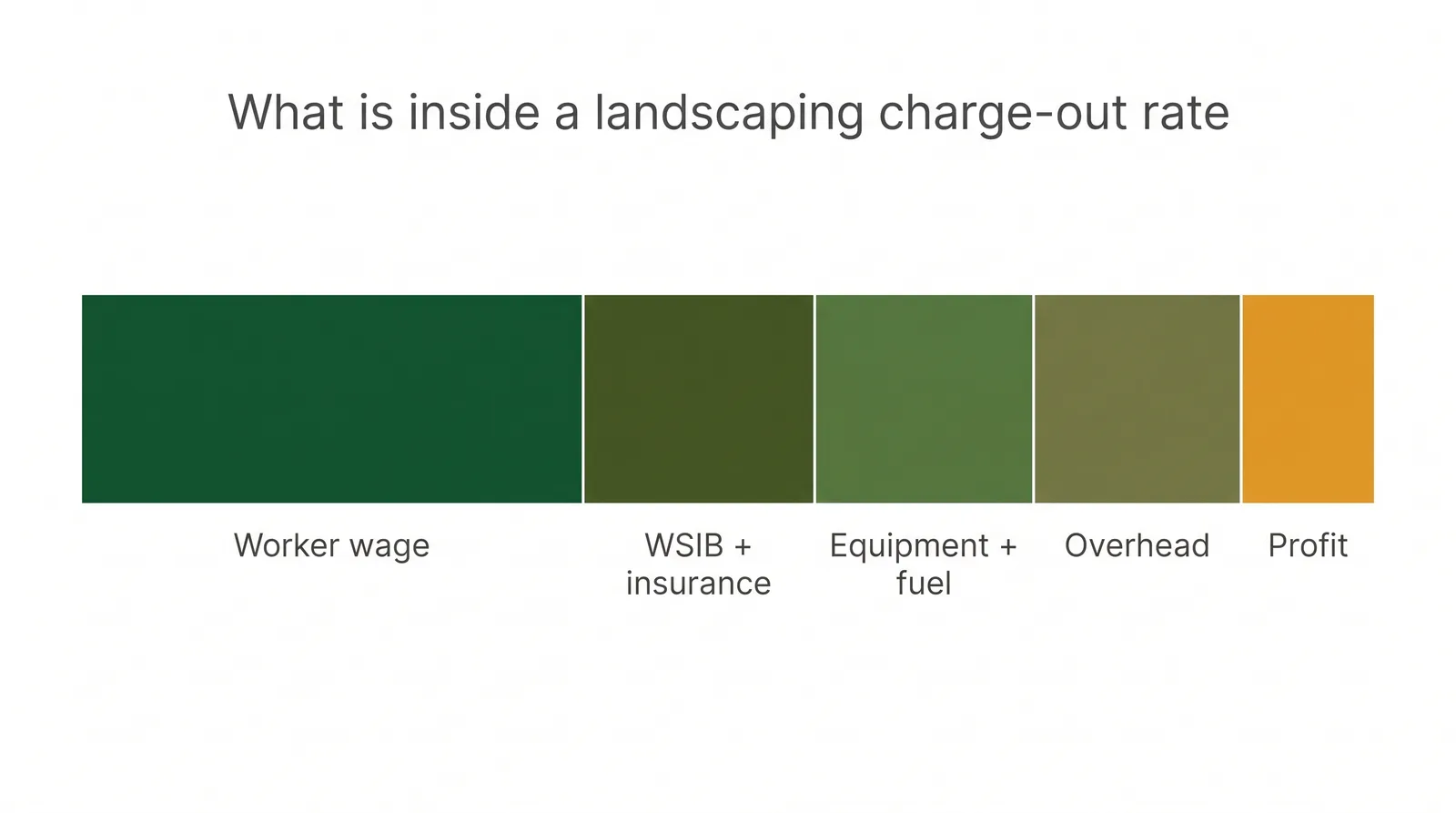
The costs stacked on top of the wage include:
- WSIB and liability insurance. Workplace coverage and commercial general liability are legally and practically required for a serious operator, and they are priced into every billed hour.
- Equipment, fuel, and vehicles. Mowers, plate compactors, mini-excavators, trucks, and trailers cost money whether or not they are running.
- Disposal. Soil, sod, and debris go to a facility with tipping fees.
- Unbillable time. Driving between jobs, quoting, buying materials, and weather downtime are hours the company pays for but cannot bill.
- Overhead. Office, software, licensing, and admin. Landscape Ontario benchmarks put overhead near 25% of sales on a healthy job.
- Profit. What keeps the business solvent and able to warranty its work, typically targeted around 10%.
Quotable: Landscape Ontario benchmarks put field labour at roughly 20 to 40% of a landscaping company's sales, meaning 60 to 80% of every dollar you pay goes to costs other than the crew's wages. The charge-out rate exists to recover that.
How Landscape Ontario says the rate is built
Landscape Ontario, the trade association most GTA professionals belong to, teaches pricing through overhead recovery: making sure the company's fixed costs are fully recovered in the price before any profit is counted. It does not happen automatically, and contractors who skip it quietly lose money on jobs that look profitable.
The method runs a job cost through two divisions, not a single markup.
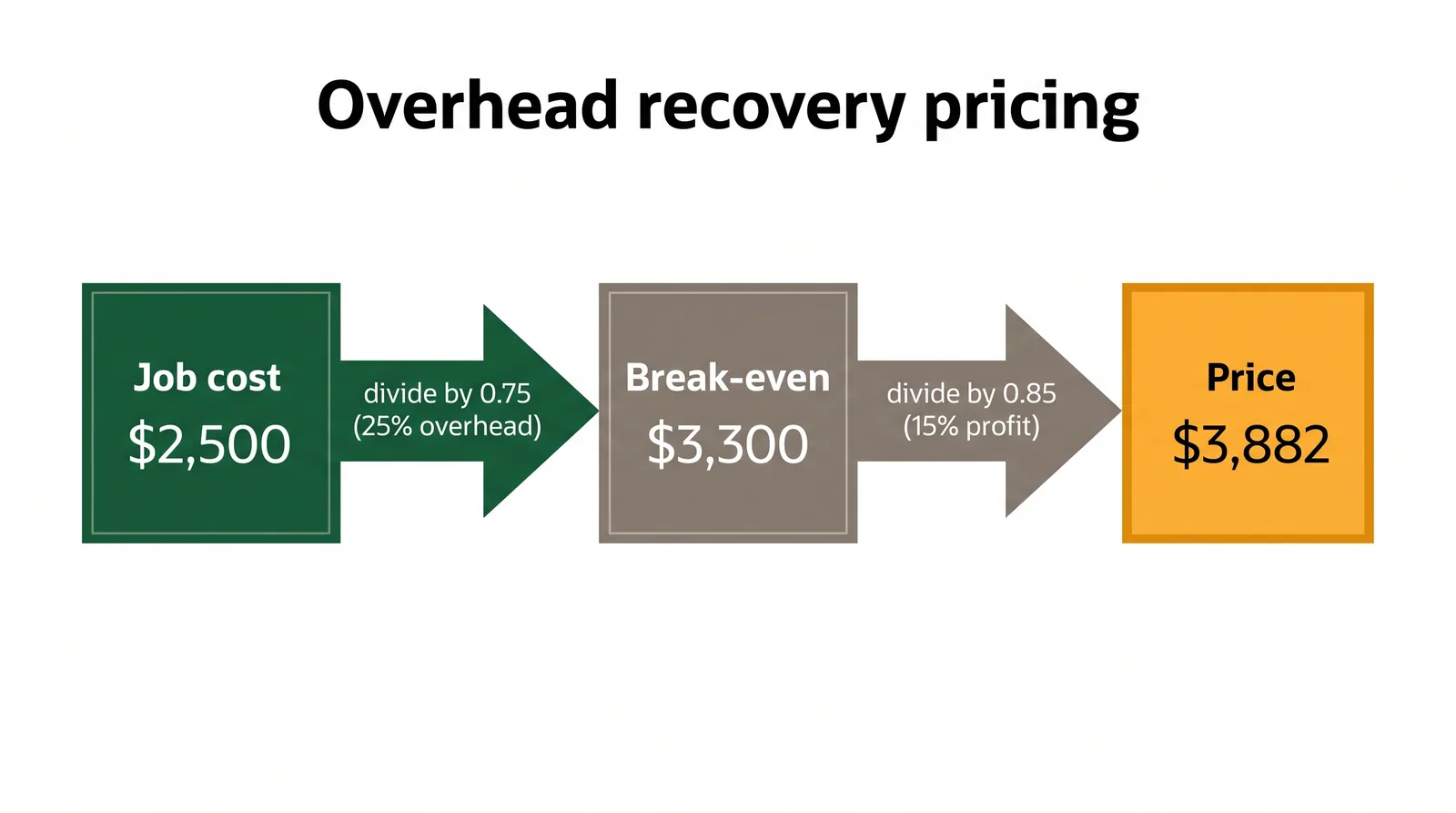
Take Landscape Ontario's own worked example: a soft-landscape install with $2,500 in direct cost, 25% overhead, and a 15% target profit.
- Recover overhead. $2,500 ÷ 0.75 = $3,300 break-even.
- Add profit. $3,300 ÷ 0.85 = $3,882.35 final price.
The reason it is two divisions and not "cost plus 40%" is that dividing recovers the overhead as a share of the final price, which is how a real profit-and-loss statement works. On a whole company, Landscape Ontario frames it as: $700,000 in sales, $455,000 cost of goods (65%), $175,000 overhead (25%), leaving $70,000 profit (10%). The charge-out rate is that same logic pushed down to a single crew-hour.
Does Landscape Ontario publish the rates?
Sort of, and the nuance matters. Landscape Ontario compiles a Contractors Rate Card from wage and charge-out surveys, with suggested rate ranges for construction and grounds-management work that reflect the province's different regional markets. It is a benchmarking tool, not a fixed price list. The association is explicit that every contractor should set rates from their own costs and overhead.
For you as a homeowner, that means a published range is a sanity check, not a quote. If a bid's hourly rate sits far outside the $50 to $150 GTA band, ask why, in both directions.
How to read an hourly rate on your quote
A charge-out rate is a signal, and both extremes carry information.
- Below $50 an hour: be careful. This usually means no WSIB, no liability insurance, or costs that have not been priced in. The saving is real until something goes wrong, and then it is your problem. An uninsured worker hurt on your property is a liability you do not want.
- $50 to $100: the normal GTA band for general crew and installation work. Fair, and where most established operators land.
- $100 to $150: skilled or design work. Reasonable for a senior designer, a certified arborist, or complex hardscape, but confirm you are actually getting that level of expertise.
- Confirm what the hour includes. A rate means little without knowing crew size, whether disposal and materials are separate, and whether travel is billed. Two "$85 per hour" quotes can still price a job very differently.
The rate is only half the comparison. The other half is scope, which is where most of the spread between quotes actually hides, covered in our guide to why Toronto landscaping quotes vary 3x, and it applies to specialty work too, like the permit and crew costs in a tree removal.
Using the rate to compare pros fairly
Once you understand that $50 to $150 is a normal, cost-driven range, the charge-out rate stops being scary and becomes useful. A fair rate from an insured, well-reviewed crew beats a suspiciously low one from an unknown, every time. You can see current GTA labour and project ranges on the landscaping cost page and browse rated crews in your area on the landscaping directory.
Want to know what your project should cost, not just the hourly rate? Request a quote and compare up to three vetted local pros side by side, so you can weigh their rates against their reviews and scope. Your contact details only go to the one you pick.