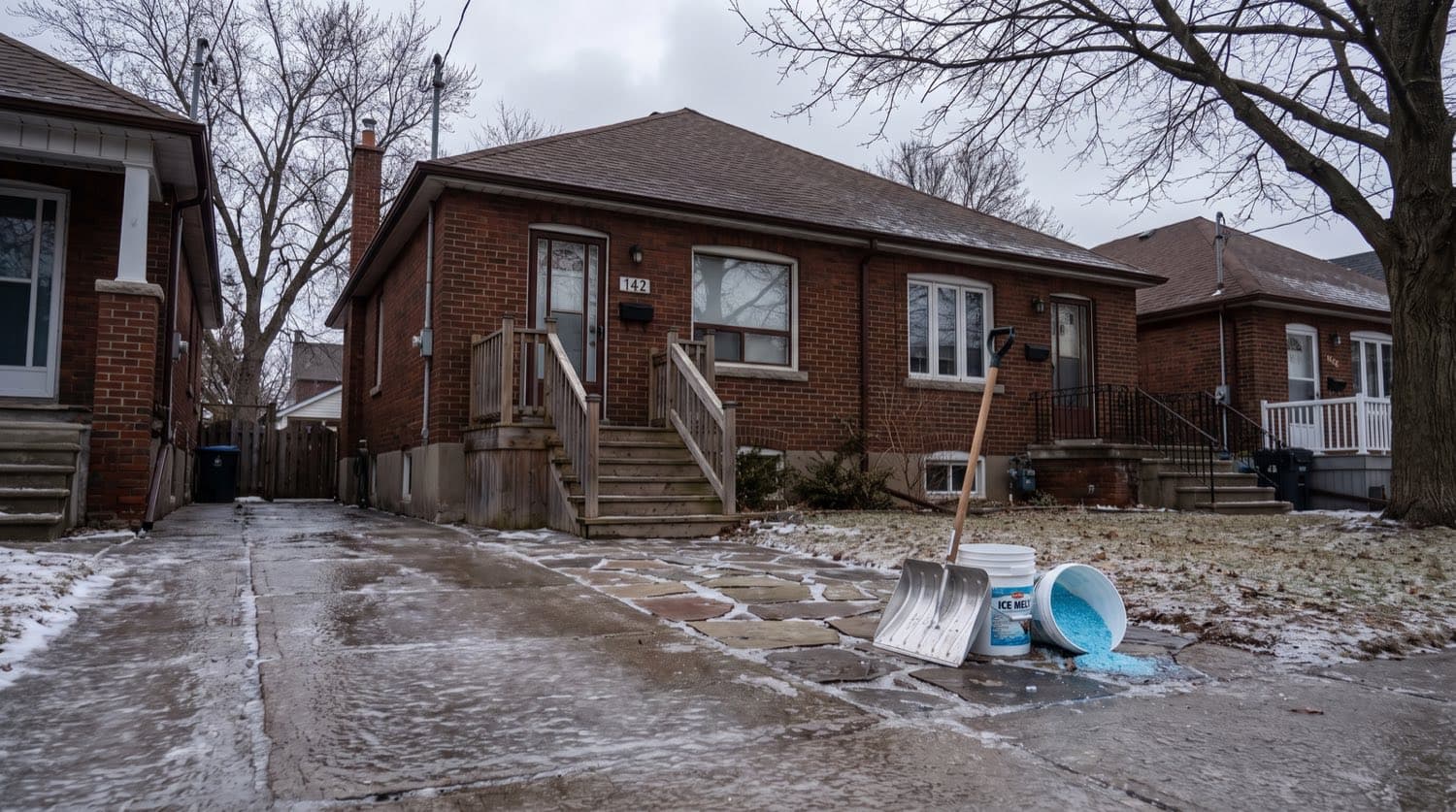
Answer First: In Ontario, the occupier, the owner or tenant in control of a property, is generally liable for a slip on that property, because the Occupiers' Liability Act requires them to take reasonable care to keep people safe. Since 2021, an injured person must give written notice within 60 days of a snow or ice fall before they can sue. In Toronto, owners must clear their private property within 24 hours and the adjacent public sidewalk within 12 hours when snow is under 2 cm and the City has not cleared it.
Someone slips on the ice outside your house. Whether that becomes your problem depends on two things most homeowners never think about until it happens: whose property it was, and a 60-day clock that starts ticking immediately. This is general information, not legal advice, but knowing the rules keeps you on the right side of them.
Who is liable for a slip on ice in Ontario?
The occupier of the property, in most cases. Ontario's Occupiers' Liability Act puts a duty on whoever is in control of a property, usually the owner or tenant, to take reasonable care that people on it are reasonably safe. In winter, "reasonable care" means clearing snow and treating ice within a sensible time, not leaving a sheet of ice on the front steps for days.
So if a visitor, a delivery worker, or a guest slips on your un-cleared driveway or walkway, you can be held responsible. The key phrase is reasonable care: you do not have to guarantee a perfectly ice-free surface at every instant, but you do have to act reasonably to manage the hazard.
Quotable: Under Ontario's Occupiers' Liability Act, the person in control of a property must take reasonable care to keep visitors reasonably safe, which in winter means clearing and salting icy walkways within a reasonable time (Occupiers' Liability Act).
The 60-day notice rule changed everything
This is the part that surprises people, injured and owners alike. Since January 2021, anyone hurt by snow or ice must give written notice within 60 days of the incident before they can bring a lawsuit. The notice must go to the occupier, and to any snow-removal contractor the occupier used, and it must state the date, time, and location of the fall.
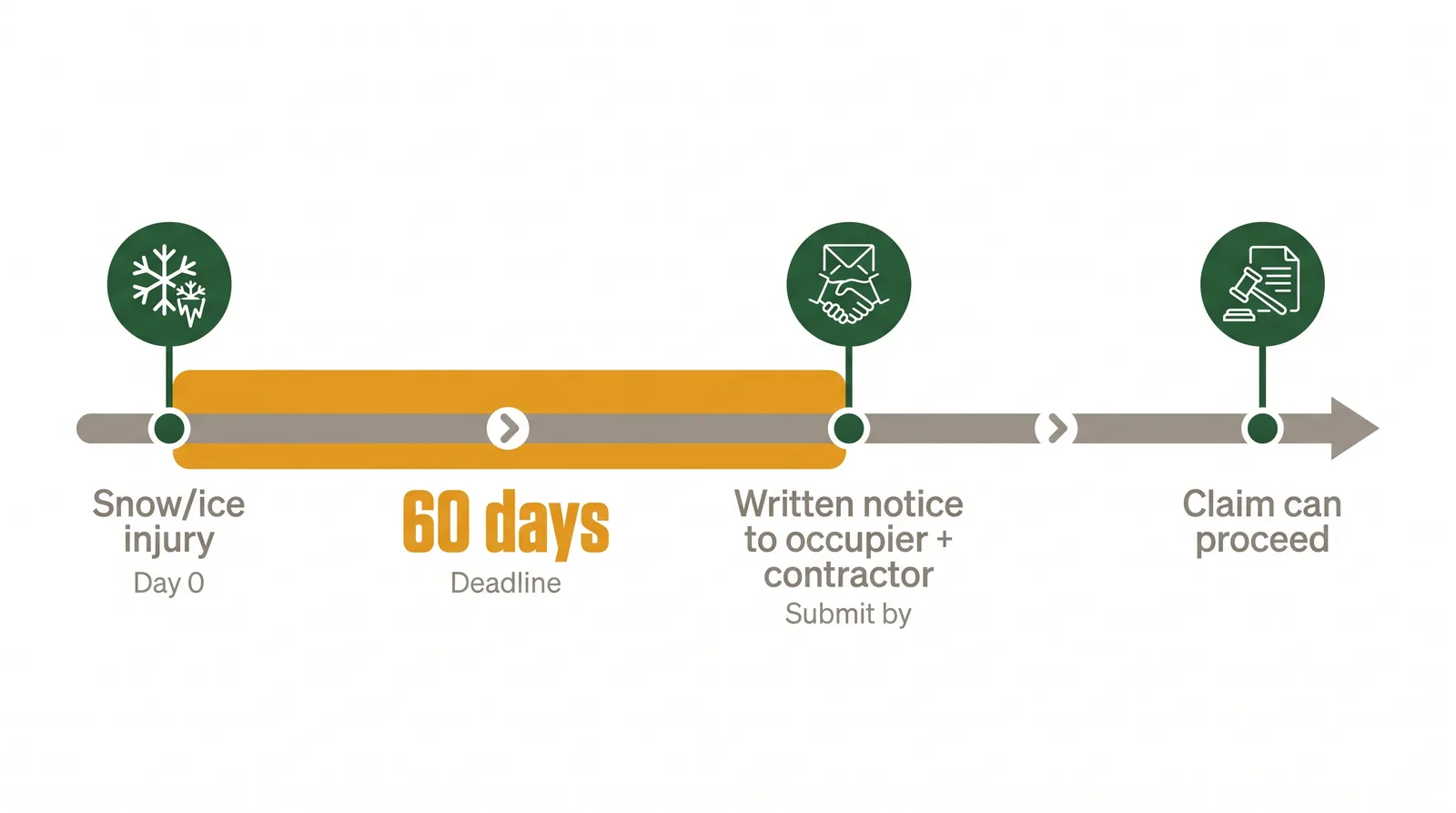
Miss the window and the claim can be barred entirely, with narrow exceptions for death or where a court finds a reasonable excuse and no prejudice to the defence. The rule was added to give occupiers and contractors a fair chance to investigate while conditions are still fresh. For property owners, it is a reason to document when your property was cleared and salted, because that record is your evidence if a claim ever comes.
Quotable: Since 2021, an Ontario snow-or-ice injury claim requires written notice to the occupier and any snow contractor within 60 days of the fall. Miss it and the claim can be barred outright (Occupiers' Liability Act).
What are your clearing duties in Toronto?
They split by where the snow is, and the City has taken over most of the sidewalks. Here is the responsibility map for a Toronto property owner.
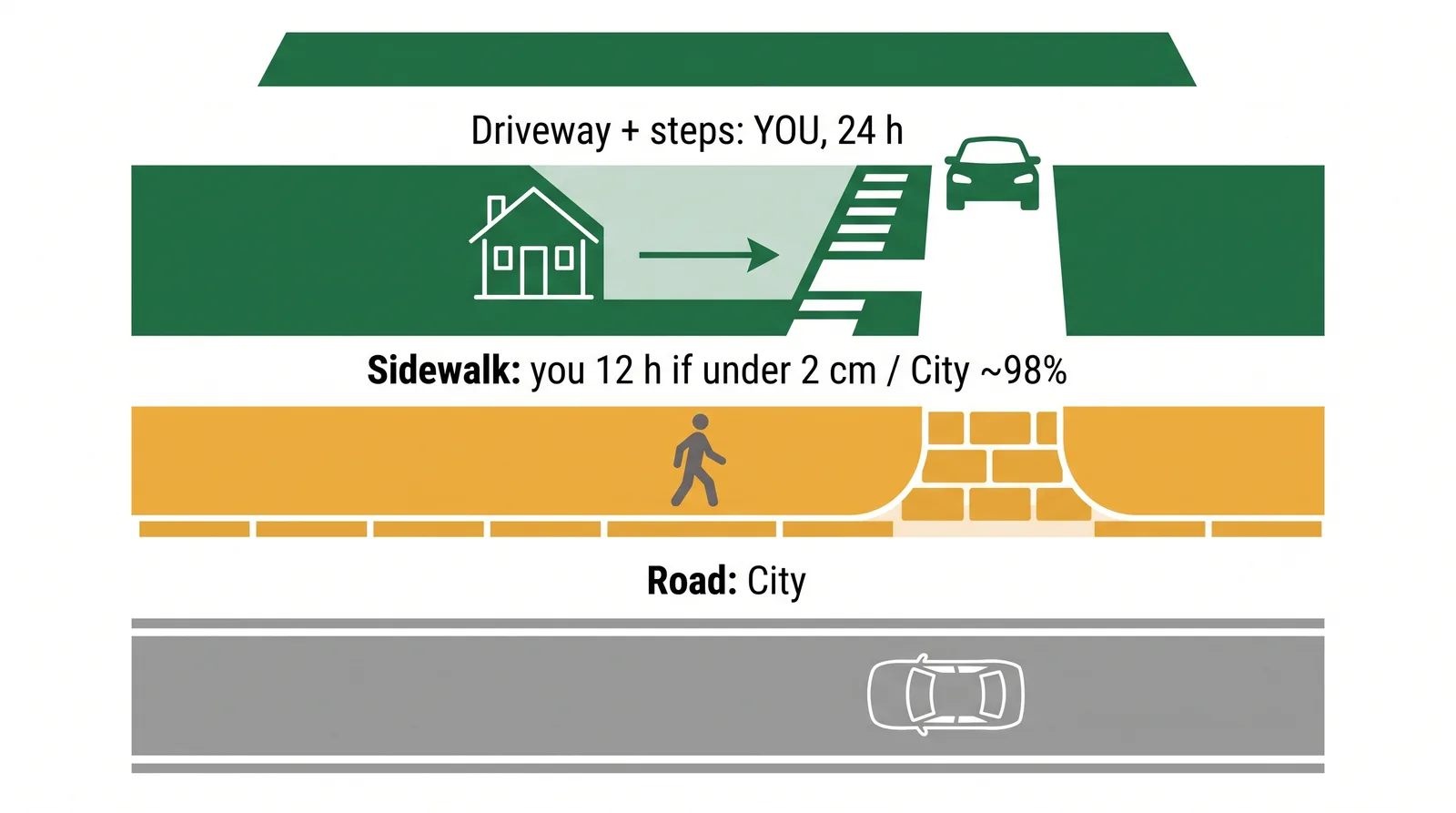
| Area | Who clears it | Time limit |
|---|---|---|
| Your driveway, steps, walkway | You (the owner) | Within 24 hours of snowfall end |
| Adjacent public sidewalk (under 2 cm) | You, if the City has not cleared it | Within 12 hours of snowfall end |
| Public sidewalks (2 cm or more) | City of Toronto | City clears ~98% mechanically |
| The road | City of Toronto | City program |
The City now clears roughly 98% of Toronto sidewalks mechanically, which has changed the picture, but it does not remove your duty on your own property or on the light-snow days the City may not service. Note too that pushing your shovelled snow onto the road, a sidewalk, or a bike lane is its own offence, carrying a $500 fine plus a $110 victim surcharge (City of Toronto).
From the data: YardQuote tracks 194 snow removal companies across the GTA. Beyond convenience, a professional contract on a documented schedule is part of a reasonable-care record, and under the 2021 rules an injured person must serve notice on that contractor too, which is exactly why keeping proof of service matters.
How do you protect yourself?
Clear reliably, treat ice, and keep records. The strongest protection is simply doing the work: clear your driveway, steps, and walkway within the time limits, salt or sand the icy patches, and do the adjacent sidewalk when it falls to you. If you travel or cannot keep up, a snow-removal contract on a dependable schedule both keeps the property safe and builds the documented routine that shows reasonable care.
To compare seasonal versus per-visit clearing, read our snow removal pricing guide and pick the right de-icer for the conditions in salt versus ice melter. To line up a pro, see the snow removal cost page or browse snow removal companies by area. For a claim or a specific dispute, talk to a lawyer, since this article is general information only.
Want the driveway and walkways cleared on a reliable schedule all winter? Request a quote and compare up to three vetted local pros side by side. Your contact details only go to the one you pick.