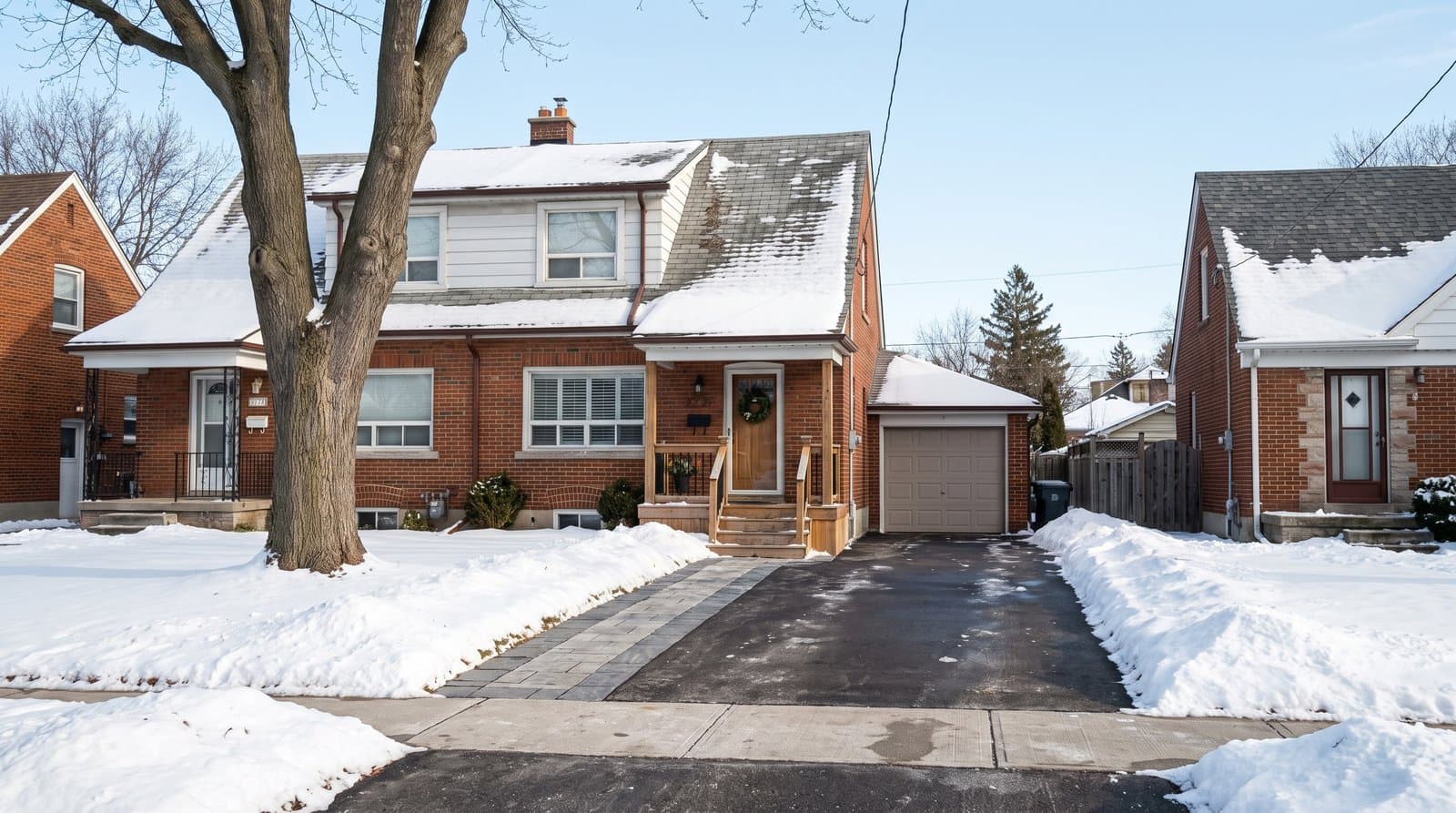
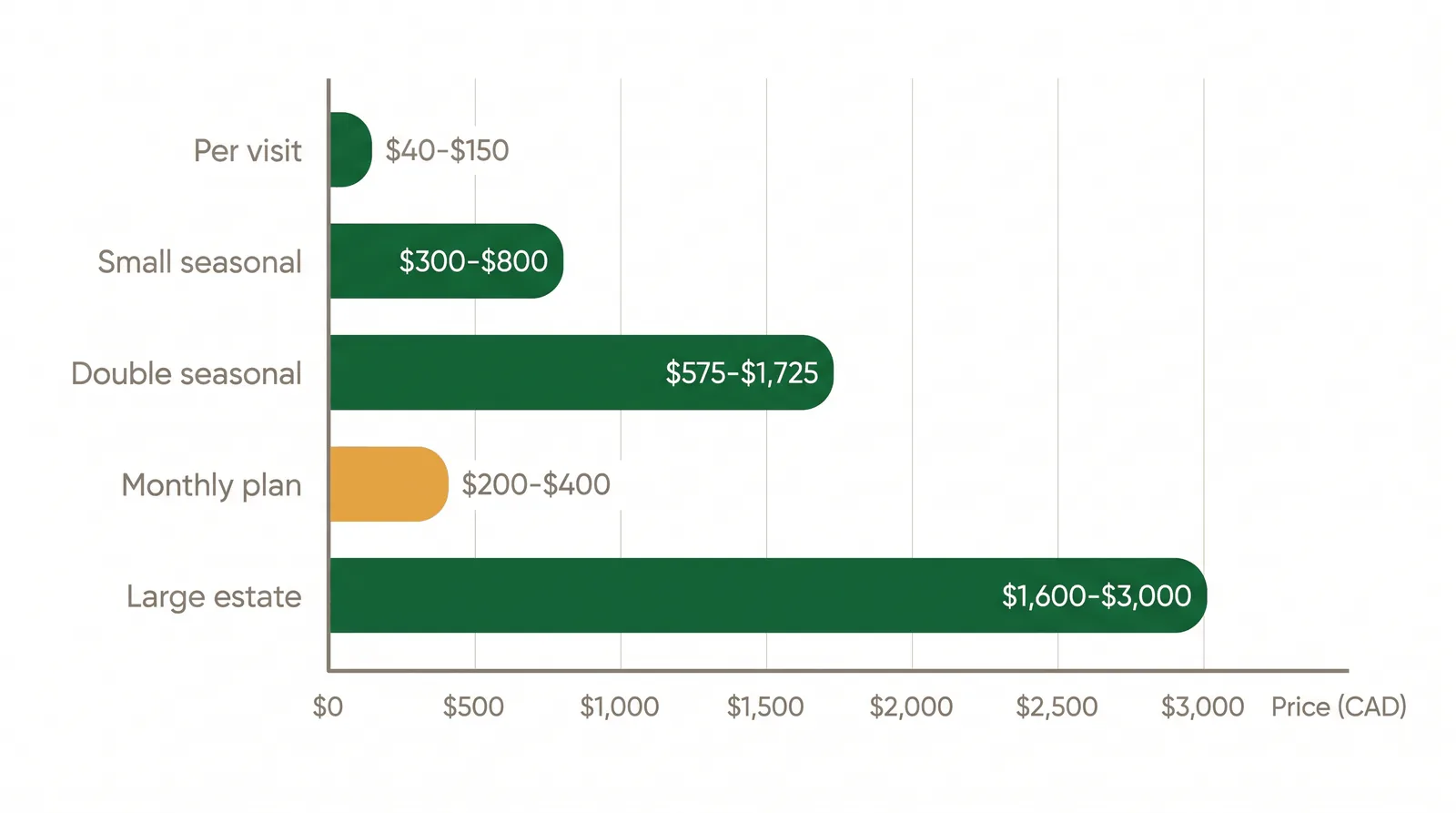
Answer First: For a standard double driveway in Toronto, an all-inclusive seasonal contract runs $575 to $1,725 for the winter (Absolute Home Services), while per-visit clearing runs $40 to $150 each time (HomeStars). Because a normal Toronto winter brings 15 to 25 plowable events, per-visit billing at $50 to $150 a clearing can add up to $750 to $3,750, which is why a seasonal contract is the safer bet in most years.
It is July, which is exactly when the smart booking happens. The homeowners who overpay are the ones who call a plow company after the first December storm, when the early-bird windows have closed and every good operator is already full. Below is what the two pricing models actually cost, and the arithmetic to decide which one fits your driveway before you sign anything.
What does snow removal cost in Toronto this winter?
Prices depend on your driveway size and what the contract includes, but the ranges below cover the GTA residential market for the 2026-27 season. Every figure is quoted before Ontario's 13% HST, which most contractors advertise as a "plus HST" price, so confirm whether a competing quote is tax-in before you compare.
| Service | Price range | Typical | Unit | Source |
|---|---|---|---|---|
| Seasonal, small single-car driveway, plow-only | $300 to $800 | $500 | per season | Cahill Landscaping |
| Seasonal, standard double driveway, all-inclusive (Nov to Mar) | $575 to $1,725 | $1,000 | per season | Absolute Home Services |
| Seasonal, large/estate driveway (4+ cars) | $1,600 to $3,000 | $2,200 | per season | Silverlight Windows & Eaves |
| Premium flat-rate package, unlimited visits over 1 cm, salting included | $499 to $949 | $499 | per month + HST | Monster Plowing Company |
| Per-visit driveway and walkway clearing | $40 to $150 | $75 | per visit | HomeStars |
| Residential monthly plan (about 4 to 6 visits/month) | $200 to $400 | $300 | per month | Outwash |
| Salting/de-icing add-on | $20 to $100 | $40 | per application | Outwash |
| Townhouse complex (shared drives, common walkways) | $85 to $175 | $130 | per visit | Absolute Home Services |
| Apartment/condo building (full service) | $2,300 to $5,750 | $4,000 | per season | Absolute Home Services |
The word "seasonal" is doing a lot of quiet work in that table, and it is the main reason published ranges look like they contradict each other. A budget plow-only contract, a full all-inclusive contract with salting, and a premium monthly-billed unlimited-visit package are three different products wearing the same name. That gap is the whole reason the seasonal-versus-per-visit question has a real answer instead of a shrug.
Seasonal contract or per-visit: which is cheaper for your driveway?
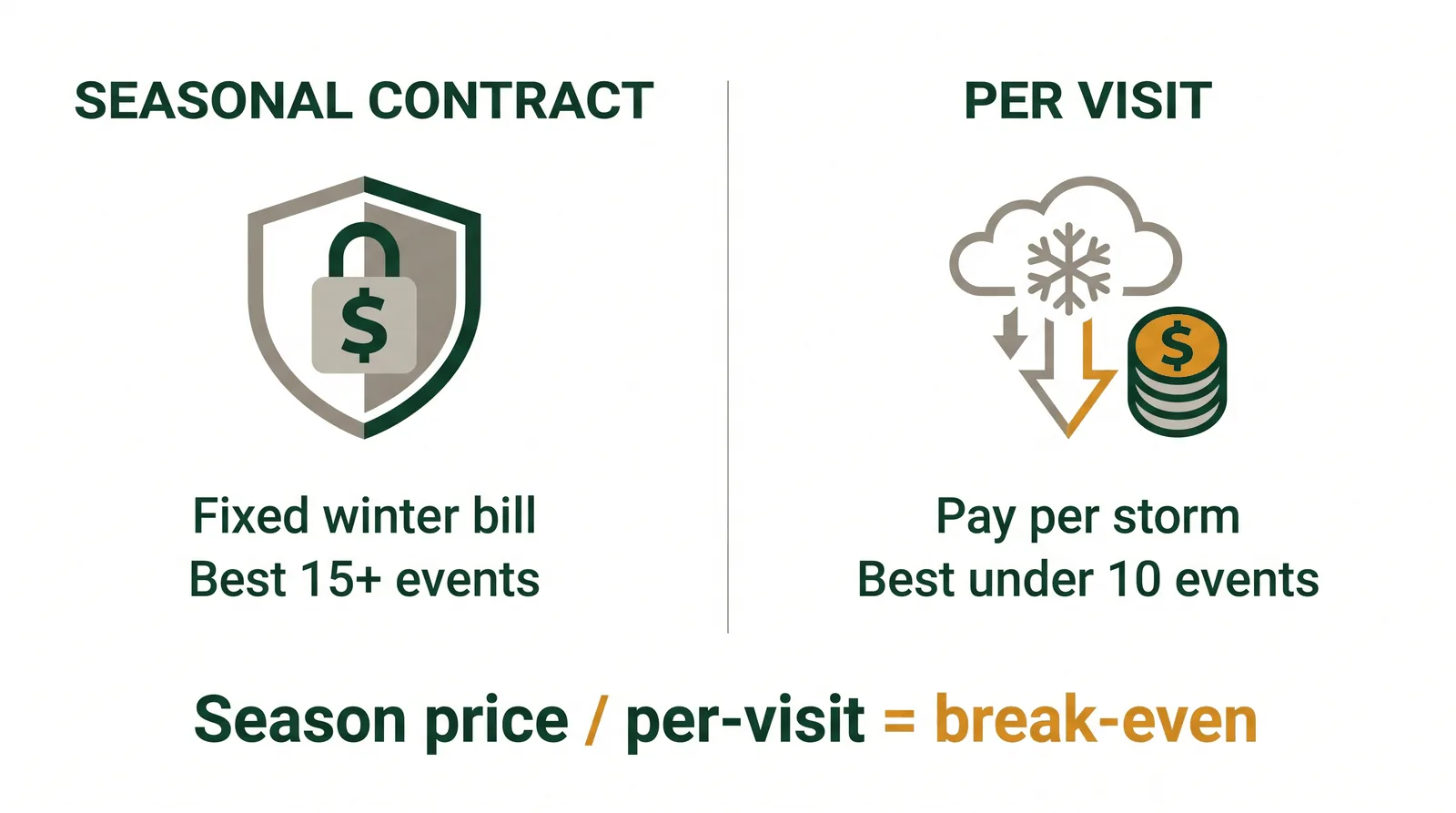
Start with one division problem. Take the seasonal price you have been quoted and divide it by the per-visit rate. That gives you the break-even number of clearings, the point where the contract and pay-as-you-go cost the same.
A cheap all-inclusive double-driveway contract at $575, divided by a typical $75 per visit, breaks even at about 8 clearings. A pricier $1,725 contract breaks even at about 23 clearings. Now compare that to reality: a normal Toronto winter brings 15 to 25 plowable events (Monster Plowing's 2026-27 guide). For most homeowners, the season blows past the break-even point, so the contract wins.
Quotable: A normal Toronto winter brings 15 to 25 plowable events, so per-visit clearing at $50 to $150 each can total $750 to $3,750, more than most seasonal contracts cost for the same driveway.
Per-visit billing only comes out ahead in a genuinely mild winter, roughly under 8 to 10 clearings. There is a second catch that the raw per-visit rate hides: storm surcharges. On most pay-per-visit plans, snowfalls of 15 cm or more are billed at 1.5 to 3 times the normal rate, and emergency, overnight, or weekend callouts carry a 25 to 40% premium (Snow Polar). One bad February can wipe out a mild winter's savings in a single week. Flat-rate seasonal contracts absorb that risk instead of passing it to you.
Here is the decision in plain terms.
| Your situation | Cheaper option | Why |
|---|---|---|
| You expect a normal or heavy winter (15+ events) | Seasonal contract | You clear the break-even count and dodge storm surcharges |
| You want a fixed, predictable winter bill | Seasonal contract | No surprise invoices after a blizzard |
| You get very little snow or travel all winter | Per-visit | You pay only for the storms you are home for |
| You can shovel light snow yourself and only want help on big dumps | Per-visit | You skip the base cost and pay for the few heavy events |
For the average Toronto homeowner who parks two cars and does not want to be shovelling at 6 a.m., the seasonal contract is the rational pick in any winter that is not unusually mild.
What is actually included in a seasonal snow contract?
Two contracts at the same price can deliver completely different service, so read the fine print before the price. The features that move the cost are trigger depth, response time, and inclusions.
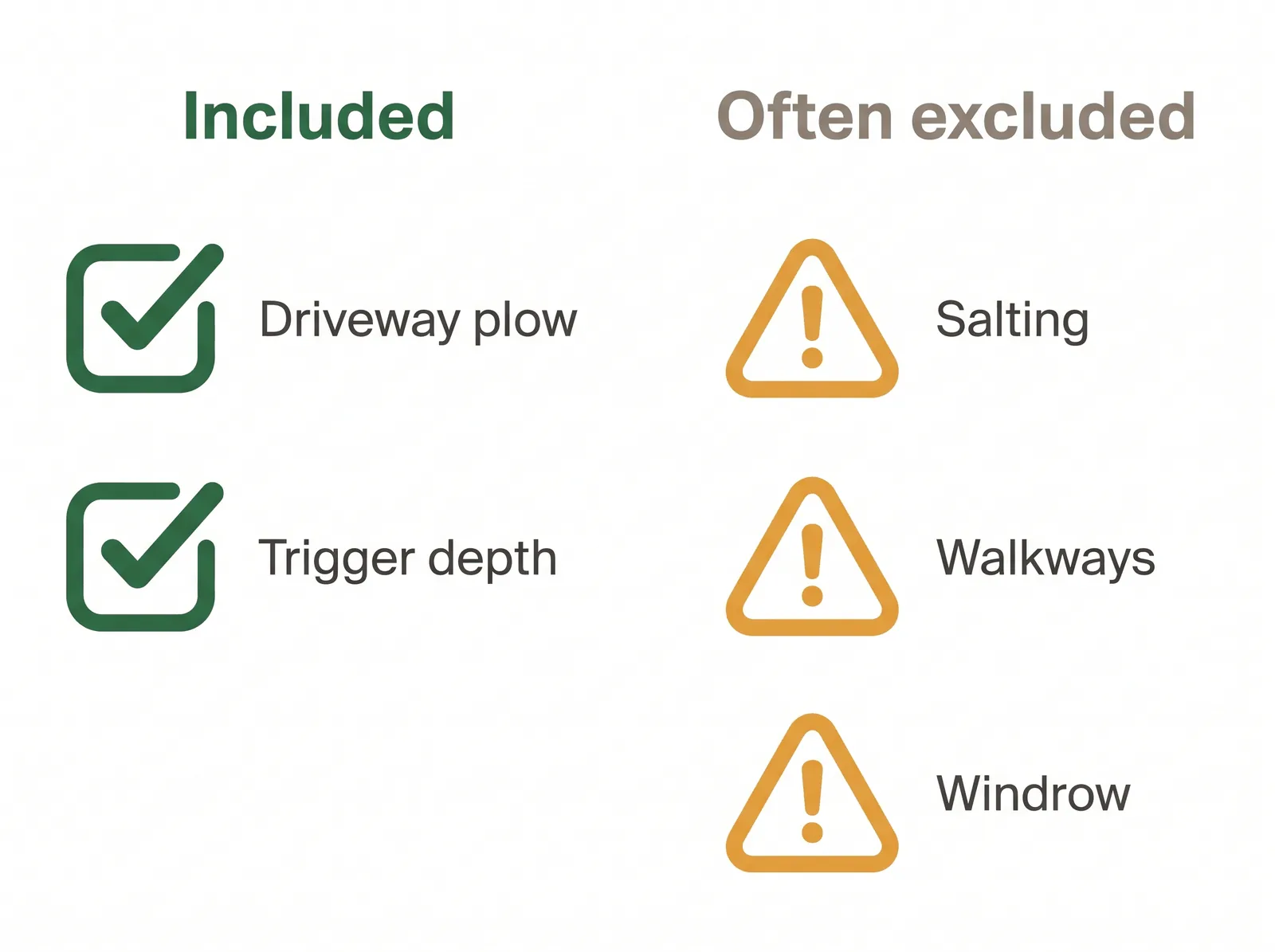
Trigger depth is the snow accumulation that starts a visit. A contract that clears at 1 cm guarantees far more visits than one that waits for 5 cm, which is why the low-trigger version costs substantially more. Response-time guarantee is the second lever: priority service before 6 a.m. can cost nearly double the standard rate. At one GTA operator, priority runs $949 per month against $499 for standard before-9-a.m. service (Monster Plowing). If you leave for work at 9, you are paying for speed you do not use.
Then there are the add-ons that budget contracts quietly leave out:
- Salting or de-icing, $20 to $100 per application if billed separately (Outwash).
- Walkway hand-clearing, often excluded from plow-only contracts.
- Windrow clearing, the hard-packed ridge the city plow leaves across the end of your driveway.
- Snow hauling off-site, $100 to $300 per truckload, which downtown lots with nowhere to pile snow sometimes need (Outwash).
Corner lots pay more, since they have more frontage to clear. One operator quotes $250 to $650 per month for corner properties (Silverlight). If you want the full picture on what pushes any landscaping or clearing quote up or down, our note on why landscaping quotes vary so much in Toronto covers the same forces that drive the threefold spread you see in snow pricing.
From the data: YardQuote tracks 194 snow-removal companies across 36 GTA areas, and 169 of them carry a Google rating with at least three reviews. Their average rating is 4.6 stars, 70% sit at 4.5 stars or higher, and the median rated company has about 20 reviews (YardQuote's own tracking, July 2026). Translation: a well-reviewed, insured operator is the norm in this market, not a rarity, so there is no reason to gamble on an uninsured cash plow to save a few dollars.
What Toronto snow bylaws mean for your contract
Your contract does not cancel your legal duties as a property owner, so the two need to line up. In Toronto, you must clear snow and ice from the public sidewalk next to your property within 12 hours after a snowfall ends, and private driveways, steps, and ramps within 24 hours, or face fines of roughly $150 to $500 plus a victim surcharge (City of Toronto). If a contract does not include your walkway, that 12-hour clock is still yours to beat.
Quotable: In Toronto it is illegal to push or blow snow from your property onto the road, sidewalk, or bike lane. The set fine is $500 plus a $110 victim surcharge, so a legitimate contractor must pile snow on your property or haul it away.
Two more local facts change what you should ask for. First, windrow clearing: the City clears the plow-left ridge across the driveway for about 262,000 households in North York, Scarborough, and Etobicoke, but in old Toronto and East York it is the homeowner's problem. If you live downtown, confirm windrow clearing is in your contract, because many budget deals exclude it. Second, insurance: under Bill 118, the Occupiers' Liability Amendment Act, a slip-and-fall claim involving snow or ice requires written notice to the occupier or their snow contractor within 60 days. The claims that followed pushed contractor liability premiums up, which is a structural reason GTA prices keep climbing. Verify your contractor carries commercial general liability insurance before you sign.
How do you get a fair snow removal quote?
The trap is comparing two numbers that were never measuring the same thing. Normalize before you choose.
- Match the trigger depth. A 1 cm contract and a 5 cm contract are different products. Ask each company for the same trigger.
- List the inclusions the same way. Salting, walkway hand-clearing, and windrow clearing either belong in the price or they do not. Get all three answered.
- Confirm HST. Snow removal is fully taxable in Ontario. A "plus HST" quote is 13% higher than it looks next to a tax-in quote.
- Get at least three written quotes. The spread on the same driveway is often threefold, and the midpoint usually reflects a properly insured operator rather than the cheapest cash job.
- Book early. Early-bird pricing typically closes mid-October. One large GTA operator sets its 2026-27 early-bird deadline at October 15, and Toronto snow prices rose about 8 to 12% in 2025 on fuel, labour, and insurance costs, so locking in early also hedges further increases.
If you have neighbours on the same street, ask about a group rate. Many GTA operators discount 10 to 20% for multiple adjacent driveways, since drive time between jobs is their biggest cost.
When you are ready to line up real numbers for your address, our Toronto snow removal cost guide has the full pricing breakdown, and the snow removal directory lets you filter GTA pros by area and rating. If you are budgeting the rest of the yard for spring, the same logic on inclusions and quote-normalizing applies to sod installation cost in Toronto.
Want to know what snow clearing should cost for your driveway this winter? Request a quote and compare up to three vetted local pros side by side. Your contact details only go to the one you pick.