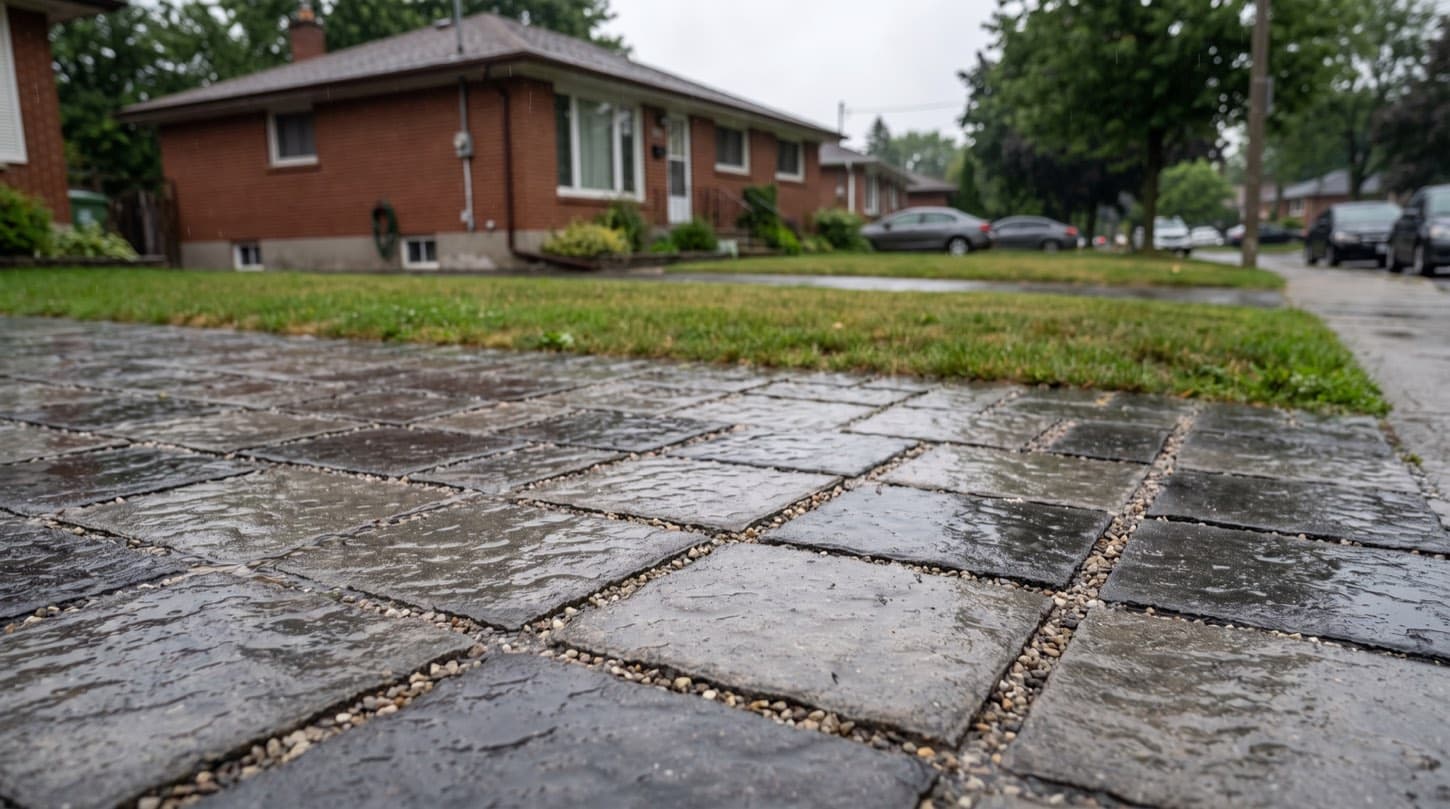
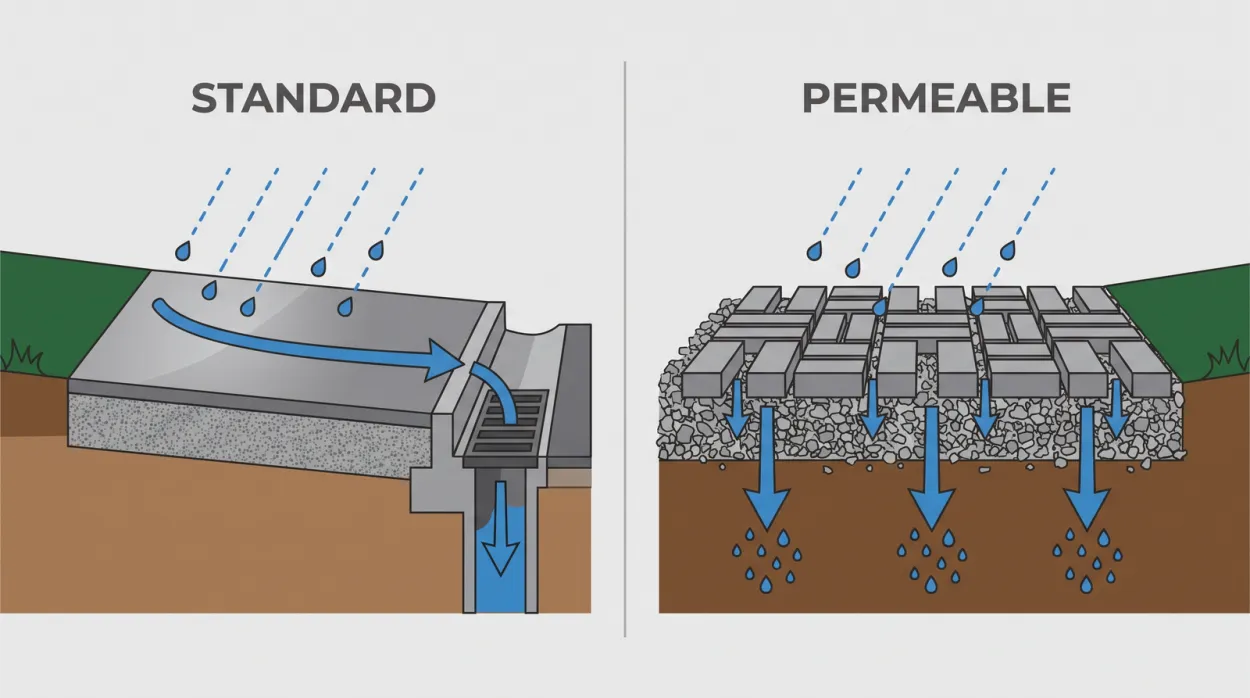
Answer First: Permeable pavers are laid with open joints filled with clean stone so rain soaks through into a gravel reservoir underneath instead of running off to the street. That fits exactly where Toronto's stormwater rules are heading: the City wants rain managed where it falls, restricts new hard surfaces on front yards, and requires most owners to disconnect downspouts onto their own lot. On Toronto's heavy clay soil they work, but only with a deep open-graded base designed for it.
Standard pavers shed water. In a city with aging combined sewers and a growing basement-flooding problem, that's increasingly the wrong default — and Toronto's rules are quietly steering homeowners away from it.
What makes a paver "permeable"?
The joints and the base, not the paver itself. A conventional patio uses fine or polymeric sand to seal the joints so water runs off. A permeable system does the opposite on purpose.
Permeable interlocking concrete pavement (PICP) — pavers laid with wider joints filled with small, clean, washed stone, sitting on a deep bed of open-graded (single-size) crushed stone. Rain drains through the joints into that stone reservoir, is stored there, and soaks slowly into the ground below.
So a permeable driveway is a solid, drivable surface that behaves like a sponge. It's the deliberate opposite of the sealed joint you want on a standard patio — where, as our guide to weeds between pavers explains, polymeric sand is chosen precisely because it keeps water out.
Quotable: A permeable paver driveway is a solid surface that drains like a sponge. Rain soaks through open, stone-filled joints into a gravel reservoir underneath, instead of sheeting off to the curb.
How do permeable pavers fit Toronto's stormwater rules?
They line up with a clear direction: manage rain where it lands. Toronto's green infrastructure program is built around handling rainwater at its source with tools like permeable pavement, and the City has been tightening how much hard, impervious surface a property can add — especially on front yards and driveway widenings.
The rule most homeowners actually meet is downspout disconnection. Under Toronto's mandatory downspout disconnection requirement, most property owners must disconnect roof downspouts from the sewer and direct that water onto their own lot — away from the foundation and off the neighbour's property and the sidewalk. During heavy rain, the City notes, overloaded sewers raise the risk of basement flooding, which is the whole reason for keeping water on site.
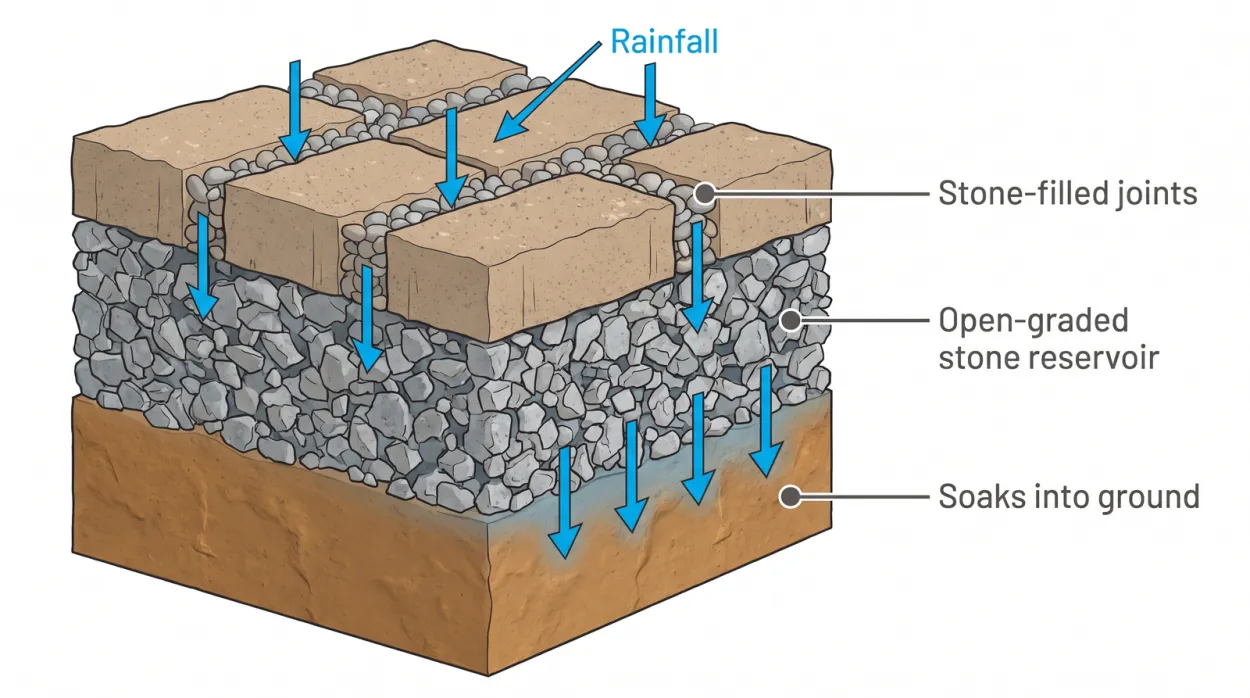
A permeable driveway or parking pad gives all that redirected water somewhere to go. That's why the City's stormwater push and permeable pavers keep showing up in the same conversation, and why permeable surfaces are one accepted way to add parking without simply adding runoff.
Do they work on Toronto's clay soil?
Yes, with the right design — and this is the local catch. Much of the GTA, especially Scarborough and North York, sits on heavy clay that drains slowly. Drop a permeable system onto clay with an ordinary base and water can pond in the reservoir with nowhere to go.
Built for clay, it works: a deep open-graded stone reservoir holds the water while it infiltrates slowly, and where the soil drains too poorly, an underdrain carries overflow to a safe outlet. The takeaway is that a permeable driveway in Toronto is an engineered build, not a standard patio with different sand. Getting the base and drainage right is the whole job.
From the data: Of the 503 interlocking contractors YardQuote tracks across the GTA, permeable installation is a genuine specialty, not every contractor's default. It's worth asking a bidder directly how they'll handle the open-graded base and the clay, because the pattern of complaints on permeable jobs is ponding from a base built like a regular driveway.
Are they worth it?
Depends on your lot and your goals. The honest ledger:
In favour:
- Less runoff and basement-flood risk, by keeping rain on your property.
- No puddles or sheet ice, since water drains down instead of pooling and freezing on the surface.
- Fits the City's direction on front-yard permeability and downspout disconnection.
Against:
- Higher cost than standard pavers, from the specialized base and jointing stone.
- Maintenance, since joints need occasional vacuuming so grit and debris don't clog them.
- Design dependency on Toronto clay — it must be built for the soil.
For a driveway that has to carry cars, pair permeability with the right layout — our guide to paver patterns explains why herringbone is still the strong choice even in a permeable build. Compare real GTA ranges on the interlocking cost page or browse interlocking contractors near you.
Thinking about a permeable driveway or parking pad? Request a quote and compare up to three vetted local contractors side by side — your contact details only go to the one you pick.