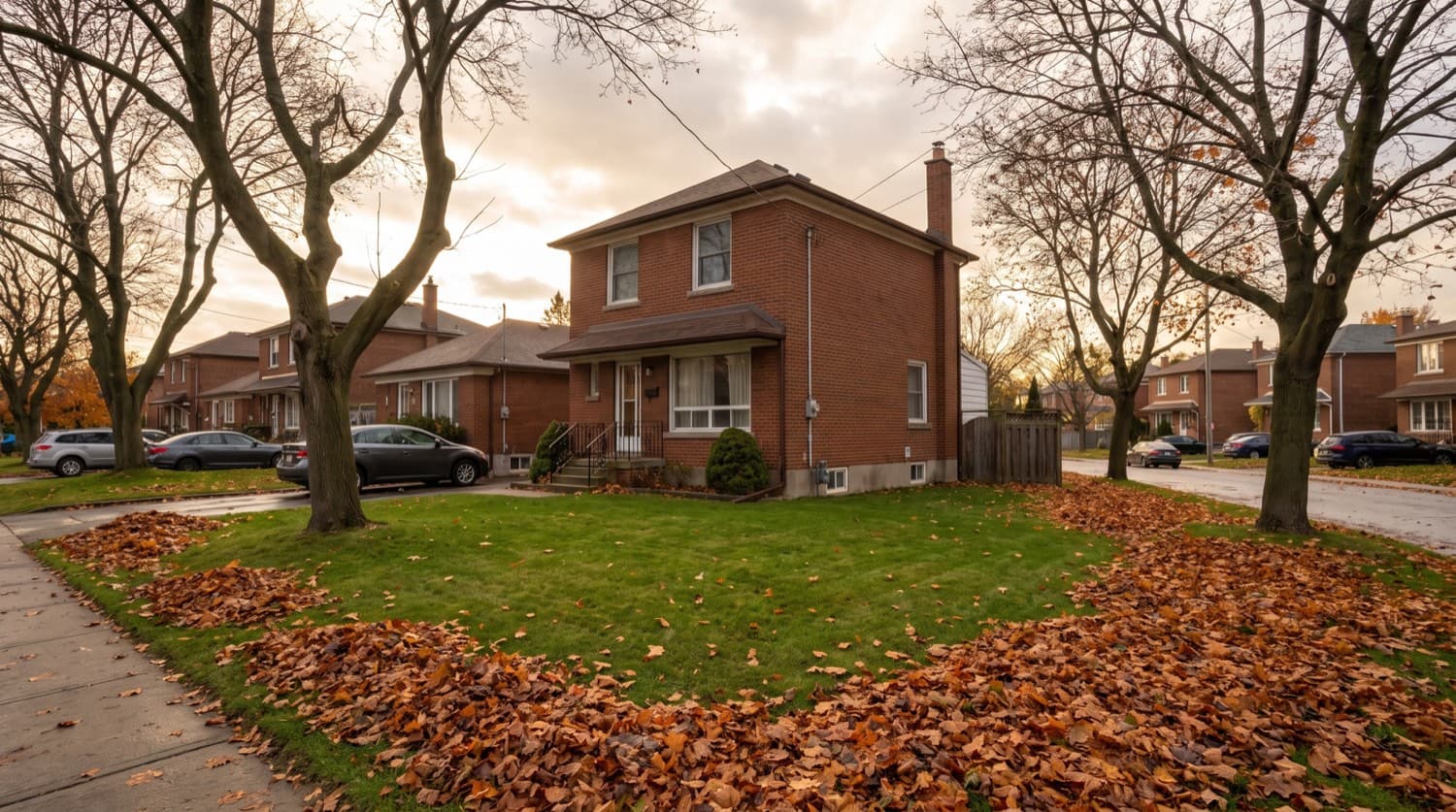
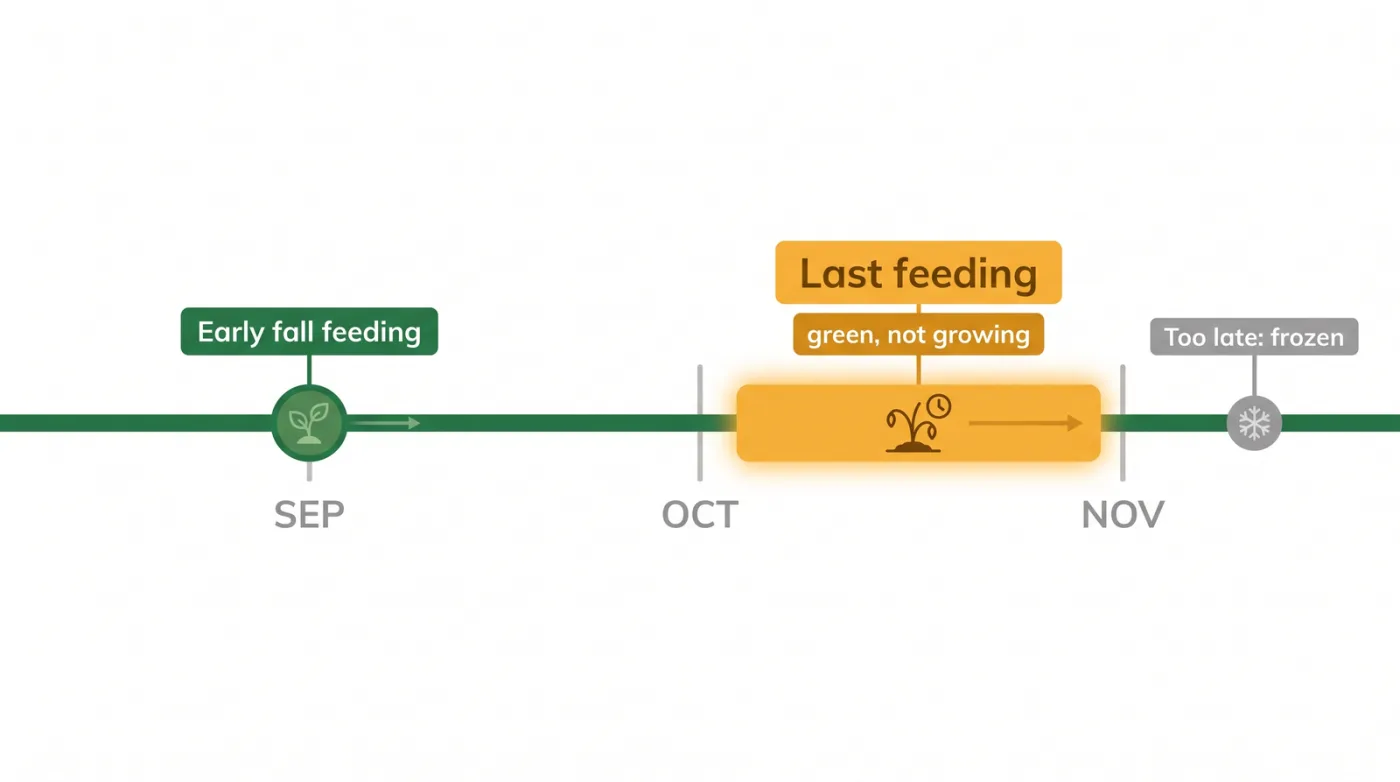
Answer First: Give your lawn its last feeding of the year in late fall — in Toronto, roughly late October to mid-November — when the grass is still green but has stopped growing enough that you've put the mower away. This late-fall feeding is the single most valuable one of the year: the nitrogen goes into roots and stored energy, driving an earlier, denser green-up the following April. Feed too late, on cold or frozen ground, and the roots can't use it.
Most homeowners fertilize hard in spring and forget the lawn by October. That is backwards. The feeding that actually decides how your lawn looks next April is the one you give it just before winter, and the timing window is narrower than a bag label suggests.
When is the last fall fertilizer feeding, exactly?
Read the grass, not the date. The target is the stretch when the lawn is still green but top growth has slowed to a stop — the point where you've mowed for the last time but the blades haven't gone dormant and brown. In the Toronto area that usually lands between late October and mid-November.
The science behind the window is about nitrogen uptake. Purdue turfgrass research recommends the last nitrogen application in early to mid-November for northern lawns, and warns that once temperatures sit only a few degrees above freezing, the roots stop taking nitrogen up. Toronto's cool-season grasses — Kentucky bluegrass, fescues, ryegrass — follow the same clock.
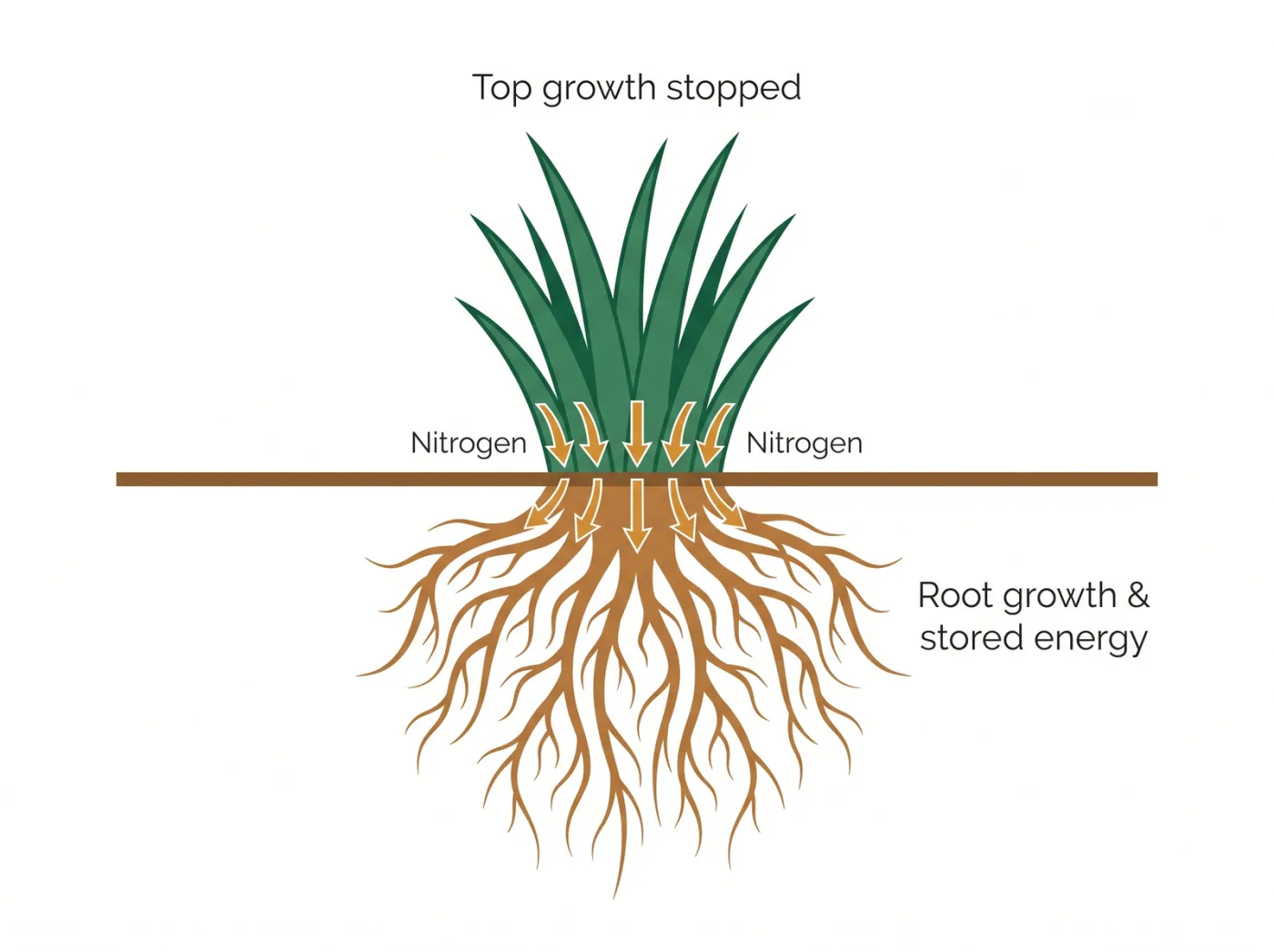
Quotable: The last lawn feeding of the year is the one that matters most. Applied in late fall while the grass is still green, nitrogen goes into root growth and stored energy, not blade growth — which is why a well-timed November feeding greens up faster the following April.
Why does late-fall nitrogen work when a spring feeding doesn't?
Because the plant does something different with it. In late fall, the grass has stopped pushing leaf growth, so nitrogen is redirected below ground. Purdue's turf specialists note that late-fall nitrogen "promotes good root development, enhances storage of energy reserves, and extends color retention," and that the payoff shows up the next spring as earlier green-up, better density, and improved tolerance to spring diseases.
A heavy early-spring feeding does close to the opposite. It buys a burst of fast, soft top growth that you then have to mow every four days, with little going to the roots. The late-fall feeding banks energy; the spring feeding spends it.
What fertilizer should I actually use?
Nitrogen is the nutrient that matters here, not the marketing on a "winterizer" bag. A lighter, quick-release nitrogen application of about 0.5 to 0.75 pounds of nitrogen per 1,000 square feet is the rate Purdue recommends for the last feeding.
Winterizer — a fertilizer marketed for fall use, usually blending nitrogen with extra potassium. The University of Minnesota Extension is blunt that if your lawn is not actually short on potassium, the added potassium does little, and nitrogen is the nutrient lawns use most readily. Most GTA lawns on ordinary soil don't need the potassium premium.
Quick-release nitrogen is preferred for this last feeding specifically because you want the lawn to use it now, before the ground closes for winter, rather than sitting in slow-release granules that release after the roots have shut down.
From the data: Of the 249 lawn-care companies YardQuote tracks across the GTA, fall visits cluster into a short late-October-to-November window for exactly this reason — the last feeding and the final cut happen on the same visit, and the good crews time it to the grass, not to a fixed date on a contract.
How do I know I've missed the window?
Look at the lawn and the ground. Three signs you're too late:
- The grass has gone dormant and brown. Once it's no longer green, it's no longer taking nitrogen up. Wait for spring.
- The soil is near freezing or crusted with frost each morning. Purdue warns that applications at these temperatures largely aren't used by the plant and the leftover nitrogen is prone to leaching.
- There's snow on the ground. Fertilizing frozen or snow-covered turf is the worst case — much of it runs off into storm drains instead of feeding anything.
Getting this feeding wrong in the other direction matters too. Nitrogen applied too early, or too heavily, pushes soft fall growth that is more prone to winter disease — including the matted patches of snow mold that show up in April. A moderate, well-timed late feeding is the safer play on both counts.
The last feeding is one piece of putting the yard to bed. Our guide to winterizing a Toronto garden covers the beds, shrubs, and evergreens, and you can compare real GTA rates for a fall lawn program on the lawn care cost page or browse lawn care companies near you.
Want a pro to time the last feeding and final cut for your lawn? Request a quote and compare up to three vetted local crews side by side — your contact details only go to the one you pick.