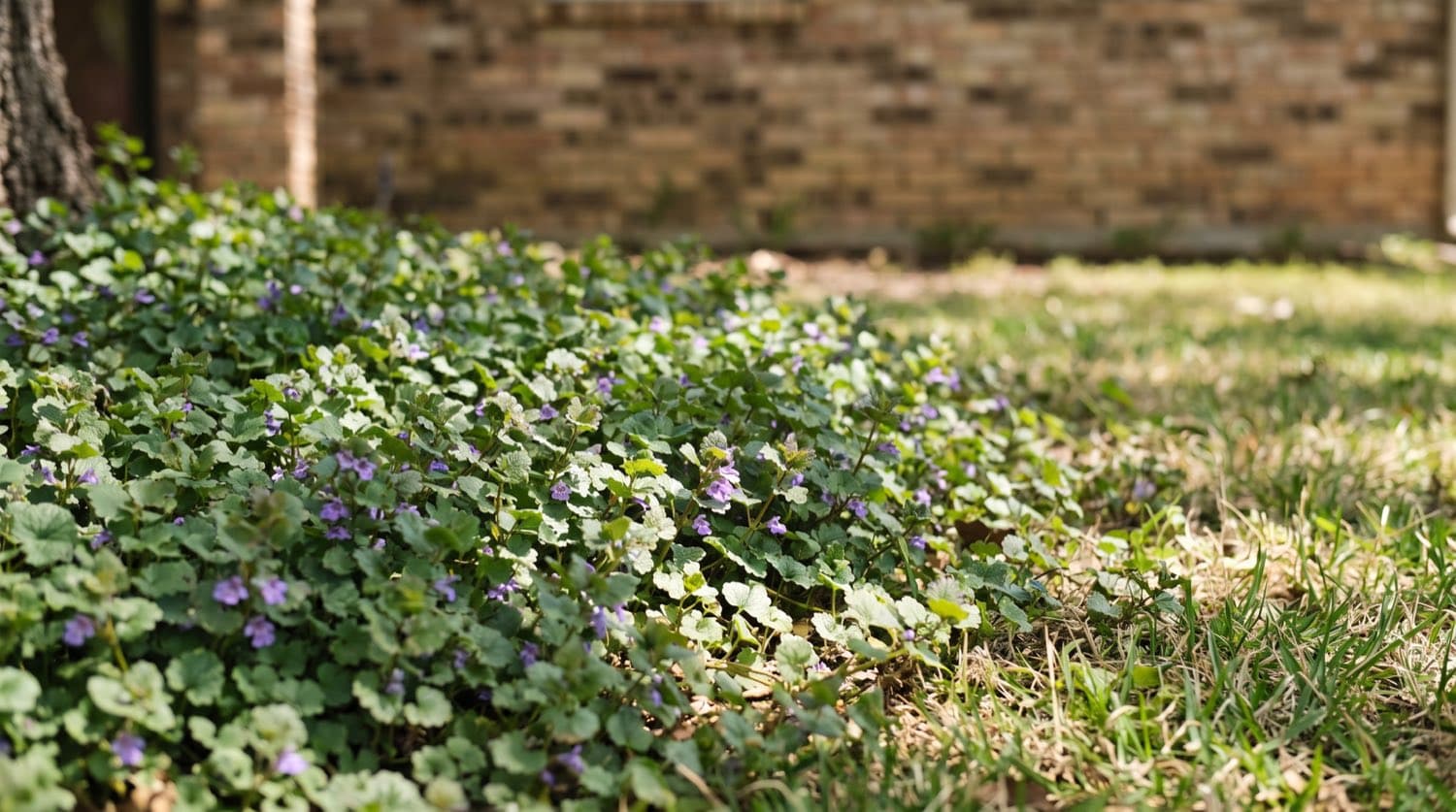
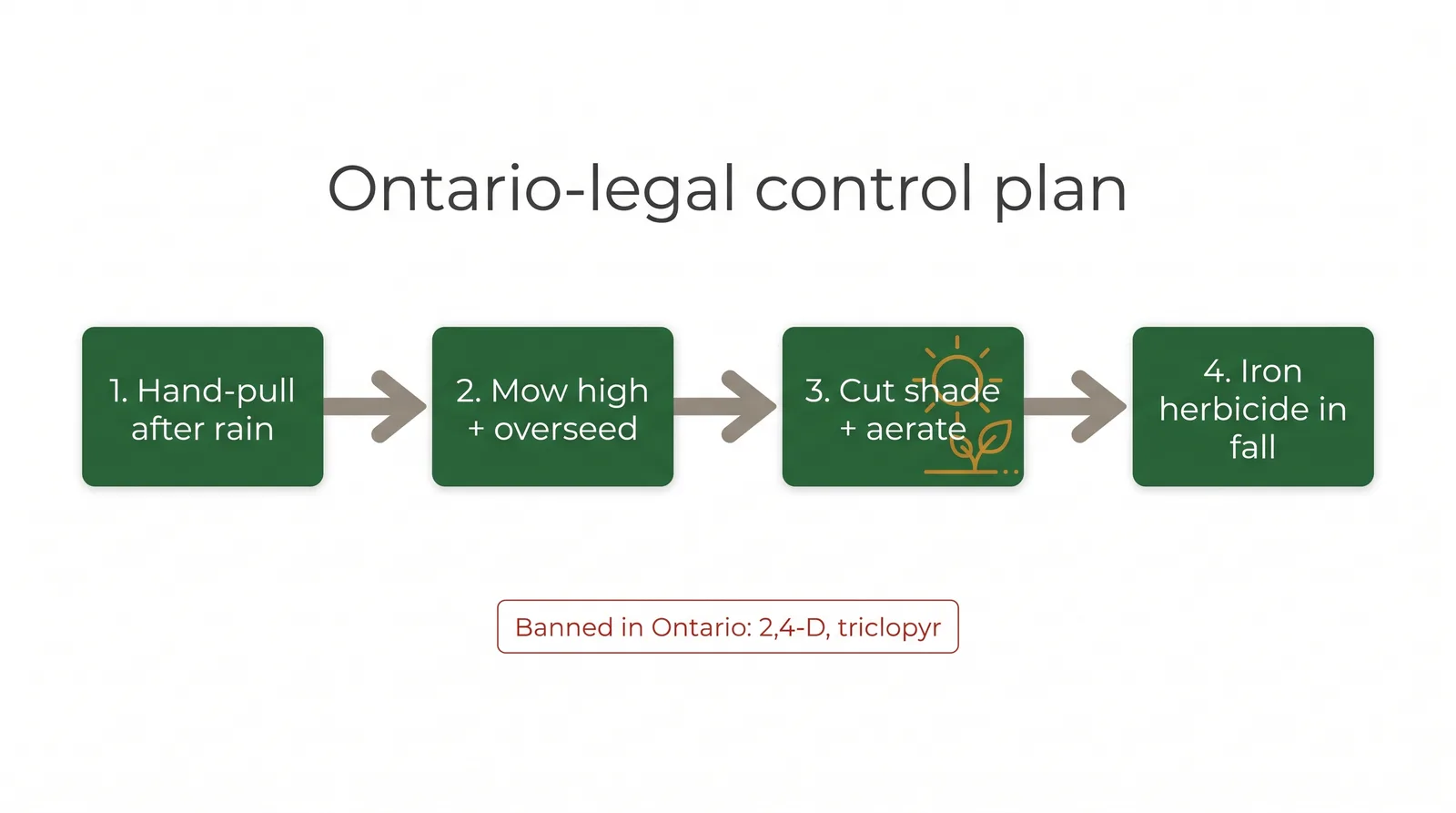
Answer First: Most creeping charlie guides tell you to spray 2,4-D or triclopyr, and both are banned for cosmetic lawn use in Ontario. What actually works here is legal and mostly cultural: hand-pull after rain, mow high at 2.5 to 3 inches, overseed to thicken the lawn, cut the shade and dampness it feeds on, and use an iron-based (FeHEDTA) herbicide in fall if you want a chemical assist. Creeping charlie is a symptom of a struggling lawn, so changing the conditions is the durable fix.
Search "how to kill creeping charlie" and nearly every result names a chemical you cannot legally buy for your lawn in Ontario. That is the trap. The good news is that creeping charlie is beatable without them, because it only took over where the grass was already losing.
Why is the usual creeping charlie advice illegal in Ontario?
Because Ontario's cosmetic pesticide rules ban the exact ingredients those guides recommend. Under the province's rules you cannot use 2,4-D, glyphosate, or triclopyr to kill weeds on a home lawn for looks (Ontario.ca), and those three are the backbone of almost every creeping charlie recommendation written for a US audience.
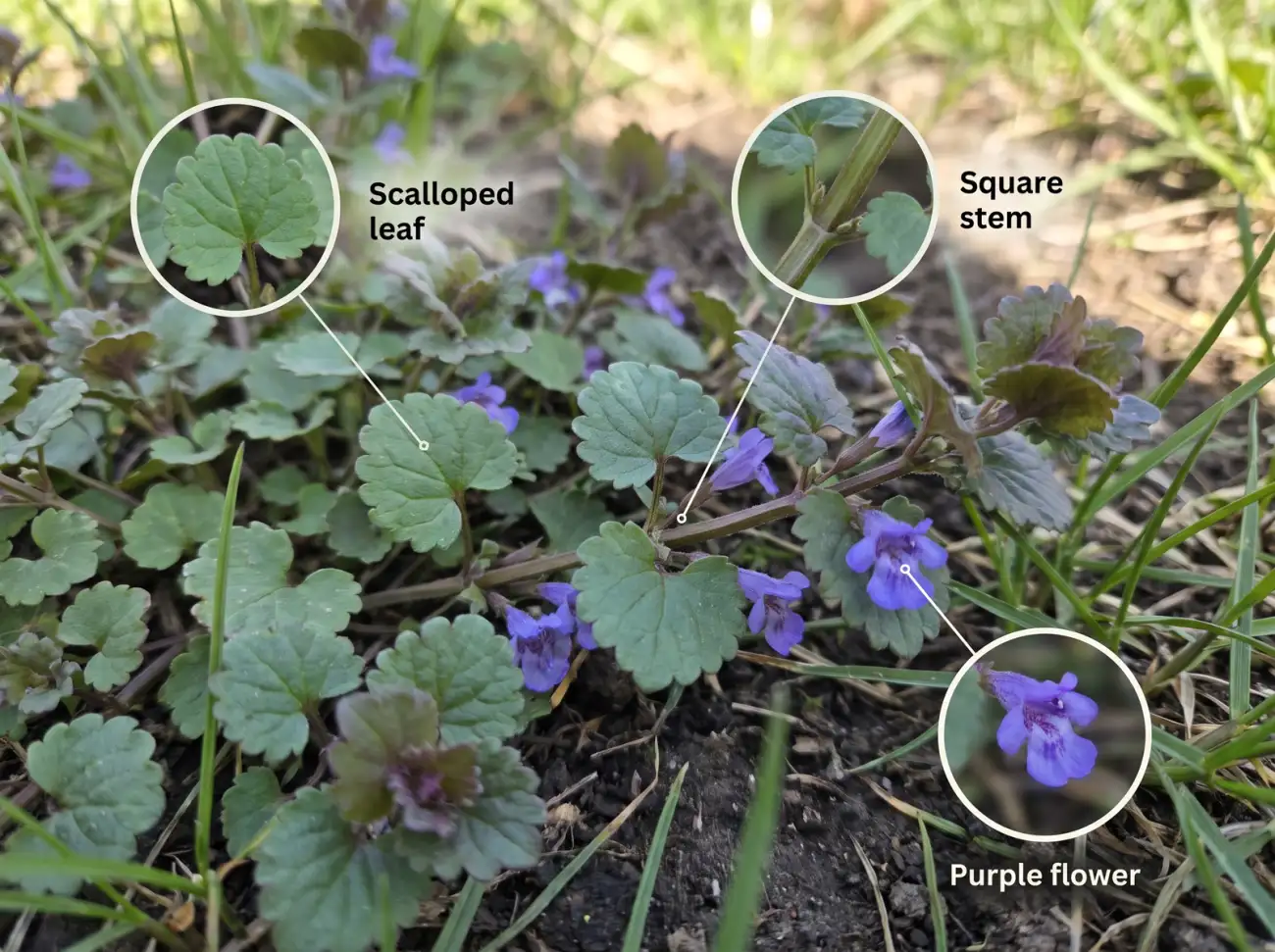
Creeping charlie (also called ground ivy, or Glechoma hederacea) — a low, perennial weed in the mint family with round, scalloped leaves, square stems, and small purple funnel-shaped spring flowers, which spreads across a lawn by creeping stems that root wherever they touch soil.
What Ontario does allow for lawns is a short list of lower-risk products: iron-based (FeHEDTA) herbicides, corn gluten meal, soap, sulphur, and a few others on the provincial allowable list. For a broadleaf weed like creeping charlie, the iron-based herbicide is the legal chemical option, and it works, but it is not a one-spray fix.
Quotable: Ontario's cosmetic pesticide rules ban 2,4-D, glyphosate, and triclopyr on home lawns, which are the exact ingredients most creeping charlie guides recommend. The legal chemical option here is an iron-based (FeHEDTA) herbicide.
Why does creeping charlie take over a lawn?
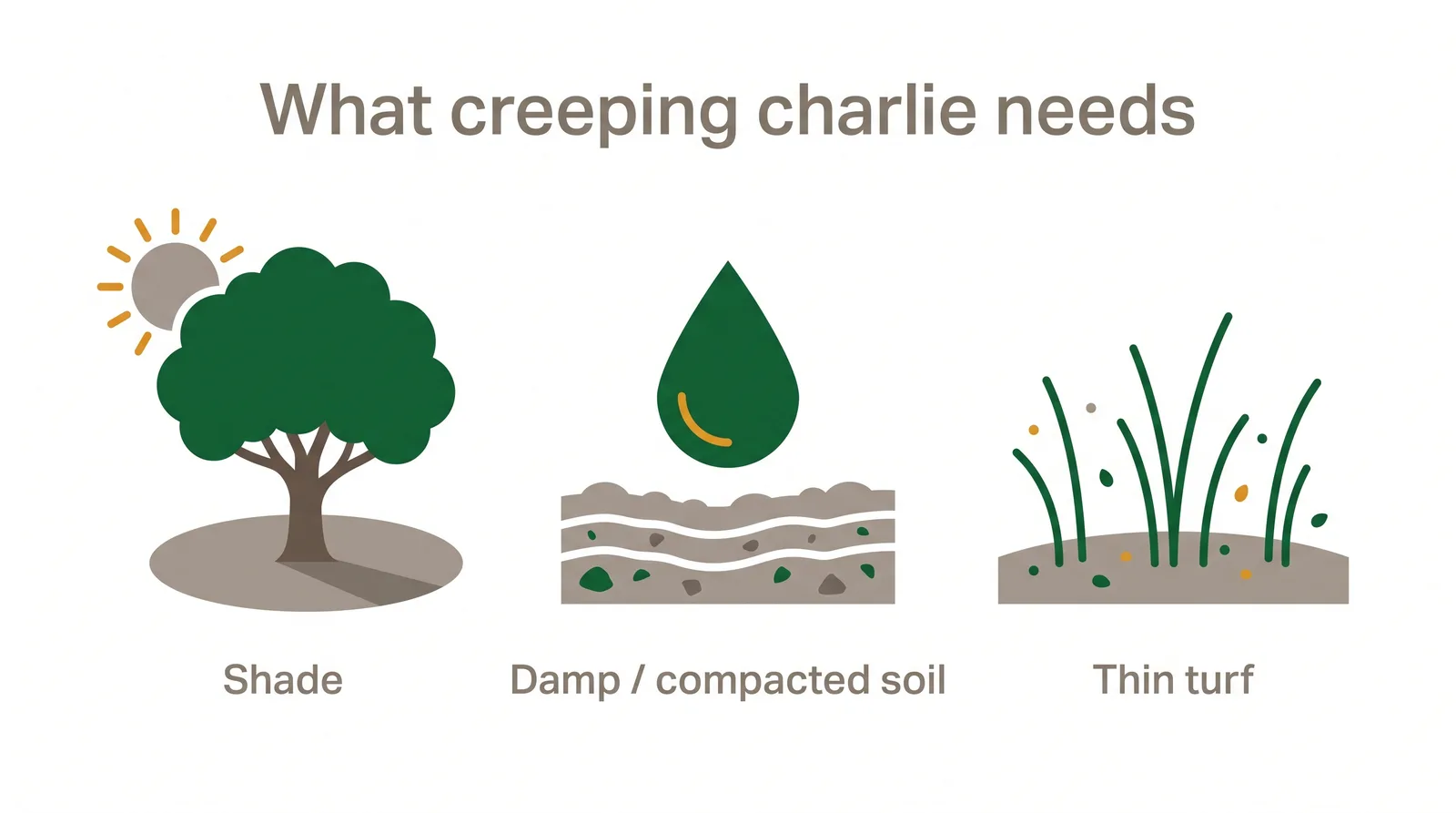
It moves into the conditions grass hates. Creeping charlie thrives in shade, damp or poorly drained soil, compaction, and thin turf, so a heavy patch is really a map of where your lawn is struggling (Illinois Extension). That is the key to beating it: fix the conditions and the grass takes the space back.
The spots it loves in Toronto yards are predictable:
- Under mature maples and along the north side of the house, where shade is deep and grass thins out.
- Low, wet corners with poor drainage or compacted clay, common on older Scarborough and Etobicoke lots.
- Thin, scalped turf mowed too short, which lets light hit the soil and the weed's runners spread unopposed.
What is the Ontario-legal way to get rid of creeping charlie?
Attack it on two fronts at once: remove what is there, and change why it is there. Neither works alone. Kill the patch without fixing the shade and thin turf and it returns; improve the lawn without removing the weed and it just keeps spreading.
- Hand-pull after rain. On small patches, loosen the soil with a soaking rain or deep watering, then lift the runners slowly to pull up the whole stem, not just leaves (Iowa State). Get the edges before they mat.
- Mow high, at 2.5 to 3 inches. Taller grass shades the soil and outcompetes the weed; scalping does the opposite and invites it in.
- Overseed to thicken the turf. Bare and thin spots are open invitations. Fall overseeding with cool-season grass fills the gaps so creeping charlie has nowhere to root.
- Reduce the shade and moisture. Thin or limb up overhanging branches to get more light in, and fix low, soggy spots or compaction with aeration so grass can compete.
- Use an iron-based (FeHEDTA) herbicide in fall if you want a chemical assist. It is the legal option in Ontario, works on broadleaf weeds, and hits hardest in fall when the plant moves energy to its roots. Plan on more than one application.
From the data: YardQuote tracks 249 lawn-care companies across the GTA, 220 of them with three or more reviews at an average of 4.75 stars (YardQuote tracking, July 2026). Many run Ontario-legal weed programs built on the iron-based products and overseeding, which matters because the effective, banned chemicals sold south of the border are not an option for a licensed pro here either.
What about the borax home remedy?
Borax is legal to use here, but it is a gamble, not a plan. It appears on Ontario's allowable list, and it does suppress creeping charlie because the weed is more sensitive to boron than grass is. The problem is the margin for error: boron accumulates in soil, turns toxic to your own lawn and nearby plants, and the correct dose is very hard to hit (Michigan State University). MSU has not validated it as a reliable method.
For most Toronto yards, the pull-plus-overseed approach, backed by an iron herbicide in fall, is safer and more durable than risking long-term boron damage to the soil for a weed that will return anyway if the shade and thin turf remain.
When should you just call a pro?
When the patch is past hand-pulling, when it is tangled through a wide shaded area, or when you have overseeded twice and it keeps coming back, the conditions likely need work a program handles better than a weekend. A pro can time the iron-based treatments, aerate compacted clay, and rebuild thin turf on a schedule.
If the lawn is more weed than grass, our guide to starting over with grass removal and regrading covers the reset, and since a scalped lawn invites creeping charlie back, choosing weekly over bi-weekly mowing in spring helps keep it dense. You can compare weed-control and overseeding pricing on the lawn care cost page and grass seed cost page, or browse lawn care companies in East York and other GTA areas.
Want an Ontario-legal plan matched to your yard's shade and soil? Request a quote and compare up to three vetted local pros side by side. Your contact details only go to the one you pick.