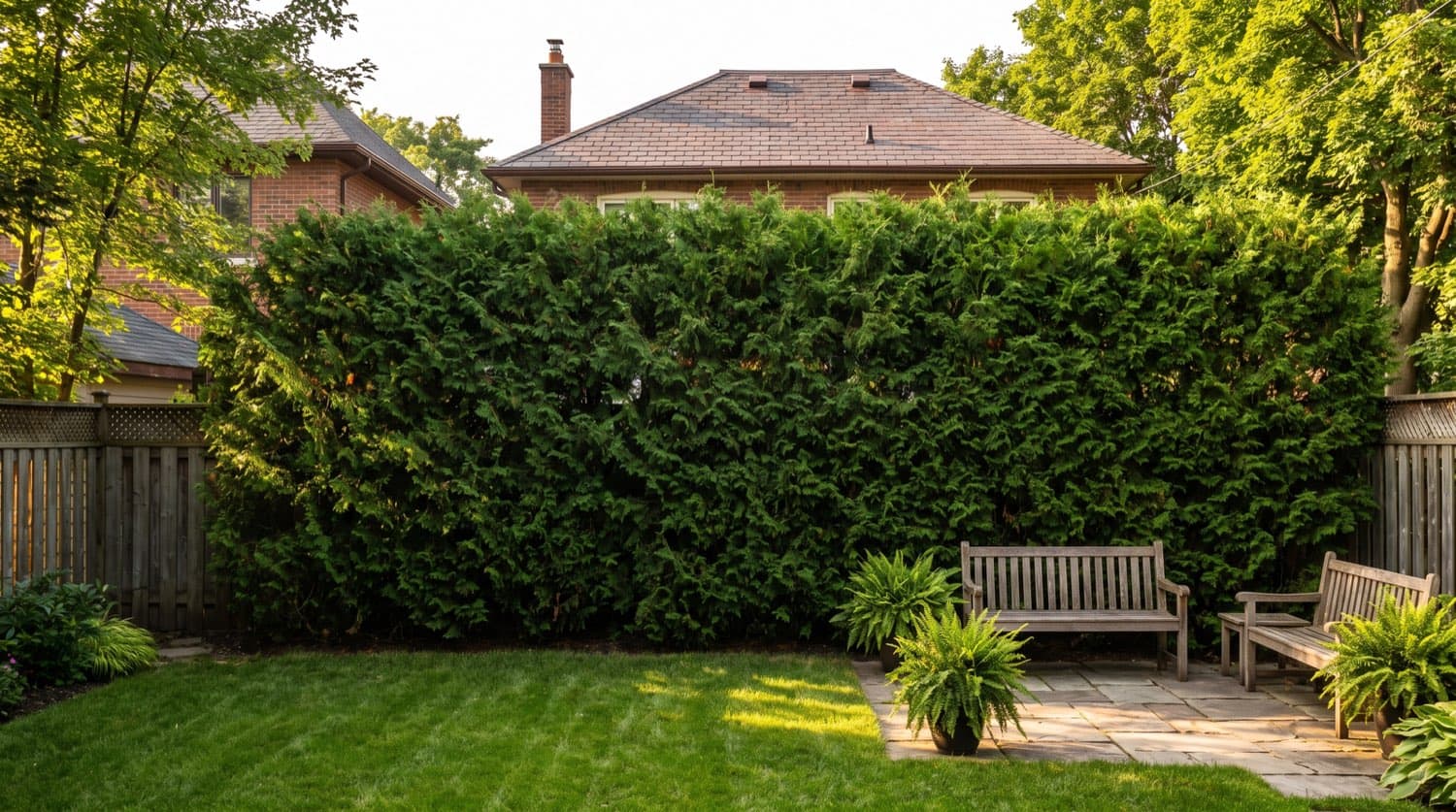
Answer First: The most reliable fast privacy plant for a GTA yard is the emerald cedar, an evergreen that grows roughly 15 to 30 cm a year and forms a dense, narrow screen ideal for tight Toronto lots. For a large property, native eastern white pine grows faster, up to about a metre a year, and Norway spruce builds a tall dense wall, but both need real space. Whatever you choose, avoid invasive quick-fixes like common buckthorn, which is a noxious weed in Ontario.
Privacy is the most common reason Toronto homeowners plant anything, and it is where the worst plant choices get made. People want a wall by next summer, so they grab whatever grows fastest, and end up with an invasive weed or a weak tree that splits in an ice storm. The good news is the fast option that actually works is also the classic one. Here is how to pick a screen by the size of your yard, and what to keep out of it.
What is the best fast-growing privacy screen for a Toronto yard?
For most lots, it is the emerald cedar. This narrow evergreen grows about 15 to 30 cm a year, holds its green through winter, and stays slim enough to line a fence without eating the yard. That combination, dense, evergreen, and narrow, is why it is the default privacy plant across the GTA.
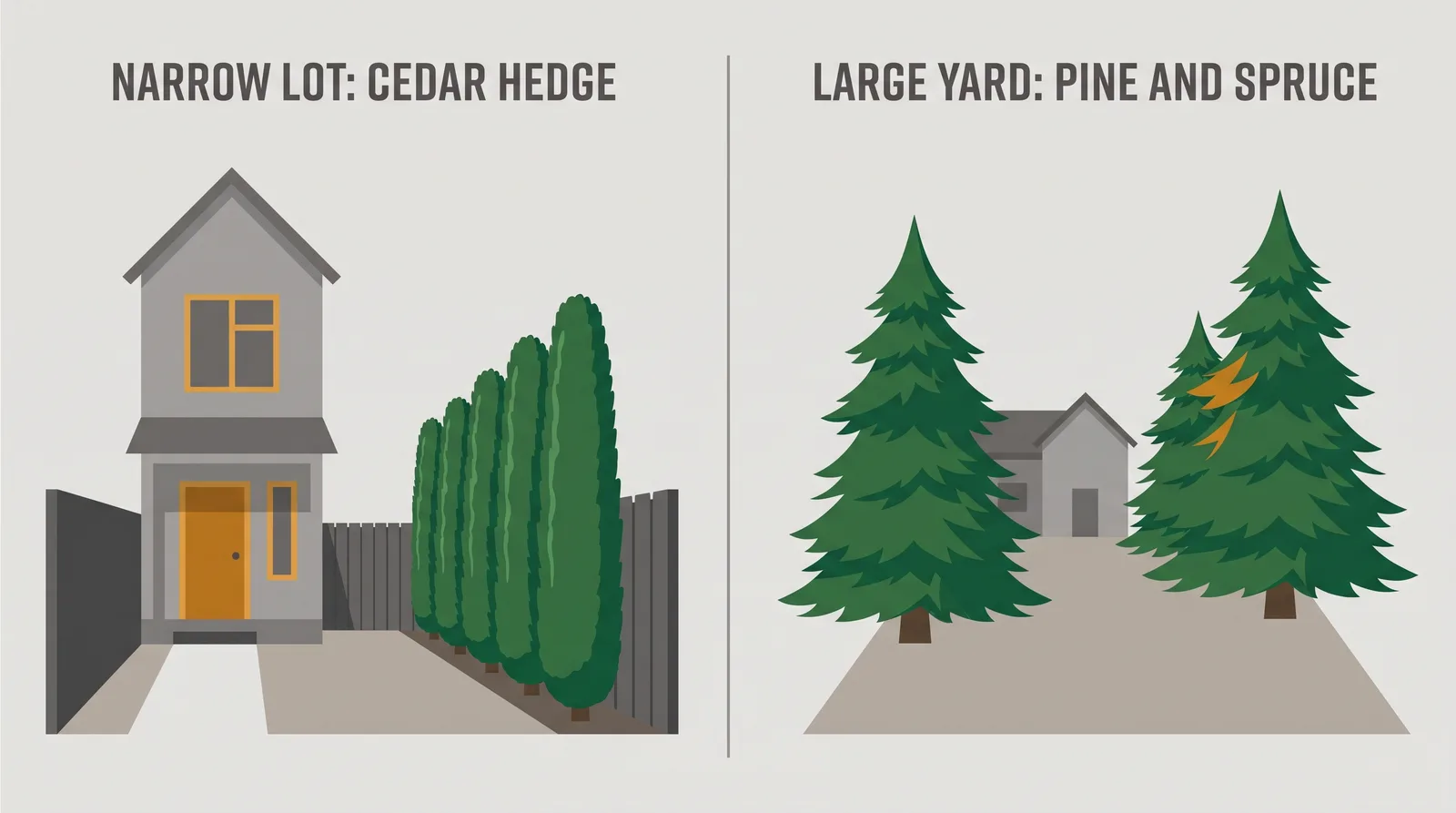
The right pick changes with your space. A downtown semi with a six-foot side yard needs the narrowest screen it can get, which is a cedar hedge. A large North York or 905 property with room to spare can use big native evergreens that grow faster and taller. The table below sorts the main options.
| Plant | Growth rate | Mature size | Best for | Native? |
|---|---|---|---|---|
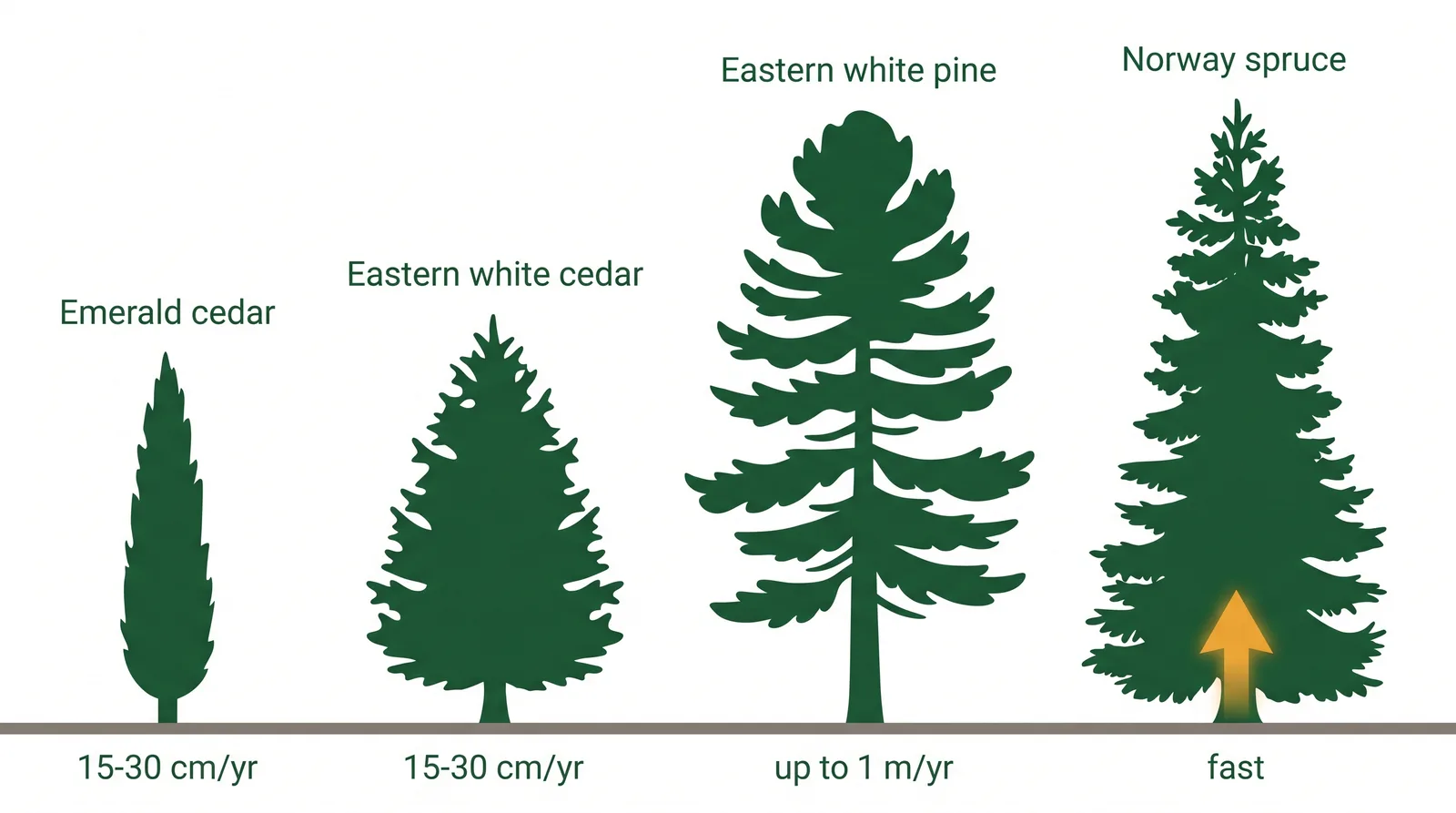
| Emerald cedar | ~15–30 cm/yr | ~15–20 ft tall, ~3–4 ft wide | Narrow lots, formal hedge | Cultivar of native cedar |
| Eastern white cedar | ~15–30 cm/yr | ~20 ft tall, 7–10 ft wide | Informal screen, more room | Yes (LEAF) |
| Eastern white pine | up to ~1 m/yr | Very large (to ~30 m) | Large yards, soft look | Yes |
| Norway spruce | Fast | Very large, dense pyramid | Large yards, windbreak | No, but non-invasive |
Quotable: The emerald cedar is the GTA's default privacy screen because it does three things at once: it stays green all winter, it grows about 15 to 30 cm a year, and it stays narrow enough for a tight Toronto lot.
When should you plant a big native evergreen instead?
When you have the room and want speed or scale. On a large property, native eastern white pine and Norway spruce outgrow a cedar hedge and make a taller, deeper screen, useful against a distant view or as a windbreak.
Eastern white pine is Ontario's fast native evergreen, growing up to roughly a metre a year in good conditions, with soft feathery needles that read less formal than a clipped hedge. Norway spruce forms a dense pyramidal wall and shrugs off Ontario winters. The catch with both is size: they become very large trees, so they belong well back from the house, overhead wires, and the property line, not squeezed along a narrow fence. Plant them in the right window, our guide on when to plant a tree in Toronto covers the spring and fall timing, and give them years, not months.
Evergreen screen, a planting of conifers (cedar, pine, spruce) that keeps its foliage year-round, so it blocks sightlines in winter as well as summer. Deciduous hedges like hornbeam hold some dry leaves but thin out in winter, which is why evergreens dominate GTA privacy planting.
What privacy plants should you never plant in Ontario?
The invasive quick-fixes. Some of the fastest screens are exactly the plants that cause the most damage when they escape a yard, and two are common enough to name.
Common, or European, buckthorn is sometimes spread as a fast informal screen, but it is classified as a noxious weed under Ontario's Weed Control Act and invades ravines and woodlots aggressively. Norway maple is invasive too, growing in dense stands that shade out native plants. Both should be kept out of the ground. Also avoid the weak-wood speed demons, hybrid poplar and Manitoba maple, which grow fast but drop limbs and turn into a hazard within a decade.
Quotable: Common buckthorn is a noxious weed under Ontario's Weed Control Act and should never be planted as a privacy screen. A native cedar, pine, or spruce gives lasting privacy without invading nearby ravines and natural areas.
From the data: YardQuote tracks 650 landscaping companies across the GTA, and a supplied-and-planted tree runs about $150 to $500 each (YardQuote cost data, July 2026). A privacy hedge is a row of those, so a fence line of cedars is a real project, which is exactly why it pays to pick a species that will not need replacing and to check whether a native option from a City or LEAF program fits first.
Getting a privacy screen that lasts
Start by matching the plant to the lot, then plant it right. A cedar hedge is the answer for most Toronto yards, and it rewards correct spacing and watering, which we cover in detail in our cedar hedge planting, spacing, and care guide. A big native evergreen is the answer when you have the room and want scale. Either way, the fast plant that is also a good plant beats the fast plant that becomes a problem.
For a full fence line or a screen tied into a larger yard project, a landscaping crew handles the sourcing, spacing, and planting. Check current landscaping costs and browse rated crews on the landscaping directory for your area before you buy a truckload of cedars.
Planning a privacy hedge or screen? Request a quote and compare up to three vetted local pros side by side. Your contact details only go to the one you pick.