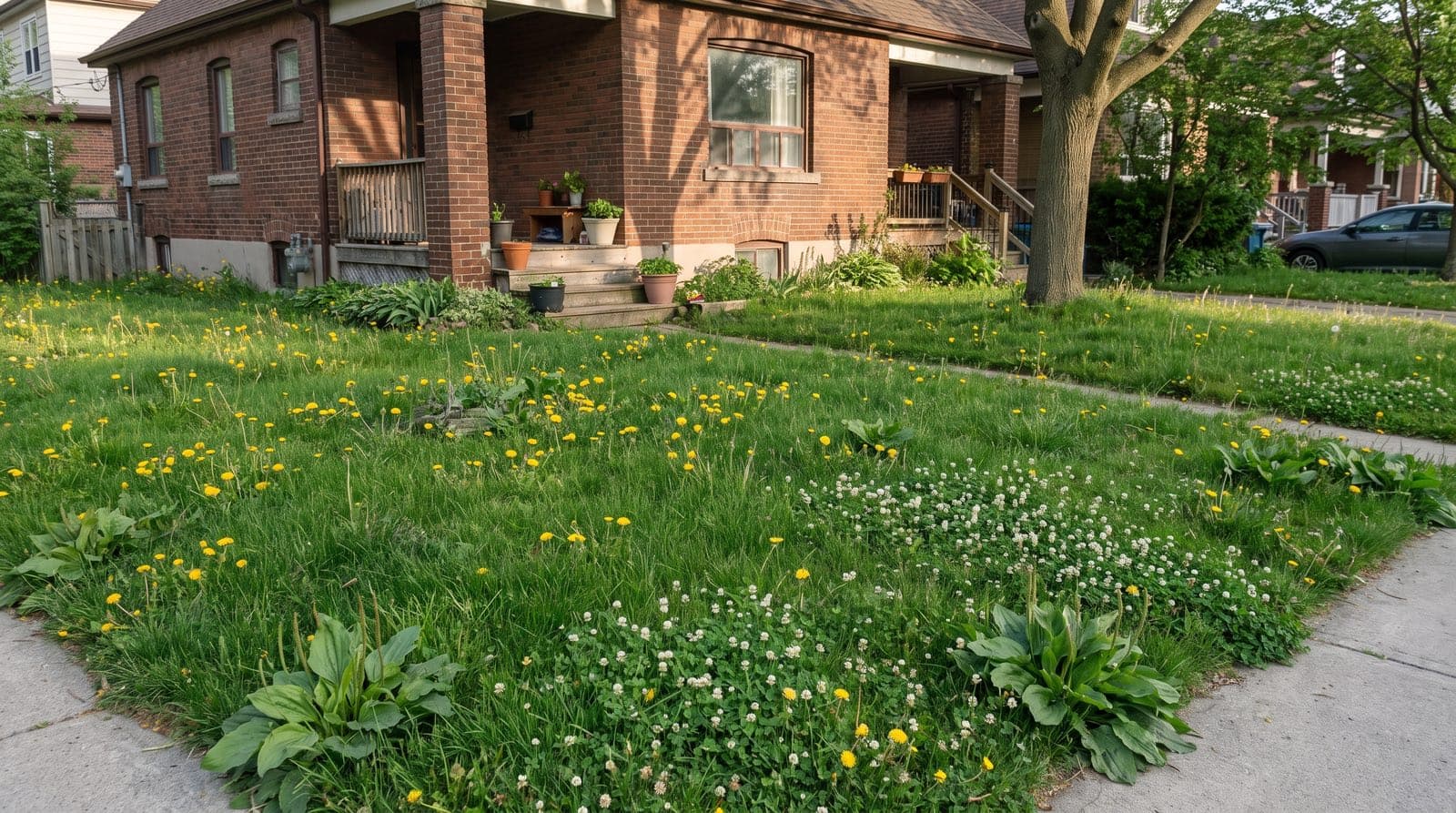
Answer First: The five most common lawn weeds in Ontario are dandelion, crabgrass, white clover, creeping charlie (ground ivy), and broadleaf plantain. Because Ontario bans chemical cosmetic weed killers, the real fix is a thick, tall, healthy lawn that crowds weeds out, backed by legal controls: hand-pulling, corn gluten meal as a spring pre-emergent for crabgrass, and iron-based products like Fiesta for spot-treating broadleaf weeds. Each weed also signals a specific lawn problem worth fixing.
Every Toronto lawn grows weeds, and since you cannot legally spray most of them away, the useful skill is reading them. A weed is not just an eyesore; it is the lawn telling you what is wrong. Name the five you actually have, and the fix usually names itself.
What are the most common lawn weeds in Ontario?
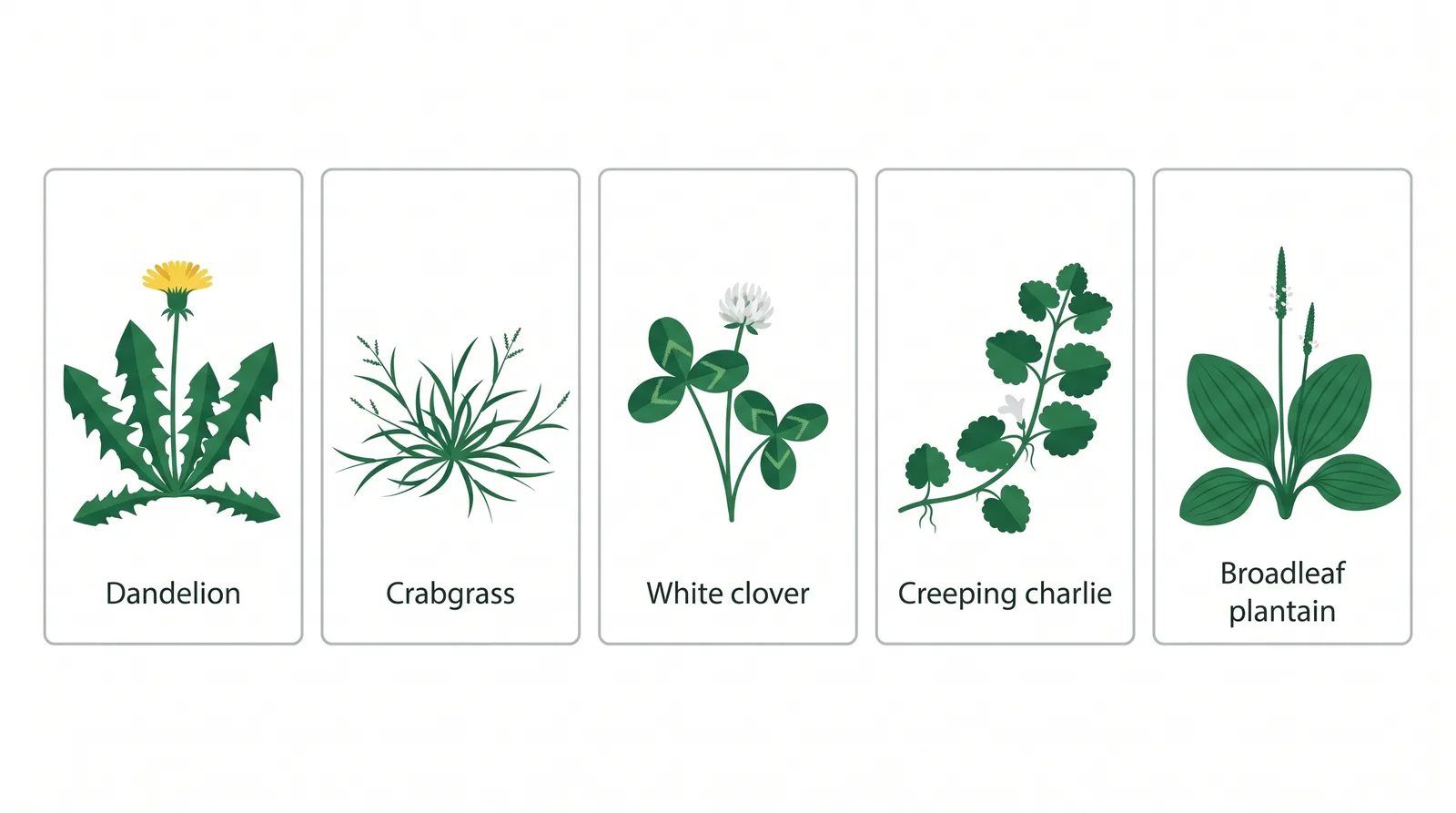
Five weeds account for most of what shows up on GTA lawns. Learn to tell them apart, because the control that beats one does little to another.
| Weed | Type | How to spot it | The real fix |
|---|---|---|---|
| Dandelion | Broadleaf perennial | Jagged leaves, yellow flower, single deep taproot | Pull the whole taproot when soil is wet; thicken turf |
| Crabgrass | Annual grass | Low, spreading star of coarse blades; dies each fall | Mow high, overseed; corn gluten in early spring |
| White clover | Perennial legume | Three-part leaves, small white flowers | Feed nitrogen if unwanted, or keep it as a benefit |
| Creeping charlie | Perennial (mint family) | Scalloped leaves, square creeping stems, mint smell | Improve light and drainage; remove runners by hand |
| Broadleaf plantain | Broadleaf perennial | Rosette of oval, ribbed leaves; tolerates traffic | Aerate compacted soil; pull the crown |
Two of these are grasses' opposites in strategy. Dandelion and plantain are perennials that return from a root every year, so half-pulling them fails. Crabgrass is an annual that wins on seeds, so stopping germination matters more than removing plants.
Quotable: In Ontario, learning to identify the five common lawn weeds is not trivia, it is the strategy. Chemical weed killers are banned, so the fix has to be matched to the specific weed and the lawn condition that let it in.
How do I get rid of lawn weeds without banned chemicals?
Fix the lawn first, then target what remains. Ontario's pesticide ban means you cannot reach for a chemical weed-and-feed, but a dense lawn is a better long-term weed control than any spray ever was.
The foundation is three habits that favour grass over weeds:
- Mow high, around 3 inches. Tall grass shades the soil and stops most weed seeds from germinating. Scalping the lawn short is the single most common reason crabgrass takes over.
- Water deeply and infrequently. Deep roots let grass outcompete shallow-rooted weeds and survive drought that would thin the turf and open gaps.
- Overseed every fall. Thickening the lawn leaves weeds nowhere to establish. Bare soil is where every weed on this list starts.
On top of that, a few legal, targeted controls help. Hand-pull dandelion and plantain when the soil is wet so the full root lifts out. Apply corn gluten meal in early spring as a natural pre-emergent that suppresses crabgrass seed. And for stubborn broadleaf patches, iron-based (FeHEDTA) products such as Fiesta are among the reduced-risk products the ban permits. What all of these have in common is that they stay on the right side of the rules, which our guide to Ontario's pesticide ban and what you can actually use lays out in full.
Quotable: You cannot spray your way out of weeds in Ontario, and it turns out you never needed to. A lawn mowed tall, watered deep, and overseeded each fall crowds out more weeds than any banned chemical did.
What is each weed telling you about your lawn?
Most weeds are opportunists that only thrive where the lawn has a specific weakness. Read the weed, fix the condition, and it stops coming back.
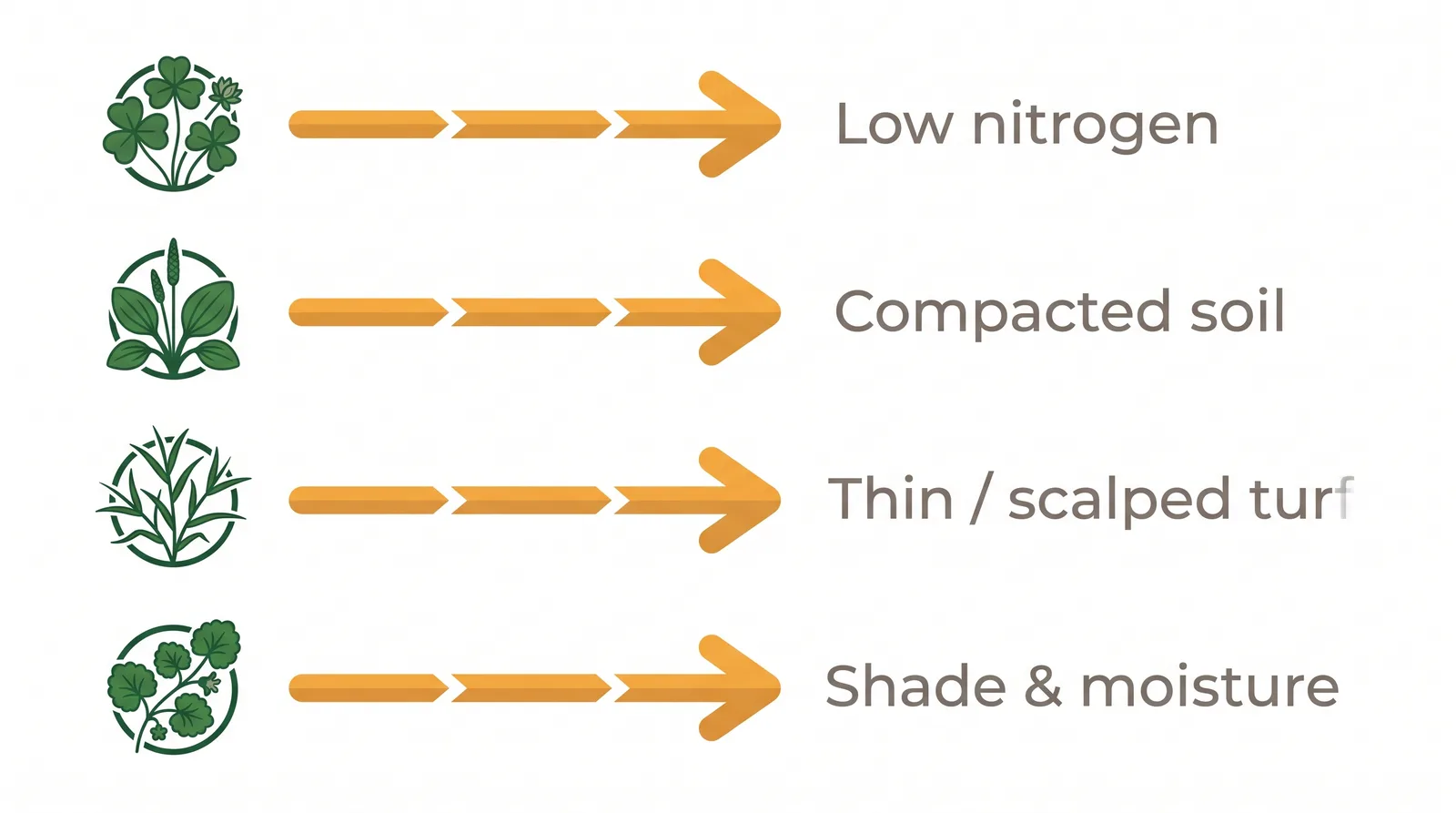
- Clover means low nitrogen. Clover pulls nitrogen from the air, so it thrives exactly where your grass is starved of it. Feed the lawn and the grass competes again.
- Plantain means compacted soil. Plantain tolerates the hard, trodden ground that chokes grass roots. Aerate to relieve compaction.
- Crabgrass means thin or scalped turf. It needs bare, sunlit soil to germinate. Mow higher and overseed to shade it out.
- Creeping charlie means shade and moisture. It outcompetes grass where light is low and drainage is poor. More light and better drainage tilt the balance back.
This is the case for treating weeds as information. Spraying a dandelion, even where you legally could, ignores why it had an opening. Fixing the condition is what keeps the lawn holding its own.
From the data: YardQuote tracks 249 lawn care companies across the GTA, and 220 carry three or more Google reviews with an average rating of 4.75, with 88% of rated companies holding 4.5 stars or higher (YardQuote tracking, July 2026). Many now build their service around overseeding, aeration, and legal spot-treatments rather than the blanket chemical spraying the ban ended, which is exactly the approach that fixes the underlying conditions above.
If the lawn is more weed than grass, a renovation (aeration plus heavy overseeding, timed to the fall) is often the honest fix, and the same window applies as in our guide on when to plant grass seed in Ontario. You can compare local pros and current rates on the Toronto lawn care cost page or browse lawn care companies in Etobicoke and other areas.
Not sure whether to treat or renovate? Request a quote and compare up to three vetted local lawn care companies side by side. Your contact details only go to the one you pick.