
Answer First: Installing artificial grass is a base-preparation job with a lawn laid on top. The steps: excavate 3 to 4 inches of soil, grade for drainage, lay a weed barrier, add and compact 2 to 4 inches of crushed stone, add a thin leveling sand layer, then lay, seam, and secure the turf and brush in infill sand. The base is roughly 80 percent of the work, and skimping on it is why cheap artificial lawns ripple, sink, and drain badly.
Artificial grass looks like the easy landscaping choice: roll it out, done. What actually decides whether it looks great in five years is entirely hidden, in the layers of stone and sand under it. Get the base right and the turf is almost maintenance-free. Get it wrong and no amount of expensive grass saves it.
What goes under artificial grass?
A built-up base of compacted stone and sand, not just bare soil. The turf you see is the last and thinnest layer of a proper installation.
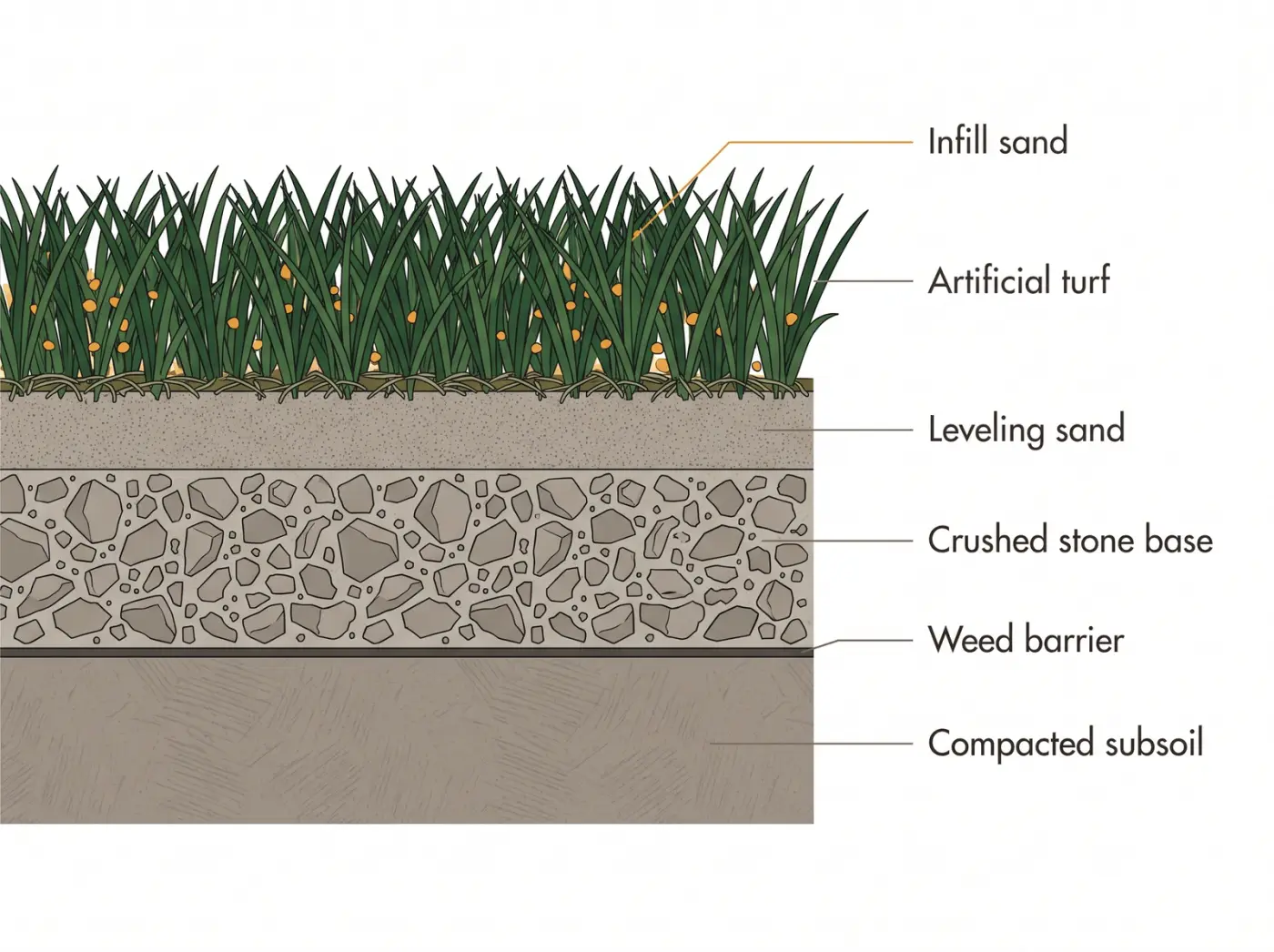
From the ground up, a correct installation is:
- Compacted subsoil graded to slope gently away from the house for drainage.
- Weed barrier fabric to stop weeds pushing up through the turf.
- Crushed stone base, 2 to 4 inches, compacted firm. This is the structural layer.
- Leveling sand, a thin layer that smooths out the final surface.
- Artificial turf, laid, seamed, and secured.
- Infill sand, brushed down into the fibres to weigh the turf and stand the blades up.
The single most important layer is the compacted crushed stone. It carries the load, drains the water, and holds its shape, and it is exactly the layer budget installs shortchange.
Quotable: Artificial grass is 80 percent base and 20 percent turf. The compacted crushed-stone layer under the grass is what keeps it flat, draining, and ripple-free, and it is the first thing a cheap install cuts.
What are the steps to install artificial grass?
Seven steps, in order, and the early ones matter most. Rushing the base to get to the satisfying part is the classic mistake.
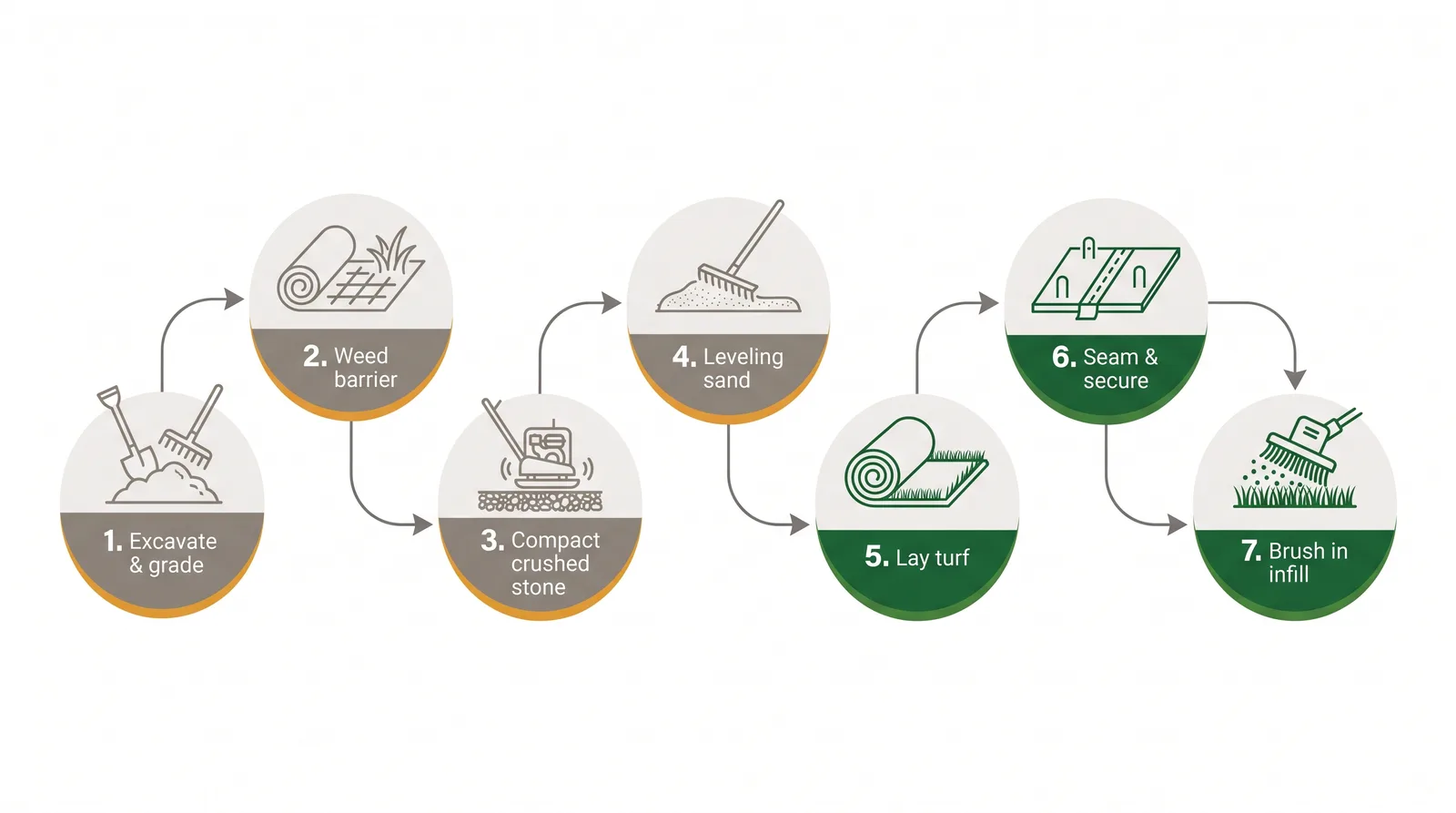
- Excavate and grade. Remove about 3 to 4 inches of existing grass and soil, and grade the ground to slope gently away from the house so water drains.
- Lay the weed barrier. Roll weed-barrier fabric over the graded soil to stop growth from below.
- Add and compact the crushed stone. Spread 2 to 4 inches of crushed stone, rake it level, mist it, and compact with a plate compactor in several passes until firm.
- Add leveling sand. A thin layer of fine sand smooths the surface; compact this too.
- Lay the turf. Roll out the artificial grass, letting it acclimate, and keep the pile direction consistent across pieces.
- Seam and secure. Join pieces with seaming tape and adhesive, and fix the perimeter with landscape nails, staples, or edging so nothing lifts.
- Brush in infill. Spread infill sand and brush the fibres upright with a stiff or power broom so the lawn stands tall and stays flat.
The two steps that separate a professional result from a DIY one are the compaction in step three and the seaming in step six. A base that is not dead-firm sinks unevenly, and seams that are not glued cleanly show as visible lines.
Quotable: The two hidden steps that make or break an artificial lawn are compacting the stone base until it is rock-firm and seaming the turf cleanly. Everything a homeowner notices later, ripples and visible joins, traces back to those two.
What should Toronto homeowners watch for?
Drainage, freeze-thaw, and the local bylaw. Toronto's conditions and rules add a few wrinkles to a standard install.
Grade and base drainage matter more here because water that cannot pass through freezes. A properly sloped, free-draining base lets meltwater move instead of pooling and heaving the surface over winter, the same base logic behind any durable hardscape. Before you install, check the rules: some Toronto situations have restrictions on artificial turf, covered in our guide to the Toronto artificial grass bylaw, and you should never grade the base so it sheds water onto a neighbour's property. Once it is in, artificial grass is genuinely low upkeep, though not zero, as our guide on artificial grass maintenance through winter explains.
From the data: YardQuote tracks 650 landscaping companies across the GTA, and 613 carry three or more Google reviews with an average rating of 4.77 (YardQuote tracking, July 2026). Many install artificial turf, and the ones worth hiring talk about base depth and compaction before they talk about turf brands, because in the GTA that is what decides whether the lawn survives its first freeze-thaw winter flat.
To compare local installers and current ranges, see the Toronto landscaping cost page or browse landscaping companies in Scarborough and other areas.
Want an artificial lawn built on a base that lasts? Request a quote and compare up to three vetted local pros side by side. Your contact details only go to the one you pick.