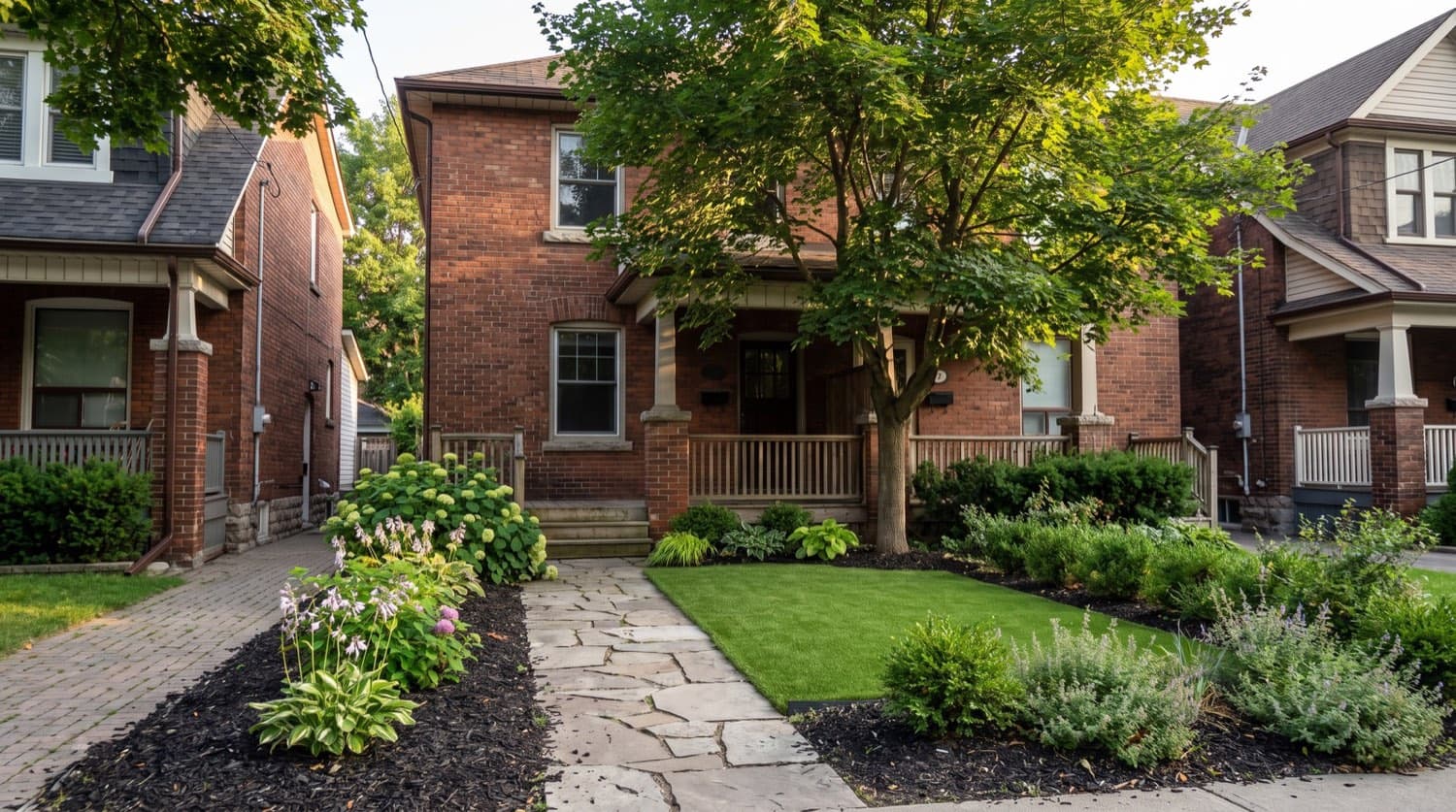
Answer First: Artificial grass is legal in Toronto, front yard or back, and needs no City permit. The one rule that trips people up: the City does not count artificial turf as "soft landscaping," so it cannot fill the permeable portion of a front yard that Zoning By-law 569-2013 requires you to keep as real soil and plants. On a typical narrow Toronto lot, that protected soft area is roughly 37.5% of the front yard.
Fake grass gets sold as the no-bylaw, no-maintenance answer to a patchy Toronto lawn. That is mostly true in the backyard. In the front yard, there is a specific catch that has cost homeowners a redo, and it is worth understanding before the base goes down.
Is artificial grass legal in Toronto?
Yes. There is no bylaw banning artificial turf on private residential property in Toronto, and no permit or inspection specific to installing it. You can turf a backyard, a side yard, or part of a front yard. YardQuote does not sell turf or lay it, which is why we can say the honest version: the "is it even legal" worry is not the real issue. The real issue is where the turf goes and what it displaces.
Quotable: Toronto has no bylaw prohibiting artificial grass on residential property, and no permit is required to install it. The only binding constraint is the front-yard soft landscaping rule in Zoning By-law 569-2013.
Why does artificial turf not count as "soft landscaping"?
Because the City's definition of soft landscaping is about permeability, not appearance. The City of Toronto's turfgrass guidance is explicit: artificial turf is not considered soft landscaping and does not count toward the soft landscaping requirement.
Soft landscaping — permeable areas made up of soil or mulch that are suitable for the planting of trees, shrubs and grass. The point is that rain soaks in. Artificial turf sits on a compacted base, so the City treats it as a hard surface, in the same bucket as a patio, walkway, or driveway apron.
That distinction is the whole ballgame for a front yard. Section 10.5 and Chapter 800 of Zoning By-law 569-2013 set how much of a front yard must be landscaped and how much of that has to be soft. Turf can help you meet the hard-landscaping side of the equation. It does nothing for the soft side.
How much of my front yard has to stay real plants?
More than most people expect. The requirement scales with your lot's frontage, and the common Toronto case is a narrow lot.
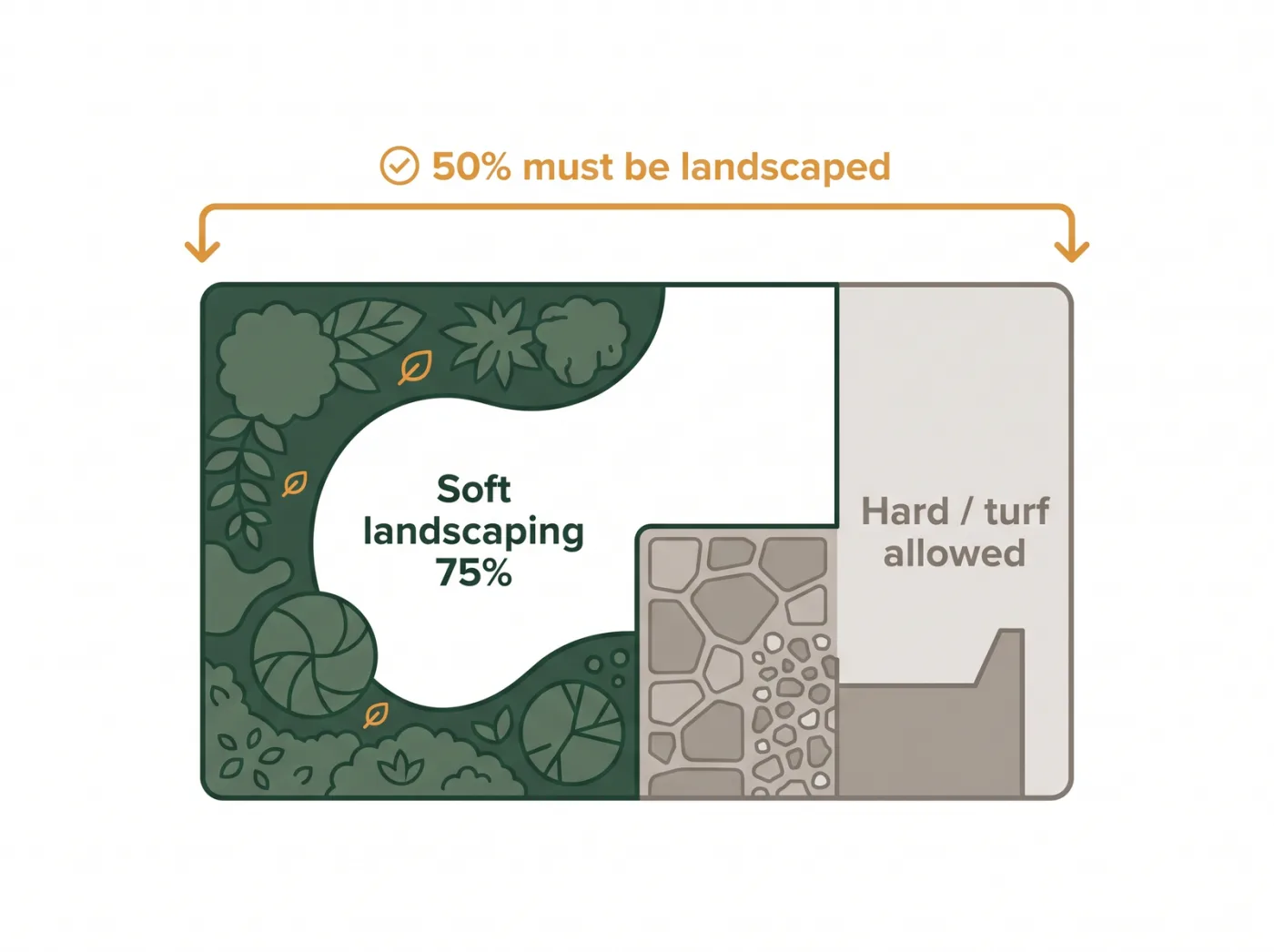
For a lot with a frontage between 6.0 metres and less than 15.0 metres — the band that covers most Toronto semis and narrow detached lots — the rule is two-layered:
- 50% of the front yard must be landscaping (not paved over for parking or a slab).
- 75% of that landscaping must be soft landscaping — real permeable planting area.
Multiply those and about 37.5% of the whole front yard must remain soft, permeable soil and plants. Artificial turf cannot occupy that 37.5%. It can go in the remaining hard-landscaping allowance, alongside your walkway and any legal parking pad. Lots narrower than 6.0 metres or wider than 15.0 metres fall under different percentages, so confirm your exact frontage against the zoning bylaw or with Toronto Building before you plan a full front-yard turf job.
From the data: Of the 650 landscaping companies YardQuote tracks across the GTA, the ones that hold their ratings above 4.5 stars tend to quote a front yard as a mix — soft planting beds plus a turf or hardscape zone — rather than a single sheet of turf. The bylaw is one reason the honest quotes look that way.
Backyard turf: what actually applies?
Much less. The soft landscaping percentage is a front-yard rule. In a rear yard, artificial turf is generally fine, and the constraints that matter are the ordinary ones for any hard-ish surface:
- Lot coverage and grading. Your yard still has to manage its own rainwater. Turf over an impermeable base that sheds water toward a neighbour or a foundation is a drainage complaint waiting to happen.
- The 20 cm grass rule does not apply to turf. Toronto's Turfgrass and Prohibited Plants bylaw (Municipal Code Chapter 489) requires you to cut real turfgrass once it passes 20 centimetres, with a $500 fine for ignoring it. Artificial turf never grows, so that particular bylaw stops being your problem — one honest point in turf's favour for a homeowner who travels or hates mowing.
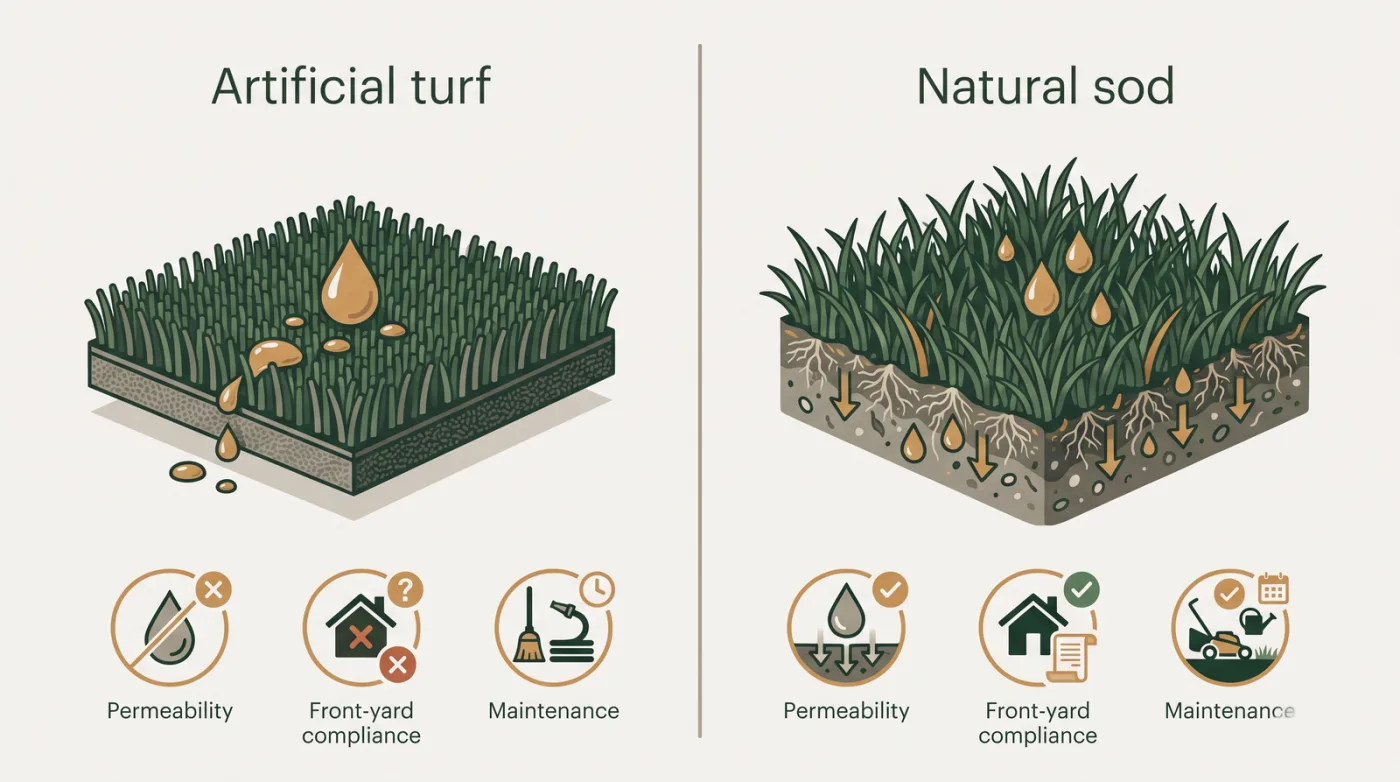
If your goal is a low-maintenance front yard that still passes the soft landscaping test, the usual answer is not all-turf. It is real ground-cover planting or natural sod for the permeable share, with turf or stone filling the rest. Our breakdown of sod installation cost per square foot covers what the natural option runs.
How do I keep an artificial grass install onside?
Treat it like a hardscape project with one zoning constraint, and it is straightforward.
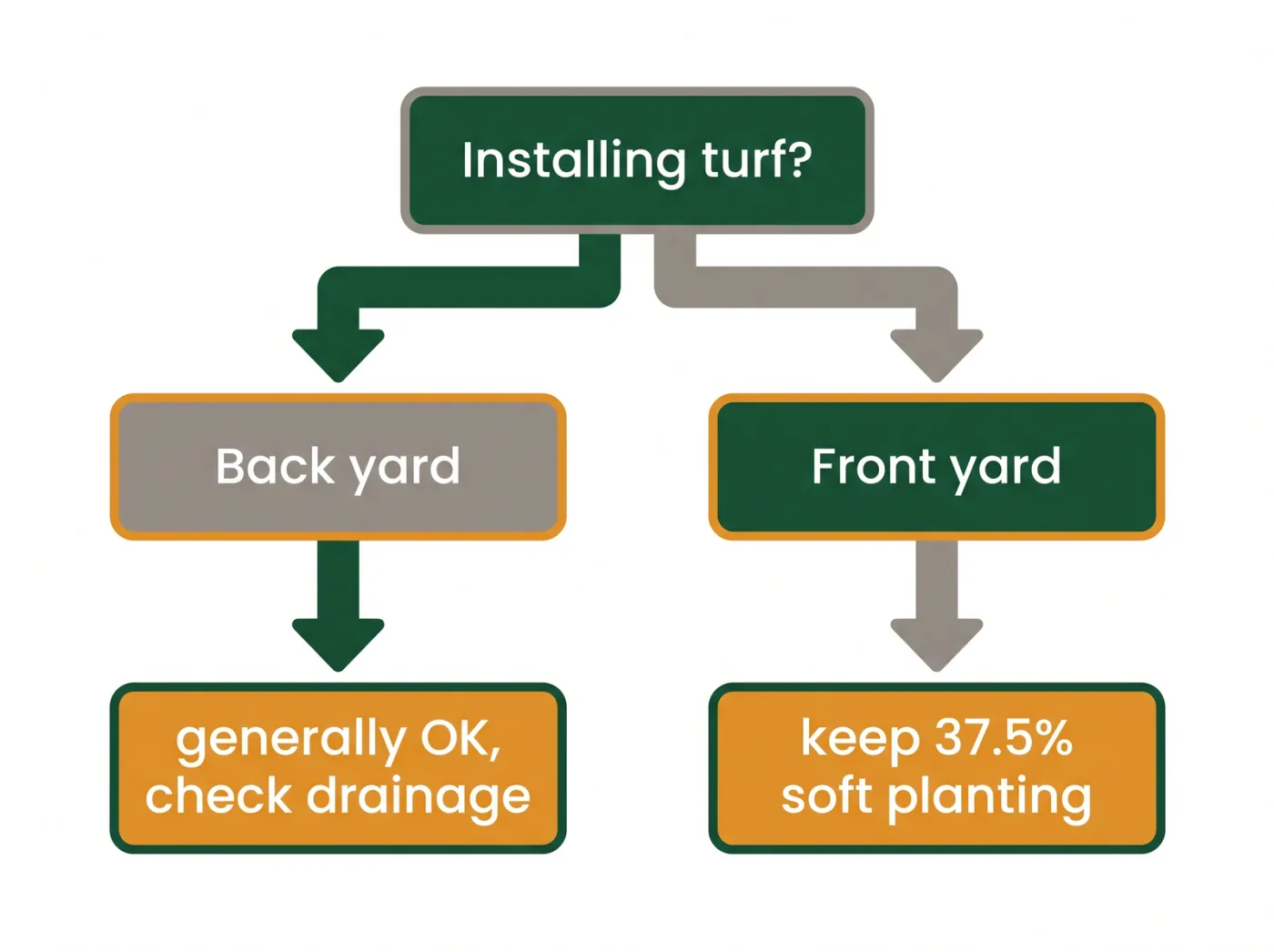
- Front or back? In the back, turf is generally fine — check grading and lot coverage and move on. In the front, keep going.
- Protect the soft share. On a 6.0 to 15.0 metre lot, leave roughly 37.5% of the front yard as real permeable planting. Turf fills only the hard-landscaping allowance.
- Confirm your frontage band. Wider or narrower lots use different percentages under Zoning By-law 569-2013. When in doubt, ask Toronto Building.
- Grade for drainage. Slope the base away from foundations and lot lines so water soaks into your own soft areas, not the neighbour's.
Two other Toronto rules often come up in the same yard project. If you are adding a raised sitting area, read whether your deck needs a permit; if you are enclosing the yard, check the fence height rules before you build. You can also compare real GTA ranges on the landscaping cost page or the full costs hub.
Want to know what a compliant front-yard design should cost for your lot? Request a quote and compare up to three vetted local pros side by side — your contact details only go to the one you pick.