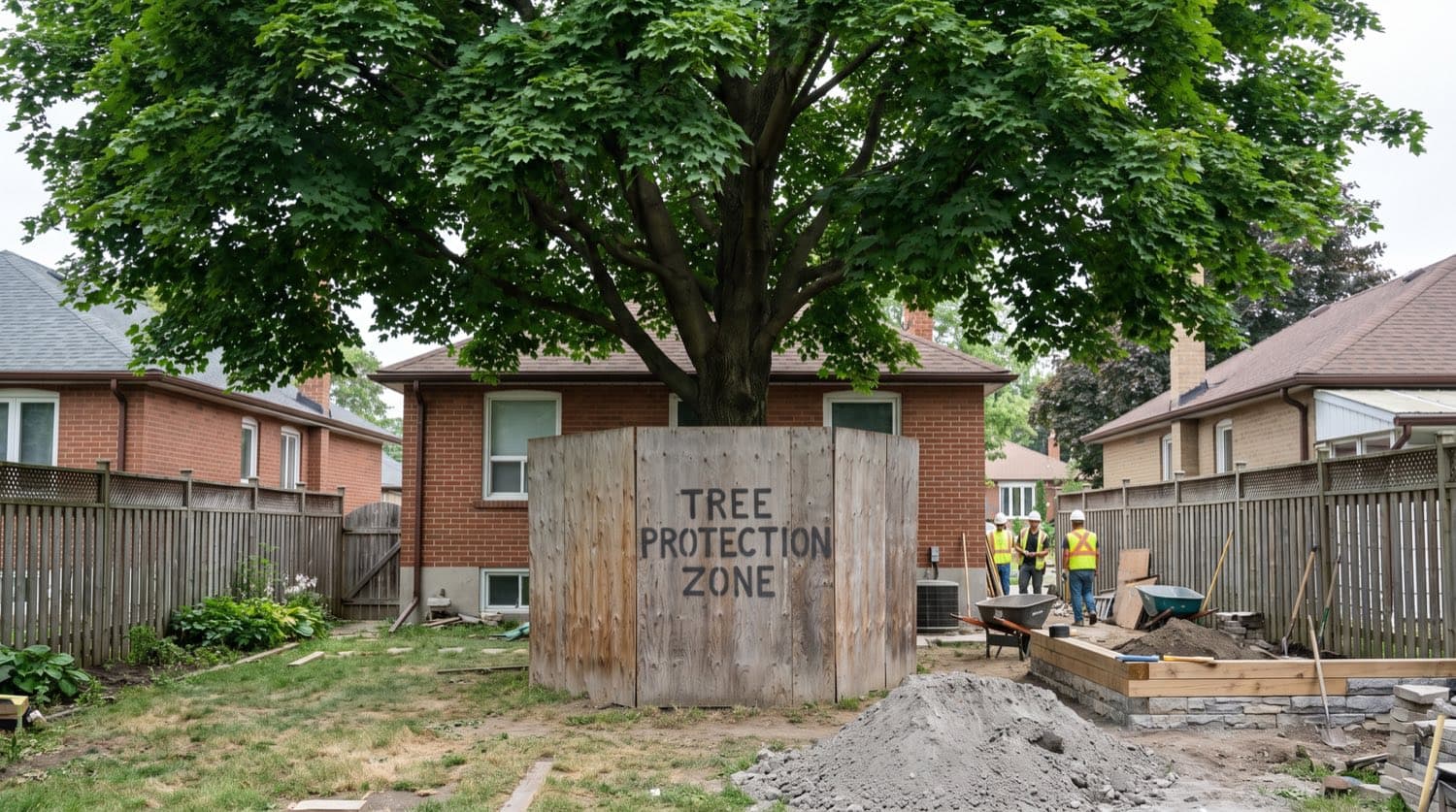
Answer First: In Toronto, a protected tree forces a Tree Protection Zone, a no-build ring measured from the trunk that runs from 1.8 m for a small tree up to 6 m for a trunk near a metre thick, and even more for larger trees (City of Toronto). Any tree 30 cm or more in diameter on private property is protected, and inside that ring you cannot build, dig, regrade, store materials, or drive over the roots without Urban Forestry's approval.
A mature tree in the wrong spot can quietly veto your patio, deck, or addition before a shovel touches the ground. In Toronto that veto has a formula, and it is worth knowing the number before you draw the plans.
What is a Tree Protection Zone in Toronto?
A Tree Protection Zone (TPZ) is the fenced-off ground around a protected tree where construction is not allowed, sized to shield the anchor and transport roots that keep the tree alive and standing. The City sets a minimum radius based on the trunk's diameter, and Urban Forestry can require more for a sensitive species or site.
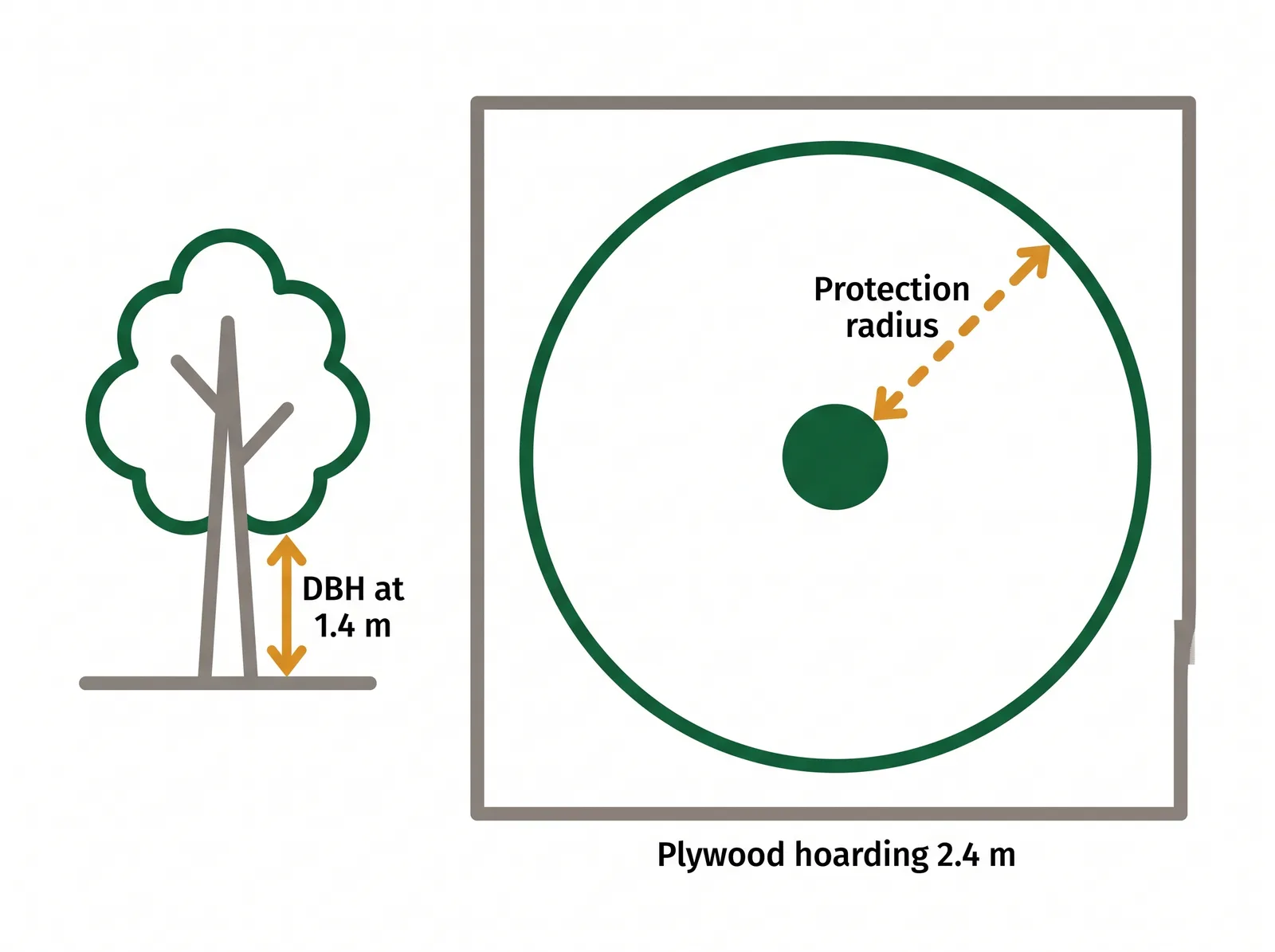
Toronto protects private trees under the Private Tree By-law once the trunk reaches 30 cm in diameter, measured at 1.4 m above the ground (the point arborists call diameter at breast height, or DBH). Trees planted as a permit or site-plan condition are protected at any size, and ravine trees are protected regardless of diameter with even larger zones.
Quotable: Toronto protects any private tree with a trunk 30 cm or more in diameter, measured 1.4 m up from the ground. Injuring a protected tree, including its roots, without a permit is an offence under the Private Tree By-law (City of Toronto).
How big is the tree protection zone?
It scales with the trunk. The thicker the tree, the wider the ring, because a bigger canopy sits on a bigger root plate. Here is the City of Toronto's minimum TPZ table for City-owned and private trees, measured from the outside edge of the trunk.
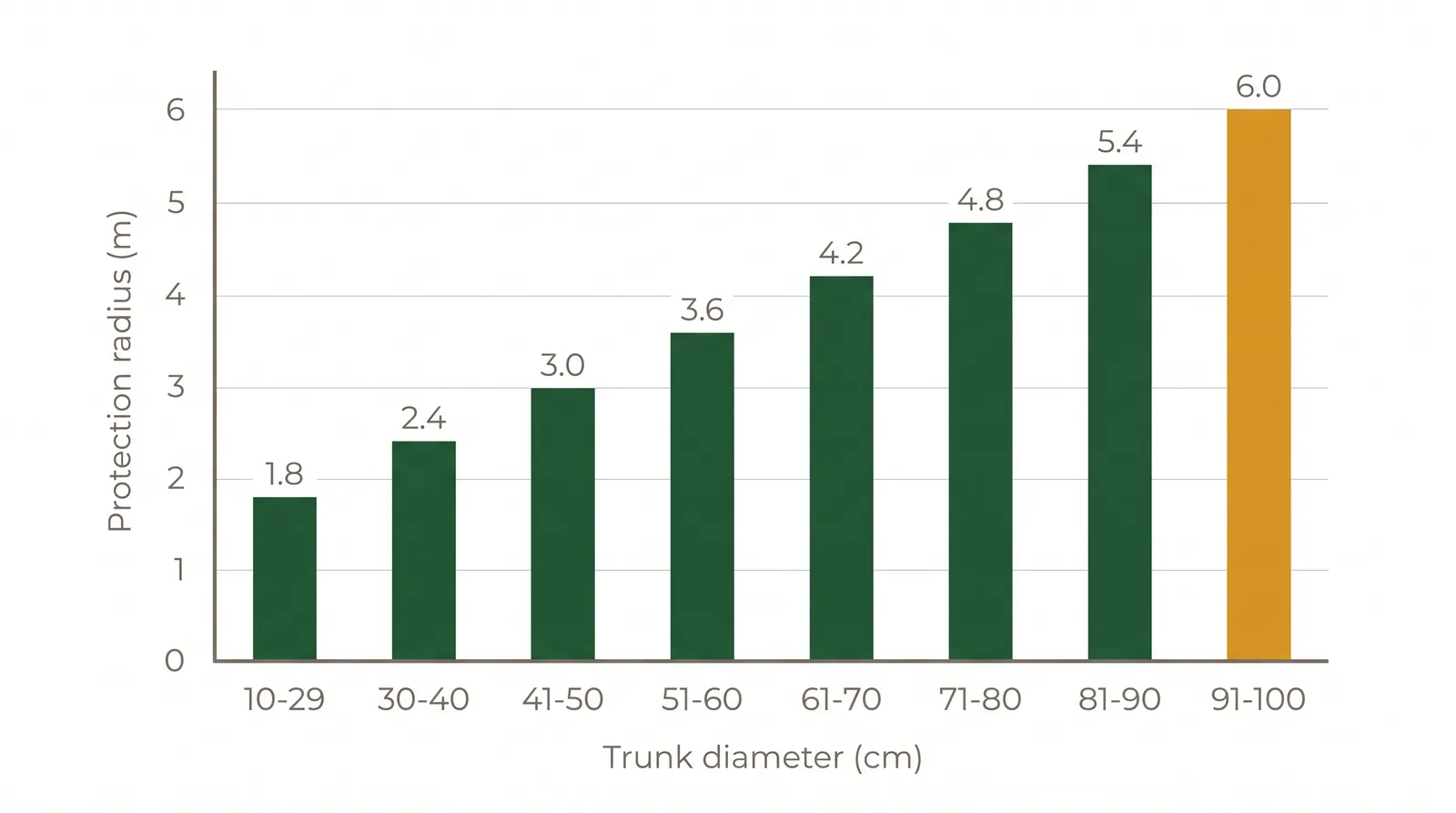
| Trunk diameter (DBH) | Minimum protection distance |
|---|---|
| Under 10 cm | 1.2 m |
| 10 – 29 cm | 1.8 m |
| 30 – 40 cm | 2.4 m |
| 41 – 50 cm | 3.0 m |
| 51 – 60 cm | 3.6 m |
| 61 – 70 cm | 4.2 m |
| 71 – 80 cm | 4.8 m |
| 81 – 90 cm | 5.4 m |
| 91 – 100 cm | 6.0 m |
| Over 100 cm | 6 cm per 1 cm of trunk diameter |
The radius is measured from the outside edge of the trunk, and the protected circle is twice that. A 60 cm silver maple, common on older North York and Etobicoke lots, needs a 3.6 m radius. That is a 7.2 m circle of untouchable ground, which is often exactly where a homeowner pictured the new patio.
From the data: A backyard patio, deck, or retaining wall next to a mature tree is one of the most common jobs across the 650 landscaping companies YardQuote tracks in the GTA, and it is the one the TPZ most often shrinks or blocks outright. Pros who work near protected trees plan the layout around the ring first, then price the hardscape.
What can you not do inside the protection zone?
Nearly everything a construction project involves. Unless Urban Forestry authorizes it in an approved plan, the City prohibits inside a TPZ:
- Building or altering structures: patios, decks, sheds, driveways, parking pads, pools, retaining walls, walkways, and raised gardens.
- Changing the grade: adding or removing soil or fill, excavating, trenching, or compacting the ground.
- Storing anything: construction materials, equipment, soil, wood, or debris.
- Moving through it: driving or parking vehicles and equipment, or heavy pedestrian traffic over the roots.
- Cutting, breaking, or exposing the tree's roots, trunk, or branches, or discharging chemicals, concrete wash, or pool water into the zone.
That last point matters more than people expect. Compacting the soil by parking a bobcat on the root zone, or burying the roots under a few inches of fill, can kill a tree slowly without a single branch being cut, which is why the City treats grade changes and vehicle access as prohibited injury.
How do you build near a protected tree the right way?
You design around the ring, and you protect it before work begins. The City requires a tree protection plan, and the barrier is not decorative: hoarding must be plywood at least 19 mm thick, standing 2.4 m high, installed at the edge of the zone. Where roots must be pruned to build, they have to be exposed by air, hand, or hydro excavation under a qualified arborist, never torn out with a machine.
Quotable: Toronto tree protection hoarding must be plywood at least 19 mm thick and 2.4 m high, installed at the edge of the protection zone before construction starts, not flimsy plastic fencing added as an afterthought (City of Toronto).
If your project needs to remove the tree or build inside its zone, that triggers a permit and often a replanting condition, which is one reason a new City tree can appear on the bill of a nearby build. It is the same tree-planting cost that shows up in a front yard parking pad application.
The practical move is to get the tree measured and the zone drawn before you finalize a design. A patio or retaining wall that ignores the TPZ is a redesign waiting to happen. When you brief contractors, ask how they will fence and work around the tree, then compare quotes the same normalize-first way we lay out in why Toronto landscaping quotes vary 3x. You can see current ranges on the landscaping cost page or browse landscaping companies in North York that handle work near mature trees.
Want a build that respects the tree and your budget? Request a quote and compare up to three vetted local pros side by side. Your contact details only go to the one you pick.