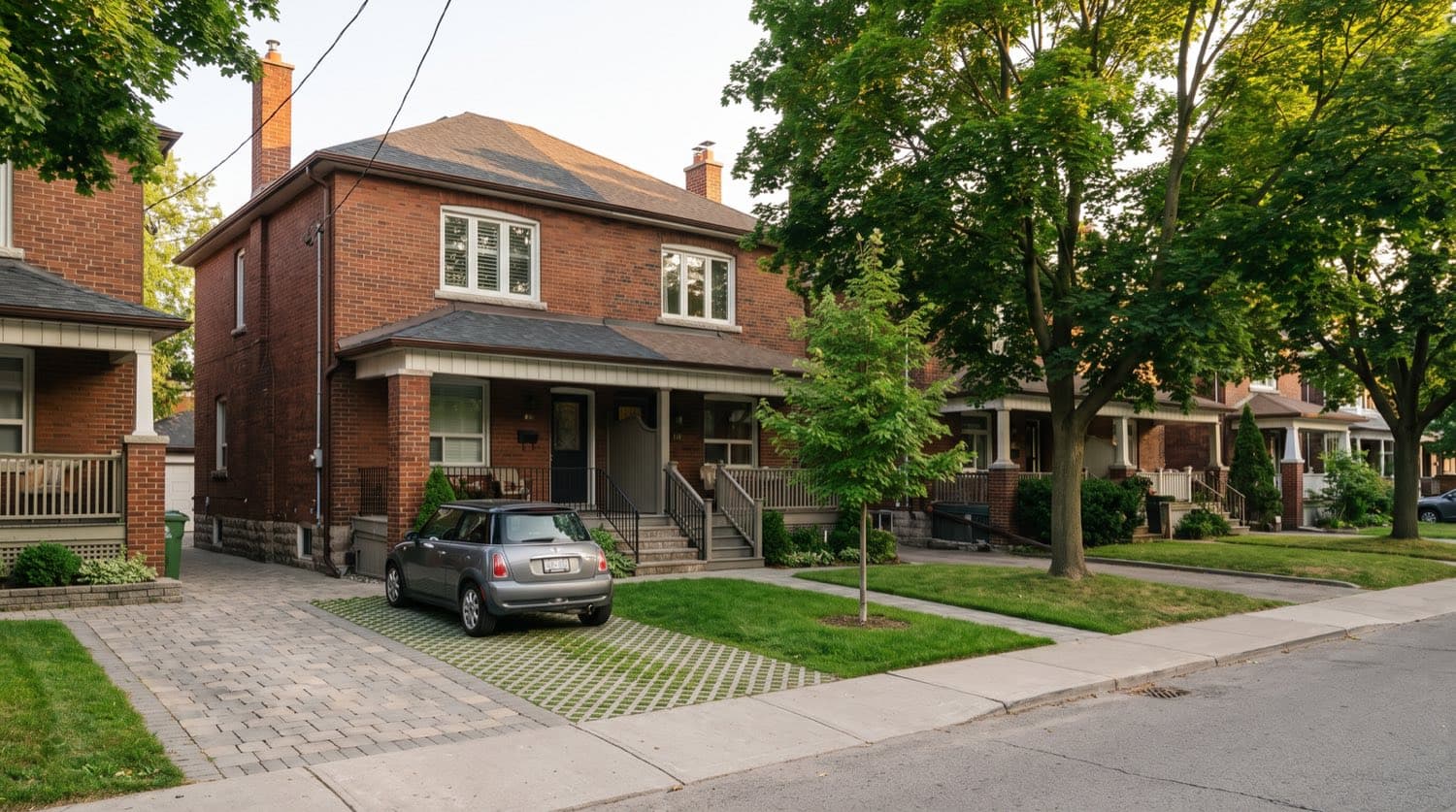
Answer First: A front yard parking pad in Toronto is legal only if it has a City licence, and getting one is a real process: you collect a petition from at least 50% of your block, the City runs a neighbour poll, and you pay roughly $1,800 in fees before pouring anything. The 2026 application fee alone is $514.41 plus HST, and the pad must be no larger than 2.6 m by 5.9 m and paved in permeable material (City of Toronto).
Paving over the front lawn and calling it parking feels like the simplest fix for a street with no permit spots. In Toronto it is one of the most regulated things you can do to a residential lot, and a surprising number of existing pads were never legal in the first place.
Do you need a permit for a front yard parking pad in Toronto?
Yes. A front yard parking pad is legal only when the City has issued an off-street front yard parking licence for that specific address. There is no version of this where you quietly pave the yard and start parking. The surface, the size, the drainage, and even whether your neighbours support it are all governed by Toronto Municipal Code Chapter 918.
This trips up buyers constantly. A pad can look established, poured years ago, and still be unlicensed, which becomes the new owner's problem. If the City inspects an unlicensed pad, the inspection fee alone is $896.62 plus HST in 2026, before any order to license or remove it.
Quotable: In Toronto a front yard parking pad is legal only with a City-issued licence tied to the address. Paving the lawn without one is a bylaw violation, not a grey area, and the inspection fee for an unlicensed pad is $896.62 plus HST (City of Toronto, 2026).
How do you get approved for a front yard parking pad?
The approval hinges on your neighbours, not just your lot. Chapter 918 requires the applicant to first submit a petition signed by residents of at least 50% of the properties on the block, showing initial support. Only then does the City run a formal poll of both sides of the street.
That poll has two thresholds. It needs a minimum response rate of 25% of eligible voters, and a favourable result requires 50% plus one of the ballots actually cast to be in favour. Miss either and the application fails, and a negative poll can block a re-application for three years.
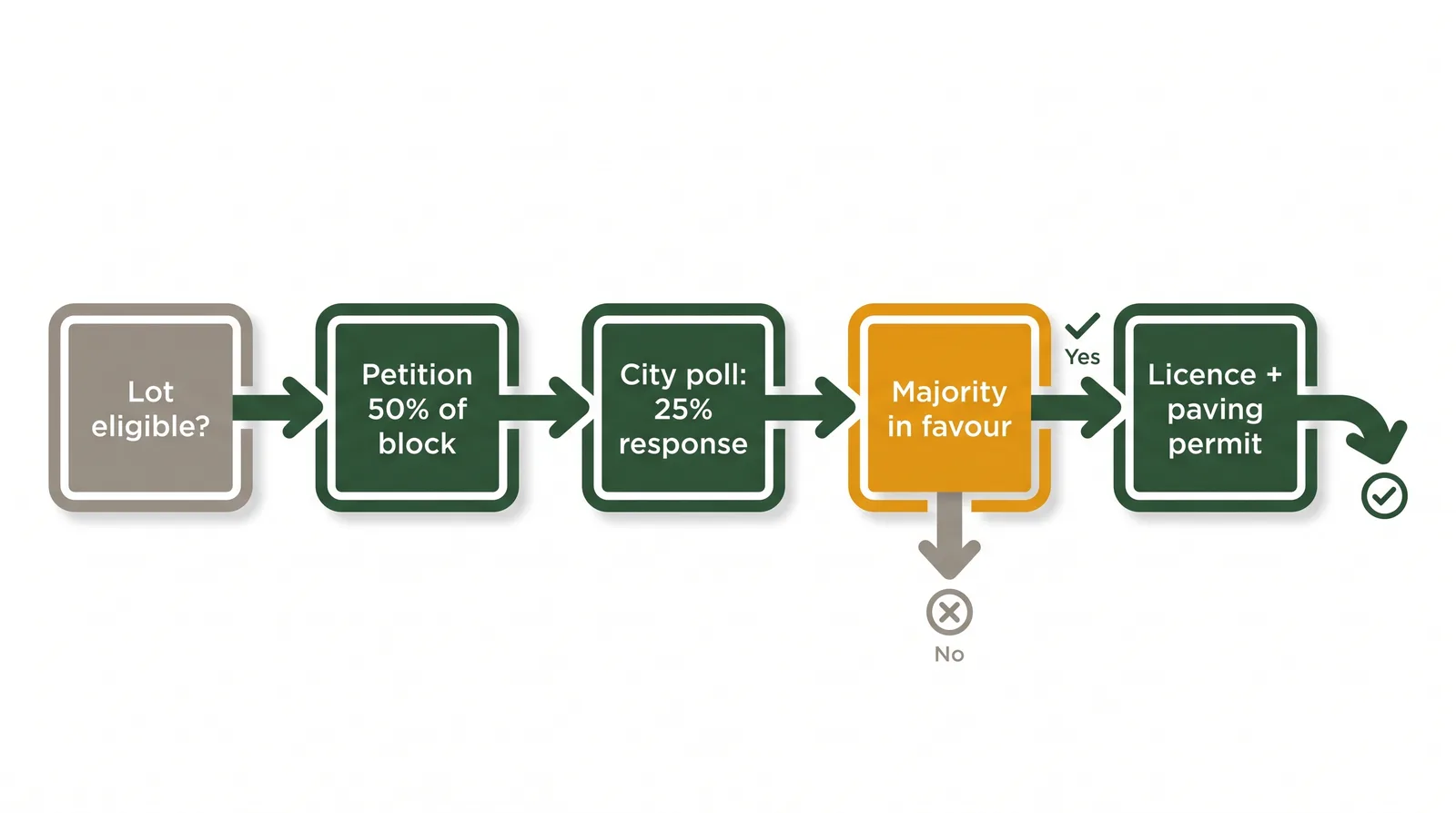
Before the poll even starts, your lot has to be eligible. Eligibility depends on your former municipality, street width, whether a legal driveway already exists, and the room to build a compliant pad. Many narrow downtown streets simply cannot support one, which is why the City tells applicants to confirm with 311 or the Off-Street Parking office first.
What does a front yard parking permit cost in Toronto?
More than most homeowners expect, and the sticker price is only the application. Below are the City of Toronto's published 2026 fees for residential off-street front yard and boulevard parking.
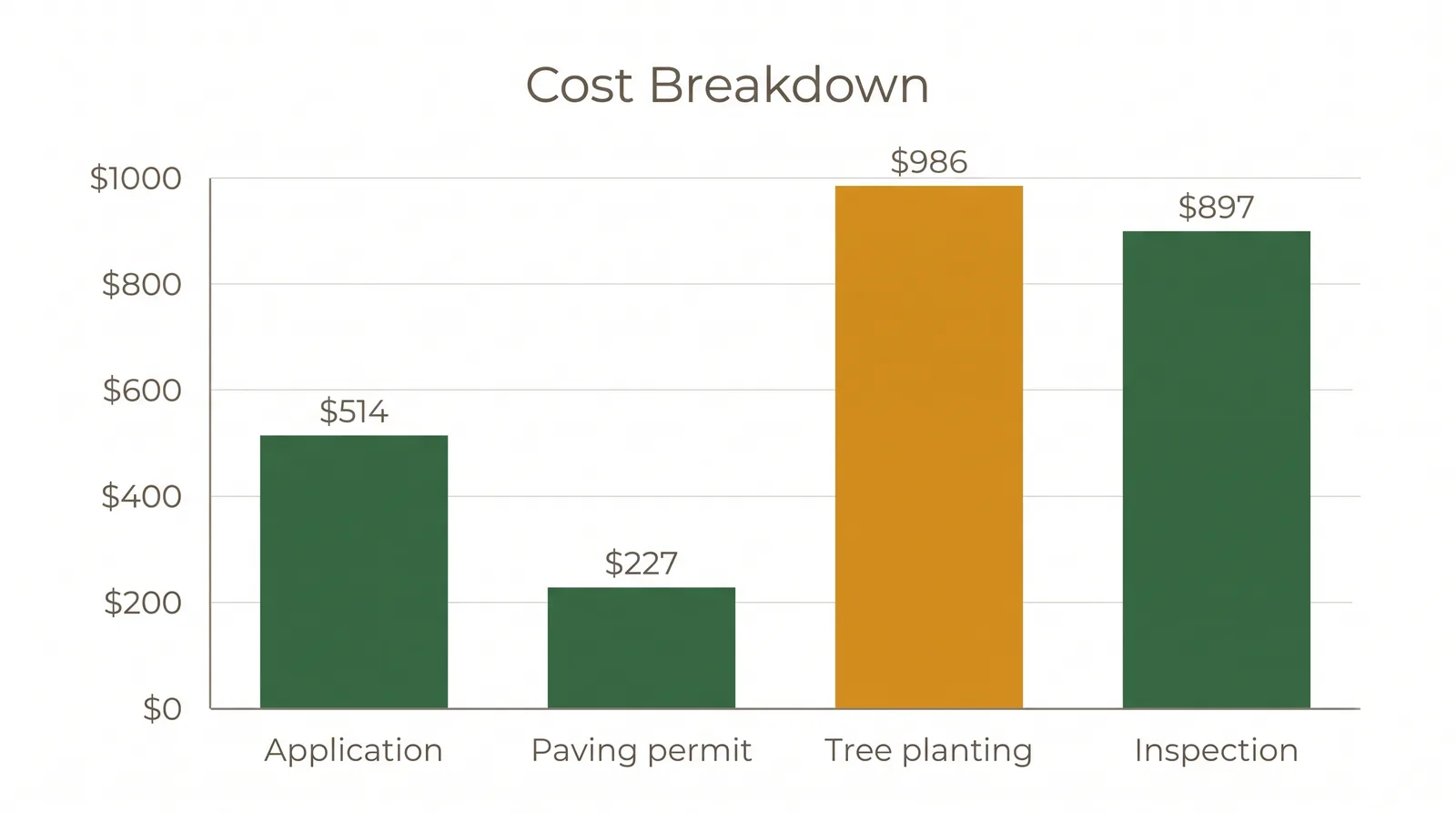
| City fee (2026) | Amount |
|---|---|
| New application | $514.41 + HST |
| Annual renewal (boulevard rental) | $331.13 + HST |
| Transfer on ownership change | $165.56 + HST |
| Paving permit | $227.26 |
| Tree planting (when required) | $986.28 |
| Unlicensed-pad inspection | $896.62 + HST |
| Appeal filing | $1,025.01 + HST |
Add the common lines for a first-time approval and you are near $1,800 in City fees before construction: the application at $581.28 with HST, the $227.26 paving permit, and the $986.28 tree-planting charge if the City requires a tree. None of that includes the paving itself.
From the data: YardQuote tracks 503 interlocking contractors across the GTA, and permeable pavers are their bread and butter for exactly this reason. The City fees are fixed, but the paving is where quotes swing, so the pad surface is worth pricing the same way you would any interlocking driveway job.
What are the rules for the pad itself?
The pad has to be small, permeable, and gently sloped. Chapter 918 caps the parking pad at 2.6 metres wide by 5.9 metres long, which fits one standard car and nothing bigger. That size limit is deliberate: the City is protecting the front-yard green space and the tree canopy, not maximizing your parking.
Permeable paving — a paved surface that is at least 25% open space, so rainwater drains into the ground instead of the storm sewer. Open-cell pavers and permeable interlock qualify; a solid slab of asphalt or poured concrete does not.
The pad must also slope upward from the rear edge of the sidewalk at a 2% to 6% grade so water runs away from the street. And the vehicle rules are strict: passenger cars and light vehicles only, with no trucks, closed vans, campers, or oversize vehicles permitted on a front yard pad.
Quotable: A Toronto front yard parking pad cannot exceed 2.6 m by 5.9 m and must be paved in permeable material that is at least 25% open space. A solid asphalt or concrete slab over the whole footprint does not meet the bylaw (Municipal Code Ch. 918).
Is a front yard parking pad worth it?
For many downtown lots, the honest answer is that it is expensive, uncertain, and often not permitted at all. Between roughly $1,800 in City fees, the paving cost, a petition, and a poll your neighbours can sink, the path is long, and a single failed poll freezes the block for three years.
Where it does make sense, treat the surface as a real hardscape project, not an afterthought. The City fees are non-negotiable, but the permeable paving is a competitive job you should quote out. You can compare current ranges on our interlocking cost page, browse vetted interlocking contractors in your area, and if you are weighing the whole front-yard redesign, the same normalize-first logic from why Toronto landscaping quotes vary 3x applies here too.
Want to know what a permeable parking pad should cost for your lot? Request a quote and compare up to three vetted local pros side by side. Your contact details only go to the one you pick.