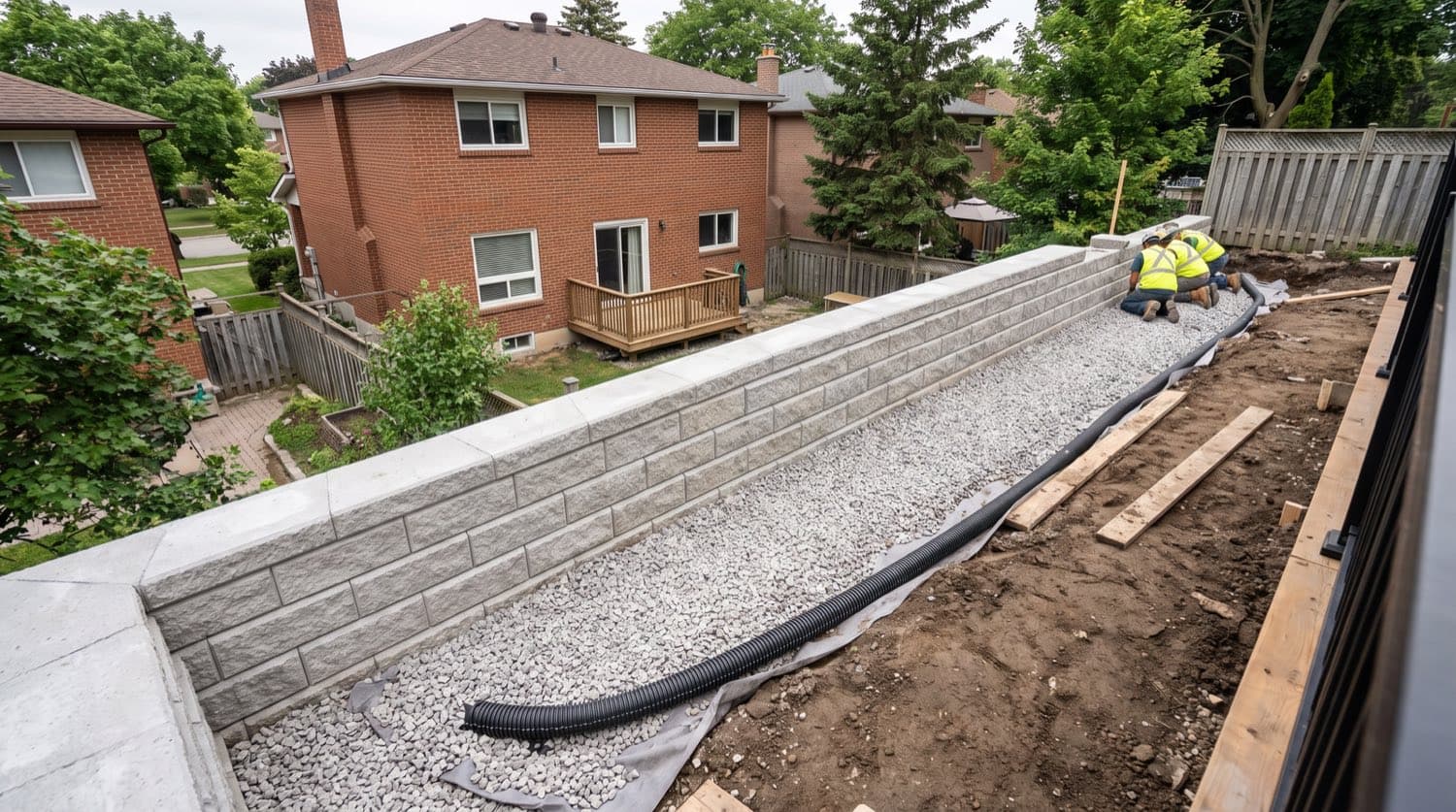
Answer First: Retaining walls fail because of water, not soil weight. When soil behind a wall saturates, it creates hydrostatic pressure, the outward push of trapped water, that builds until the wall leans, bulges, or cracks. About 90% of GTA retaining wall failures trace to drainage and foundation shortcuts (Renovation Price). A properly drained wall has a gravel backfill zone, a perforated drain pipe at the base run to daylight, a filter to keep soil out of the gravel, and surface grading that sheds water. In Toronto's clay and freeze-thaw, none of that is optional.
A retaining wall looks like a job of stacking heavy things well. It is really a job of managing water. The blocks are the visible 20%; the drainage behind them is the 80% that decides whether the wall is still straight in ten years. Skip it, and even a beautiful stone wall leans out and fails.
Why does water make retaining walls fail?
Because saturated soil pushes far harder than dry soil, and the wall has to resist that push. When water fills the spaces between soil particles behind a wall, the soil gets much heavier and the trapped water exerts its own sideways force. That force is hydrostatic pressure, and unrelieved, it builds until it opens joints, bows the wall forward, and eventually topples it (Allan Block).
Hydrostatic pressure — the outward, sideways force that water trapped in saturated soil exerts against a retaining wall; the more waterlogged the soil behind the wall, the harder it pushes, which is why draining that water away is the core of every sound wall design.
This is the single most important thing to understand about retaining walls: the enemy is water, not gravity. A wall built to hold back dry soil can be overwhelmed by the same soil once it is saturated and freezing. That is why drainage, not block strength, is where good walls are won or lost.
Quotable: Saturated soil behind a retaining wall can weigh far more than dry soil and adds its own water pressure, so the outward push a drained wall never feels is what topples an undrained one.
What does proper retaining wall drainage include?
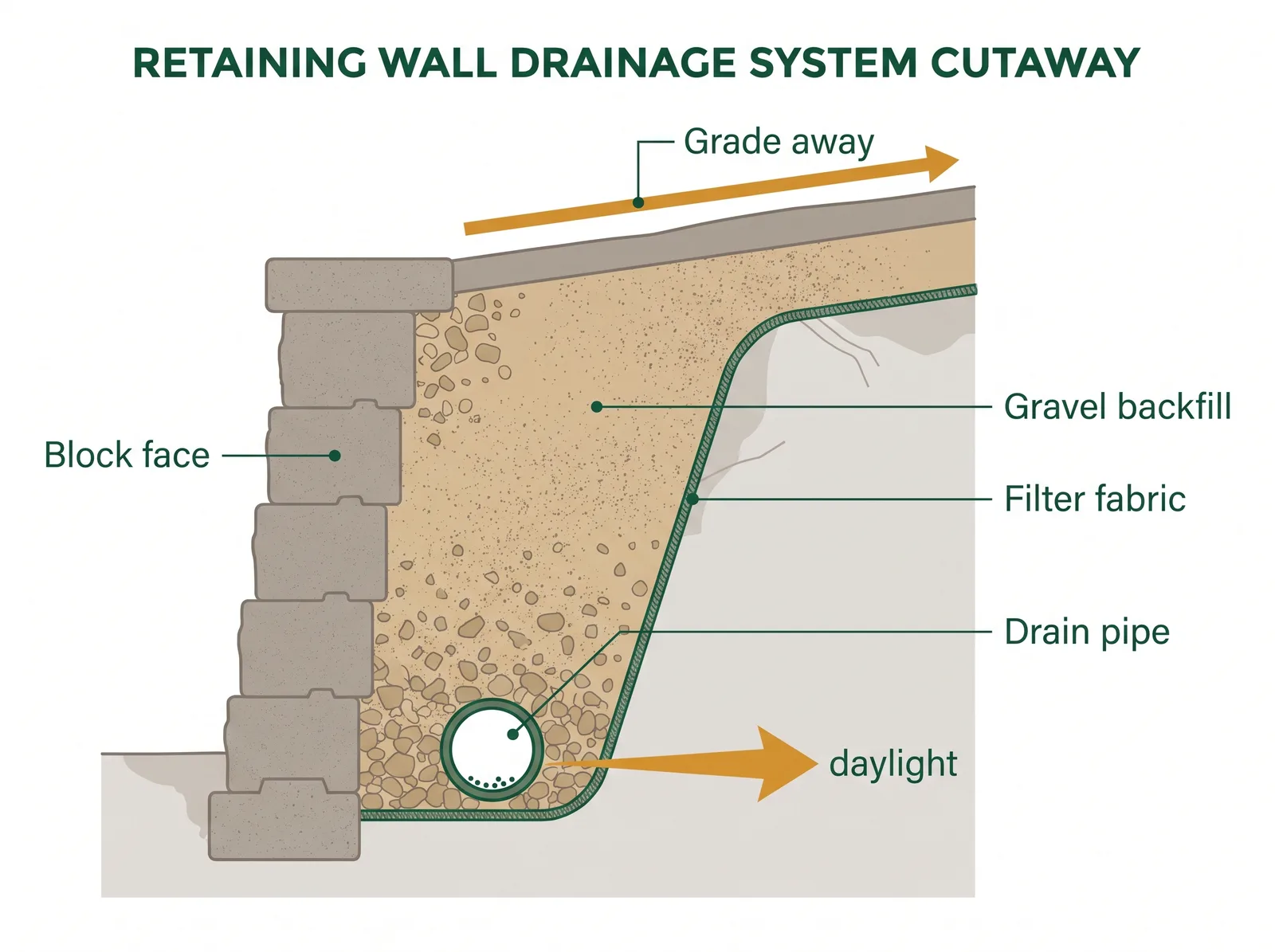
Four parts, working as one system. Leave any one out and the others cannot do their job.
- Gravel backfill. A zone of clean, free-draining gravel placed directly behind the wall gives water a fast path down instead of soaking the soil against the face. This drainage zone is the first line of defense (Allan Block).
- A perforated drain pipe. A perforated pipe (weeping tile) laid at the base of the wall collects the water and carries it away to daylight or a drain. It sits behind the blocks, set back about half a metre to a metre, with the holes down so water rises into it from below and silt does not fall in from above.
- A filter. Filter fabric or a graded aggregate keeps fine soil from washing into and clogging the gravel and pipe. In heavy clay, a graded stone filter is often safer than fabric on the wall face, because clay can blind the fabric and trap pressure.
- Surface management. Grading the ground above the wall to shed rain away from it, plus a cap on top, stops water from pouring into the backfill in the first place.
How do you know a wall's drainage is failing?
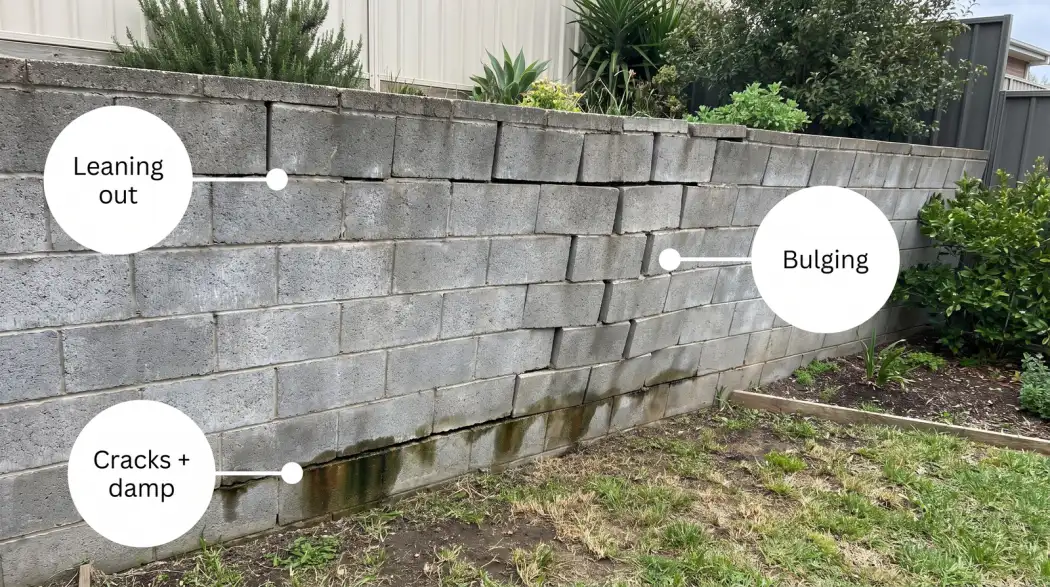
The wall tells you, usually before it collapses. These are the warning signs that water is winning:
- Leaning or tilting outward, the clearest signal that pressure is pushing and the drainage is not relieving it.
- Bulging or bowing in the middle of the wall face, where lateral pressure is highest.
- Horizontal cracks near mid-height on solid walls, from the wall bending under saturated soil.
- Water stains, efflorescence, or constant damp at the base, or soil and mud washing out through the joints after rain.
- Pooling water behind or on top of the wall that never drains away.
From the data: YardQuote tracks 61 retaining-wall contractors across the GTA, 58 of them with three or more reviews at an average of 4.80 stars (YardQuote tracking, July 2026). The recurring theme in this category is that the failures homeowners call about are almost never the block cracking; they are the drainage that was never built, which is why about 90% of GTA wall failures trace to that shortcut (Renovation Price).
Why does drainage matter even more in Toronto?
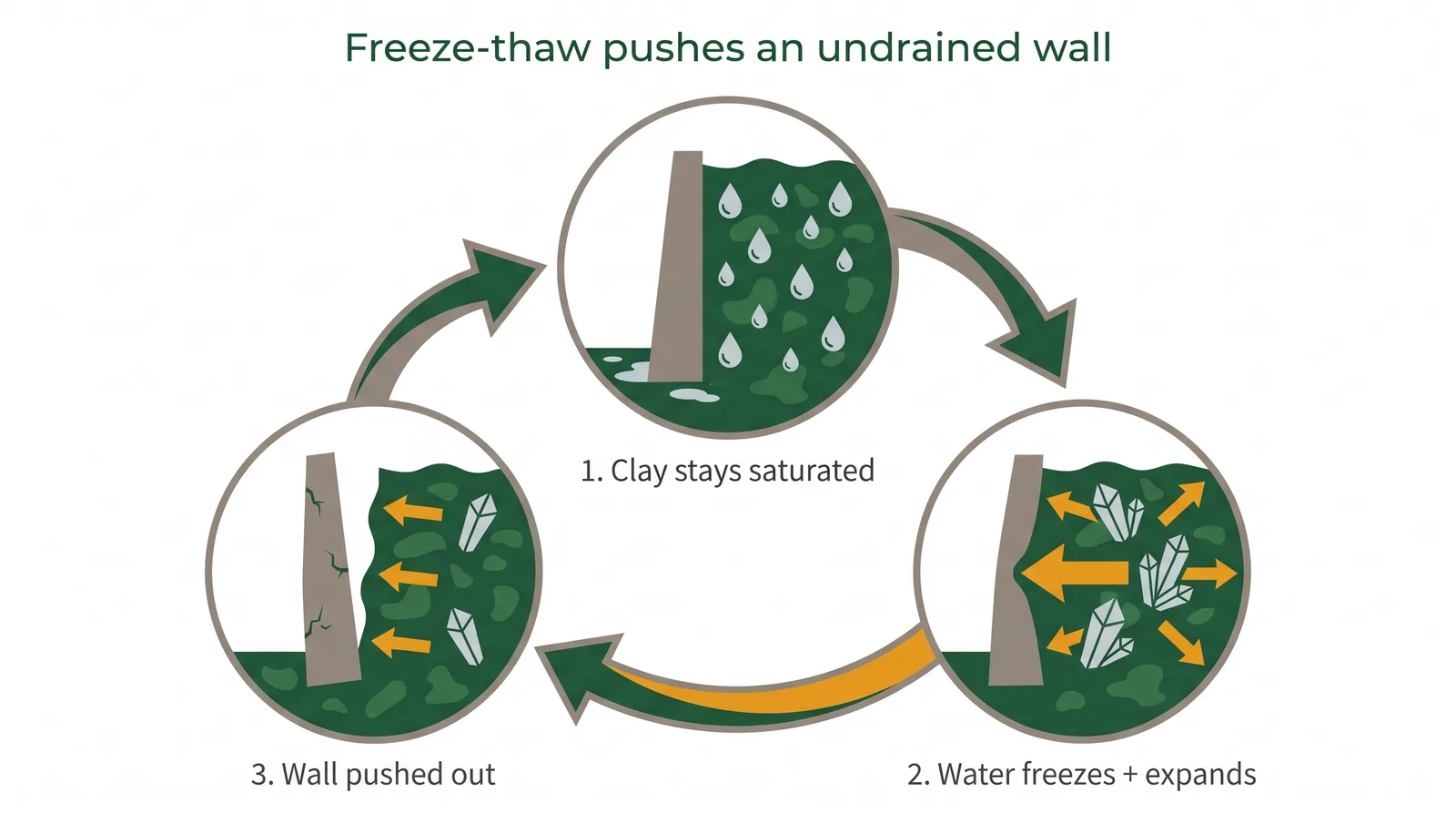
Because the GTA hands a wall two extra challenges: clay soil and freeze-thaw. Much of Toronto sits on heavy clay, which holds water against a wall rather than letting it drain naturally, so pressure builds faster than it would in sandy ground. A wall that ignores drainage is fighting the soil type from day one.
Then winter makes it worse. Saturated soil that freezes expands and pushes the wall outward, then thaws, refreezes, and repeats through the season. That repeated freeze-thaw cycle is why a poorly drained Toronto wall can look fine in year one and lean noticeably by year three. Good drainage keeps the soil behind the wall from saturating, so there is far less water to freeze and heave in the first place.
Drainage is also cheap insurance relative to the wall. Basic weeping tile behind a wall runs about $5 to $10 per linear foot, and solving a complex water problem adds $1,000 to $3,000 (Project Landscaping), against $5,000 to $15,000 to rebuild a failed wall. You can compare full wall pricing on the retaining wall cost page and see how block material choices affect the build. If your wall already shows these signs, our guide to supporting a failing retaining wall covers the fixes, and you can browse retaining wall contractors in Etobicoke and other GTA areas.
Worried your wall's drainage was cut to win a low bid? Request a quote and compare up to three vetted local pros side by side, and ask each exactly what drainage they build in. Your contact details only go to the one you pick.