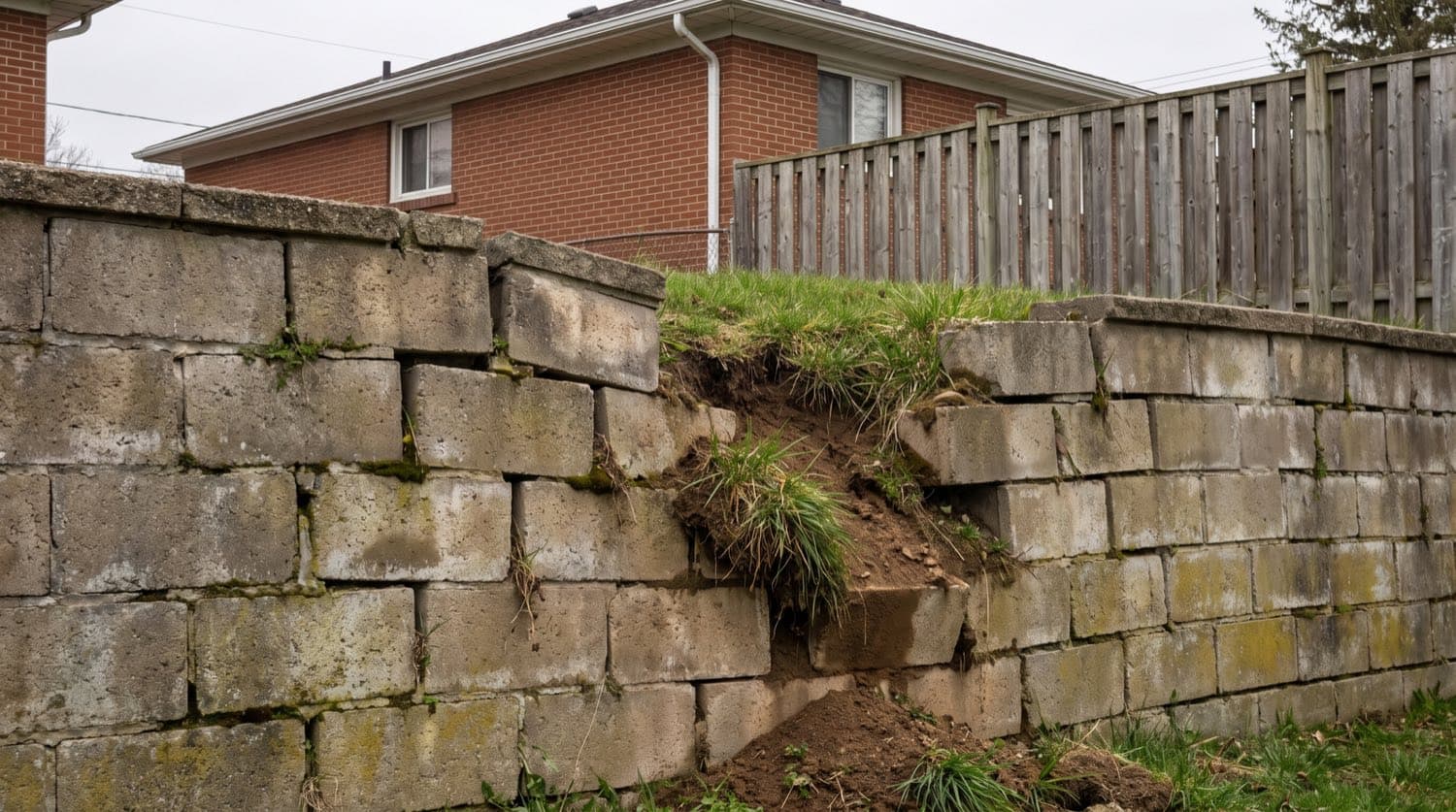
Answer First: A leaning or bulging retaining wall is failing under water pressure, and how you support it depends on how far it has gone. Caught early, fixing the cause, restoring drainage, regrading the top, and removing extra load, can stop a wall that has barely moved. A wall with a real structural lean usually needs tieback or helical anchors that screw into stable soil and pull it back. A severely displaced wall or a failed base is a rebuild, and any wall over 1 metre needs an engineer in Ontario (City of Toronto).
A retaining wall rarely fails overnight. It leans a little, then a little more, and the window to save it cheaply closes as it goes. Reading the wall correctly, and acting while it is still a support job and not a rebuild, is what keeps the cost down and the yard safe.
How bad is it? Reading a failing wall
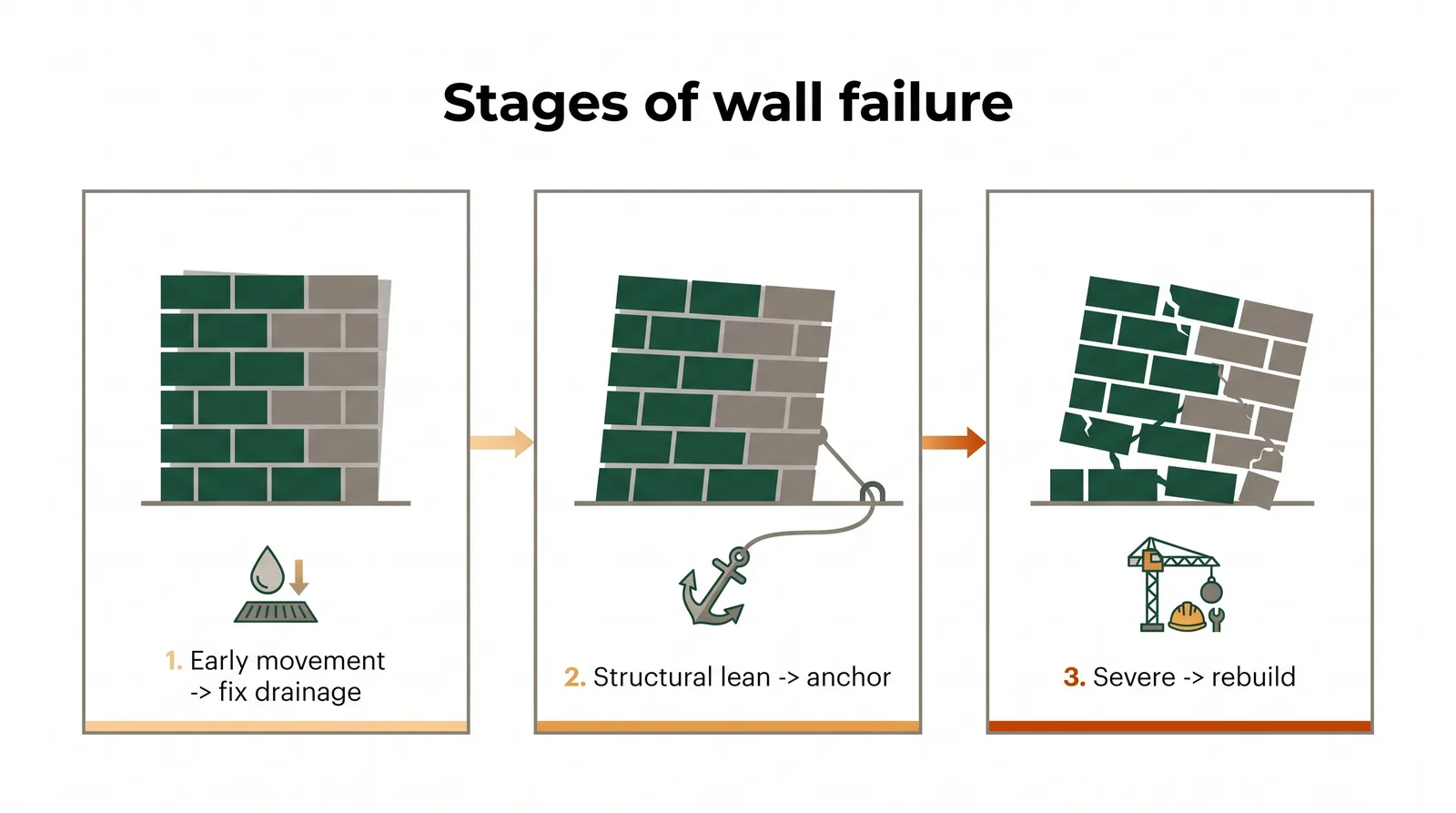
Match the fix to the stage, because the same wall costs wildly different amounts to save depending on how early you catch it. Retaining wall failure runs on a spectrum from "watch it" to "rebuild now."
- Early movement: slight lean, minor cracks, or damp and washed-out soil at the base. The wall is structurally intact but the pressure is winning. This is the cheap-to-fix stage.
- Structural lean or bulge: a clear outward tilt or a bowed section in the middle of the face. The wall is moving under load and needs structural support, not just drainage.
- Severe displacement or base failure: a heavy lean, blocks separating or sliding, or the base kicked out. Support hardware cannot pull this back safely; it is a rebuild.
Quotable: A retaining wall fails on a spectrum: early movement is a drainage fix, a structural lean is an anchoring job, and a severe displacement is a rebuild. The cost triples at each stage, so catching it early is the whole game.
Early movement: fix the cause first
If the wall has barely moved, treat what is pushing it, not just the symptom. In most cases that push is water, so relieving the pressure can stabilize a wall that is only starting to go.
- Restore drainage. Add or clear a drain pipe behind the base, install weep holes through the face, or add a French drain. Basic weeping tile runs about $5 to $10 per linear foot, and a bigger water fix adds $1,000 to $3,000 (Project Landscaping). This attacks the root cause behind about 90% of GTA wall failures (Renovation Price).
- Regrade the top. Slope the ground above the wall so rain sheds away from it instead of soaking the backfill.
- Remove the surcharge. Take the extra load off the top: stop parking on it, move the woodpile, or rework a patio that sits above the wall. A surcharge multiplies the pressure the wall has to resist.
The honest caveat: these work only while the wall is still structurally sound. Once it has a real lean or bulge, drainage alone will not pull it back upright, though it is still worth doing so the repair lasts.
Structural lean: anchor the wall back
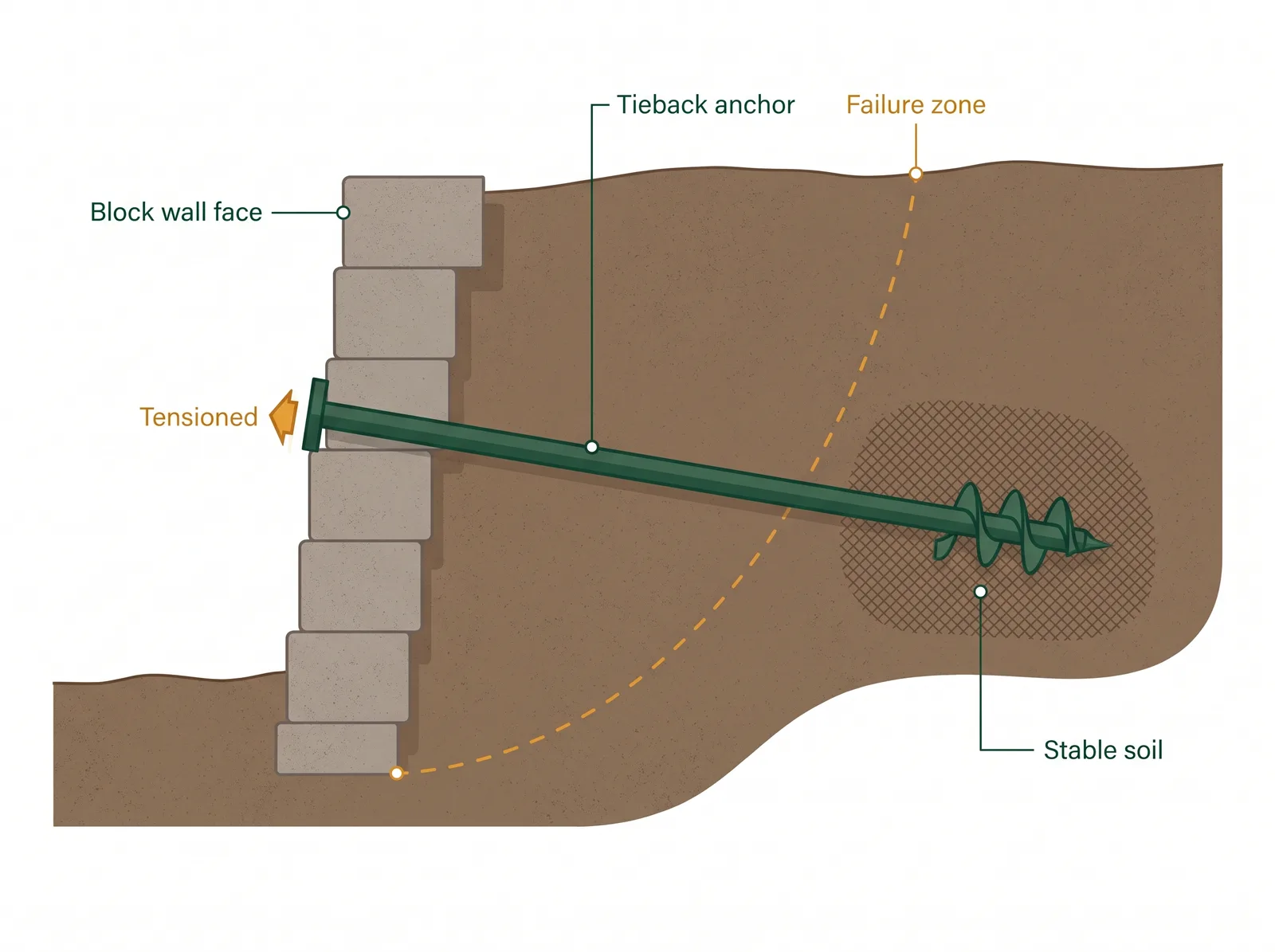
A wall that is clearly leaning or bulging needs something to hold it against the soil pressure, and the standard engineered fix is a tieback or helical anchor. This is how failing walls get saved without a full teardown.
Tieback (helical) anchor — a steel anchor drilled or screwed through the wall and deep into stable soil behind the failure zone, then tensioned so it pulls the wall back and braces it against the pressure that pushed it out.
Because the anchor reaches soil well beyond the wall, it resists forces that surface water and freeze-thaw never touch, making it a durable fix. An engineer may also specify related methods: plate or deadman anchors (a steel plate buried back from the wall and tied to it with a rod), or soil nails with a sprayed concrete facing that creates a new reinforced face over the old wall. Which one fits depends on the wall type, the soil, and how much it has moved, which is exactly why this stage needs an engineer.
When does a failing wall need an engineer or a rebuild?
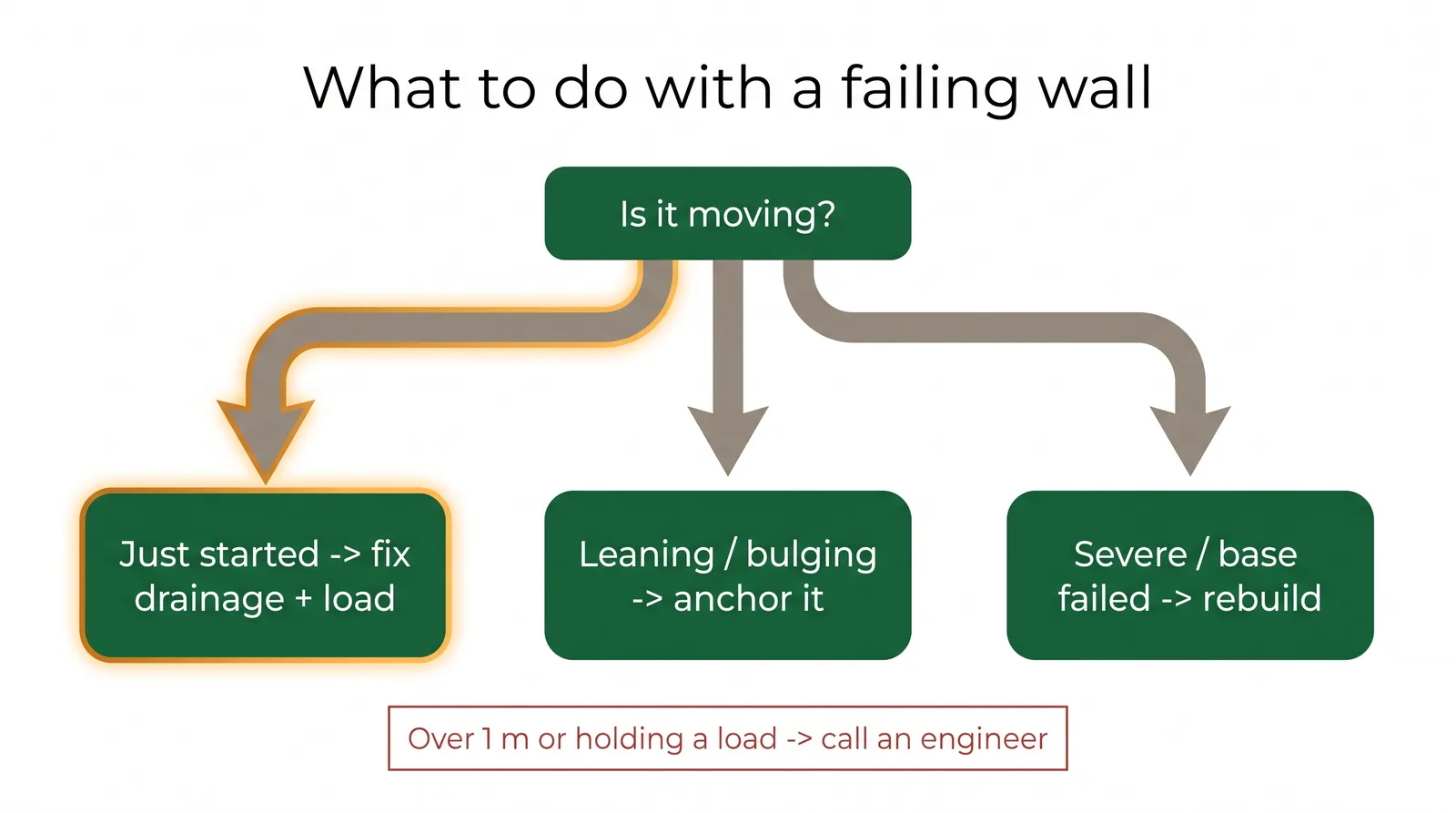
Bring in an engineer the moment the problem is structural, and expect a rebuild when the wall has moved too far. In Ontario this is not just good practice; a wall over 1 metre near public or publicly accessible property legally requires drawings stamped by a licensed engineer (City of Toronto), and engineered drawings run $800 to $1,800.
Call an engineer, not just a landscaper, when:
- the wall is over 1 metre tall,
- it shows a structural lean, bulge, or sliding,
- it holds up a surcharge like a driveway, parking pad, or building, or
- you cannot tell why it is moving.
A rebuild becomes the right call when the wall is severely displaced, the base has failed, or the material is spent, like timber that has rotted through. A rebuilt wall with a proper base and drainage runs $5,000 to $15,000 for a typical residential wall, plus $1,500 to $3,500 for engineering and permits over 1 metre. That is more than an anchor repair, but on a wall that is too far gone, anchoring is throwing money at a wall that will fail again.
From the data: YardQuote tracks 61 retaining-wall contractors across the GTA, 58 of them with three or more reviews at an average of 4.80 stars (YardQuote tracking, July 2026). The pattern in this category is clear: the walls that get anchored and saved are the ones whose owners called at the first lean, and the rebuilds are the ones that waited a few more winters.
Whether yours is a support job or a teardown comes down to the repair-versus-rebuild math, which our guide to retaining wall repair in Toronto works through, and since water is usually the culprit, why walls fail without drainage explains what to fix so the repair holds. You can compare wall and rebuild pricing on the retaining wall cost page or browse retaining wall contractors in North York and other GTA areas.
Not sure if your wall can be saved or needs rebuilding? Request a quote and compare up to three vetted local pros side by side, and get more than one read before you commit. Your contact details only go to the one you pick.