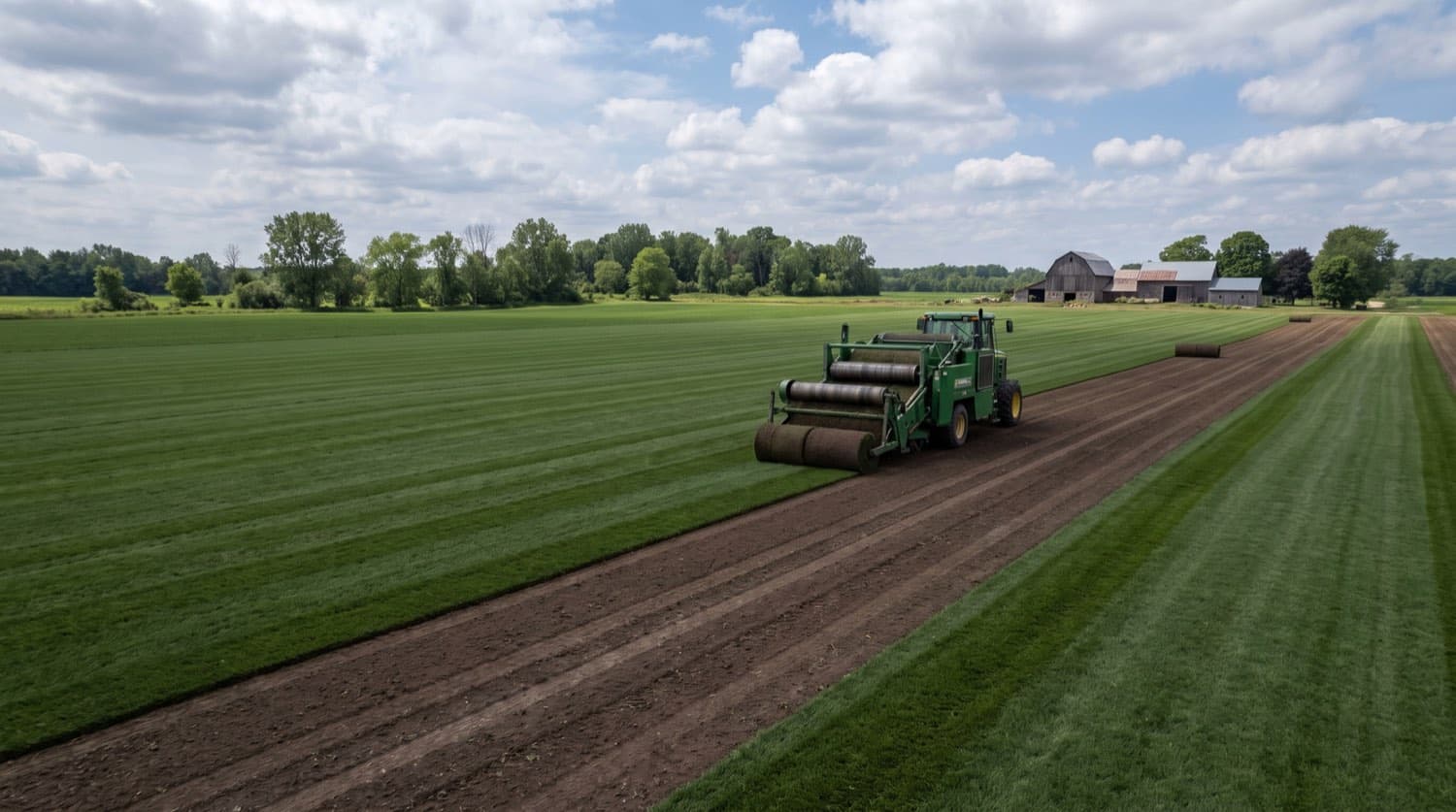
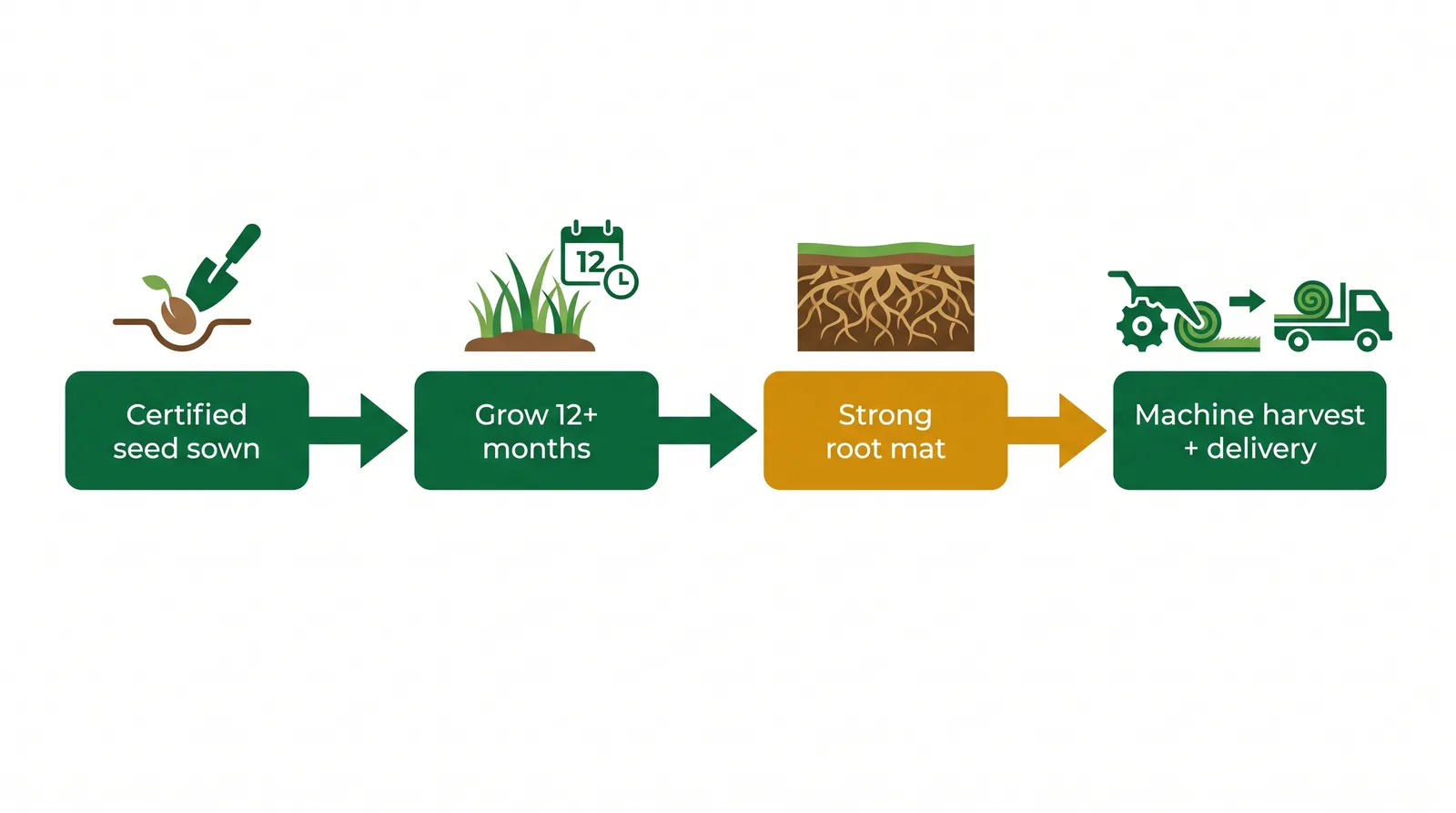
Answer First: Sod is a farm crop, not a manufactured product. Ontario growers seed certified Kentucky bluegrass blends on fertile topsoil, grow the field for at least 12 months (often two to three years to a finished crop), then machine-harvest it in thin slabs, about 15 mm of soil, rolled to cover roughly 9 to 10 square feet each. By the time a roll reaches your yard it already carries a mature root system, which is why it can knit in within a few weeks.
The green roll on the pallet looks instant. It is the opposite: it is one of the slowest crops a farmer grows, and understanding that explains both why installed sod costs what it does and why it works so fast once it is down.
What is sod, and how is it grown?
Sod (also called turf) — a living sheet of grass and its interwoven roots, grown to maturity in a field and cut off with a thin layer of soil so it can be transplanted whole onto prepared ground.
Ontario sod starts as certified seed. Growers plant improved turfgrass cultivars registered for sale in Canada onto fertile agricultural topsoil, drained and free of subsoil or clay, with a soil pH around 6.5 to 7.5 (Landscape Ontario). It is almost never a single grass. The provincial standard caps any one cultivar at 90% of the turf, so a field is a deliberate blend, which spreads the risk of disease or winterkill across several grass types.
Then it grows, and waits.
How long does sod take to grow?
Longer than almost anyone guesses. Ontario's turfgrass sod standard sets a minimum age of 12 months before harvest, and the roots must be developed enough that a lifted slab holds its own weight when you pick it up by the two top corners. The wider industry treats natural grass sod as a two-to-three-year crop: seed sown one spring may not be a finished, marketable field for two or three growing seasons (Ontario Recreation Facilities Association).
That long grow-out is exactly what you are buying. The farm spent a year or more building the dense root system that lets a cut roll survive being lifted, trucked, and re-laid.
Quotable: Ontario sod must grow a minimum of 12 months before it can be cut, and the industry treats it as a two-to-three-year crop. The roll you buy is the end of a multi-year head start on root growth.
How sod is harvested
Once the root mat is strong enough, harvest is fast and mechanical. Purpose-built machines slice horizontally under the turf, cutting at a uniform soil thickness of about 15 mm, excluding the grass blades and thatch, and roll or stack the slabs. A standard Ontario roll covers roughly 9 to 10 square feet.
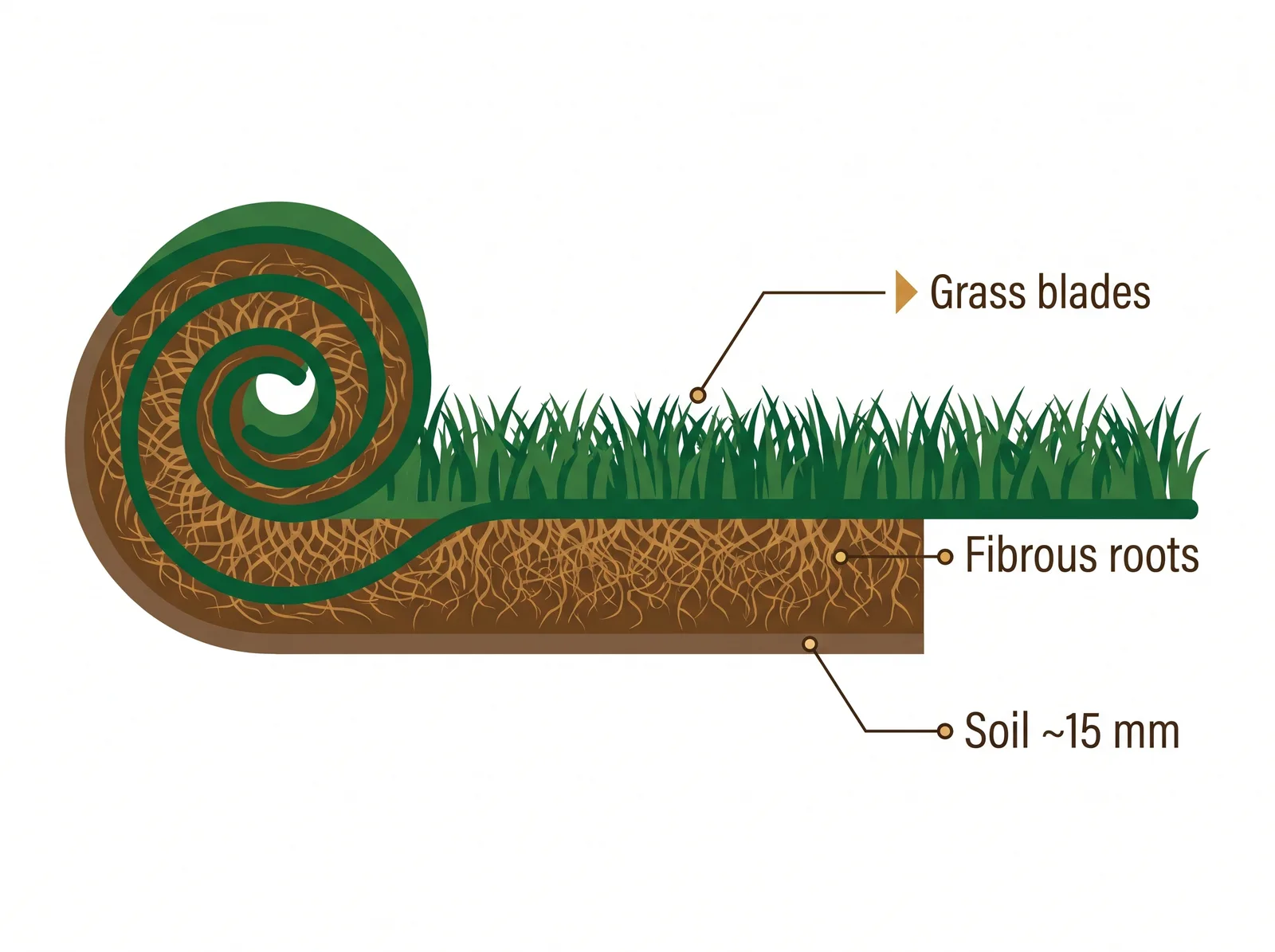
The thinness is intentional. A thin slab is lighter to carry and, more importantly, sets the mature roots right against your prepared soil so they re-establish quickly, usually in two to three weeks. Sod is also perishable once cut, which is why it is harvested to order and trucked in fresh rather than stockpiled.
Where GTA sod comes from
Because fresh-cut sod cannot sit around, the farms that supply Toronto sit in the agricultural belt around it, commonly the Hamilton, King, and Cambridge areas, and deliver by the load. Growers including Greenhorizons, Brookdale, Turf Care, and King Sod serve the region.
From the data: In YardQuote's Toronto sod pricing data (July 2026), farm sod runs $0.35 to $0.90 per square foot as material, while a fully installed lawn is $1.50 to $3.50. The grass itself is the cheap part; roughly 60 to 75% of an installed quote is labour, topsoil, and prep. The farm did the slow work, and the crew does the expensive work.
Why farm-grown sod roots so fast
A seeded lawn starts its root system from zero in your yard and needs a full season to mature. Sod arrives with a year or more of root growth already done at the farm, so it knits into prepared soil in weeks, not months. That head start is the entire value proposition: you are paying for the grower's time so you do not have to wait through it.
It is also why prep matters so much. Sod re-roots only as well as the soil under it, which is why installed quotes lean so heavily on topsoil and grading. If you are weighing the fast-but-pricier roll against the slow-but-cheap seed, our breakdown of sod installation cost per square foot runs the real math, and if you are set on sod, Kentucky bluegrass, the default Ontario choice, explains what you are actually getting. You can compare current installed ranges on the sod cost page or browse rated crews on the lawn care directory for your area.
Trying to decide between sod and seed, or which farm blend suits your yard? Request a quote and compare up to three vetted local pros side by side, so you know exactly what you are paying the farm for and what you are paying the crew for. Your contact details only go to the one you pick.