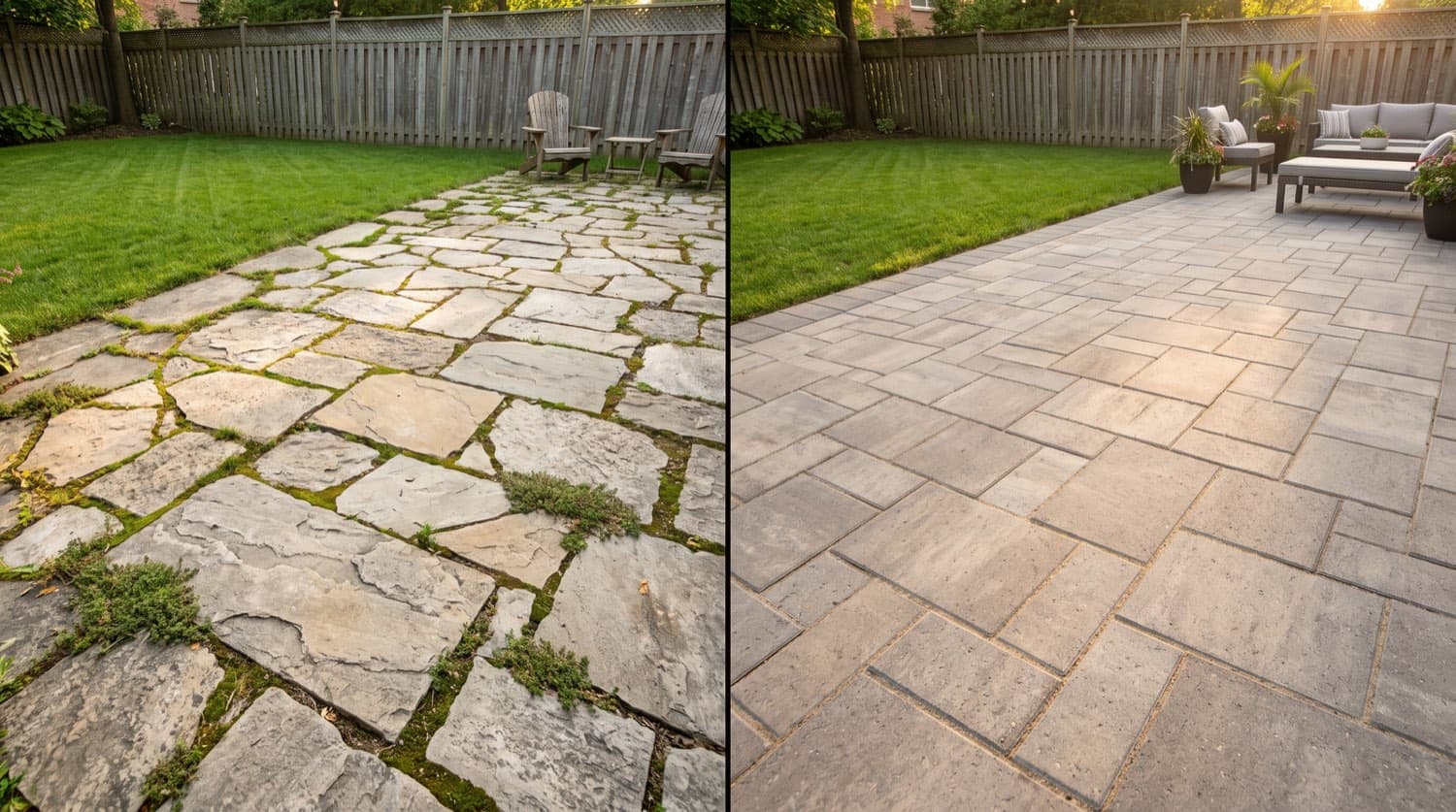
Answer First: For most Toronto patios, interlocking concrete pavers are the better default: they cost about half of natural flagstone installed ($18 to $30 versus $35 to $65+ per square foot), they are engineered for freeze-thaw, and a single damaged paver lifts out and gets replaced. Flagstone is natural stone that looks richer and more unique, but it costs more, porous types can crack in our winters, and its irregular joints need more upkeep. Choose flagstone for looks; choose pavers for value and durability.
Both end up as a hard, handsome surface underfoot, so the choice is really about three things: what you pay, how it survives a Toronto winter, and what happens when something goes wrong. Here is how they line up.
What is the difference between flagstone and interlocking pavers?
They are two different products that solve the same problem.
Flagstone — natural stone quarried into flat slabs, sold in irregular or cut shapes that a mason fits together by hand, so no two patios are identical.
Interlocking pavers — manufactured concrete units of uniform size and shape, engineered to lock together over a compacted gravel base with sand-filled joints.
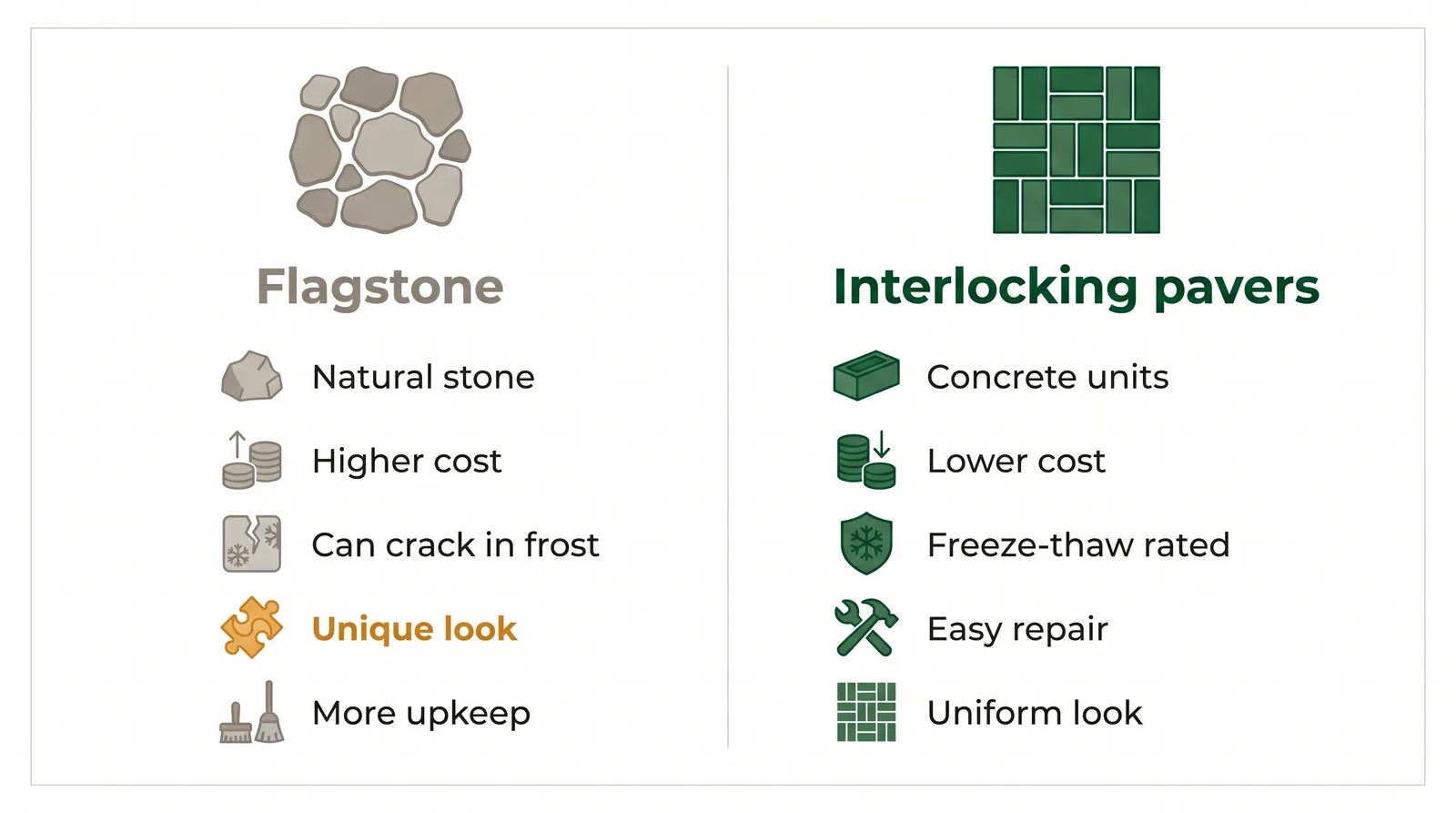
That difference, hand-fitted natural stone versus uniform engineered units, drives everything else: the price, the winter performance, and the repair.
What does each cost in Toronto?
This is usually the deciding factor, and the gap is large.
| Surface | Installed | Material only |
|---|---|---|
| Interlocking pavers (standard) | $18 – $30 / sq ft | $5 – $8 / sq ft |
| Premium textured pavers | up to ~$38 / sq ft | $12 – $20 / sq ft |
| Natural stone (flagstone) | $35 – $65+ / sq ft | $25+ / sq ft |
Installed interlock patios run $18 to $30 per square foot in the GTA, while natural stone installs at $35 to $65 or more. On a typical 400 square foot backyard, that is roughly $7,000 to $12,000 in pavers versus $14,000 or more in flagstone. Two things drive the premium: natural stone material costs several times more, and fitting irregular slabs is slower, more skilled labour than laying uniform units.
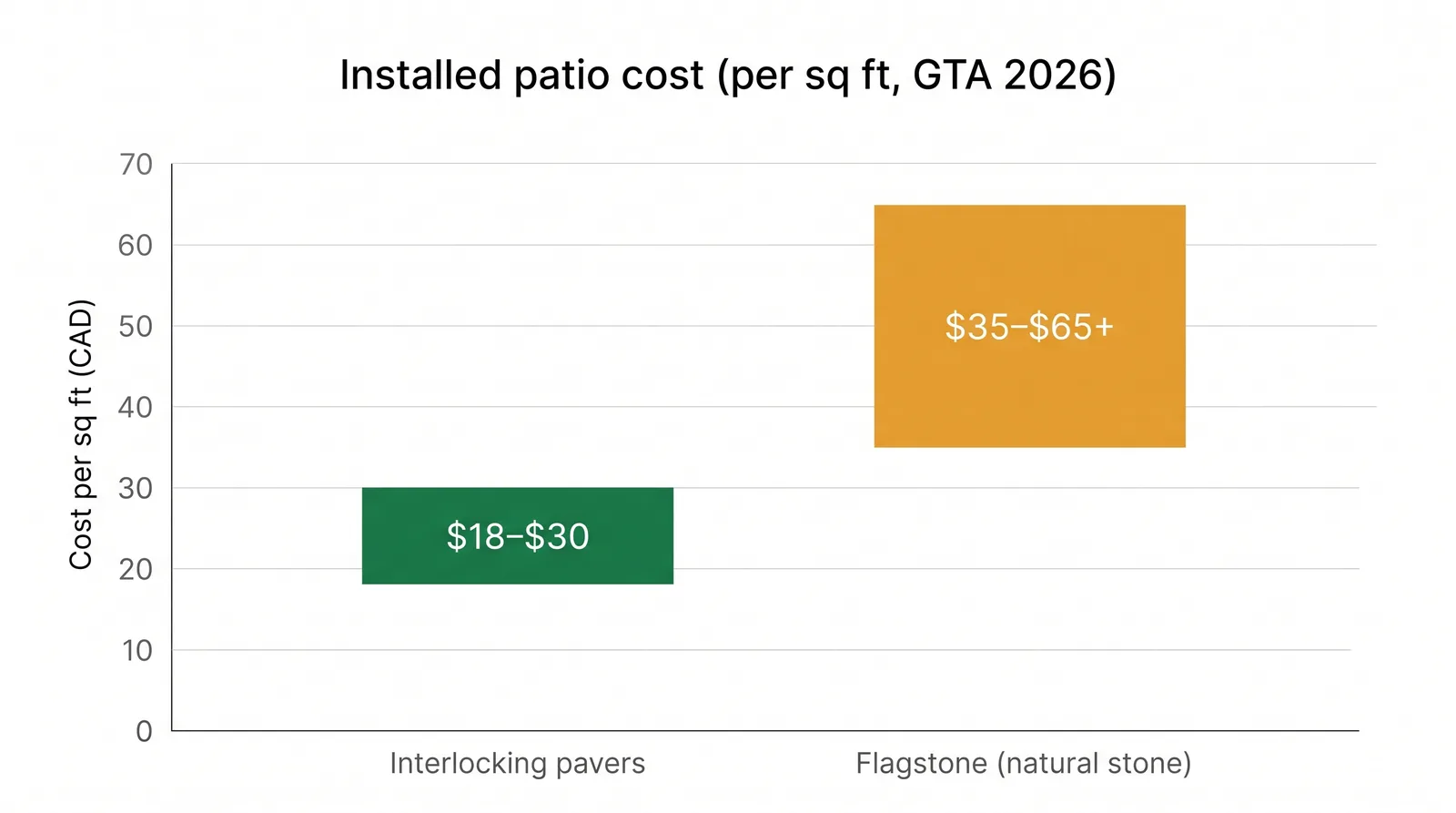
Quotable: Installed flagstone runs $35 to $65+ per square foot in the GTA versus $18 to $30 for interlocking pavers, roughly double. You are paying for the natural material and the slower hand-fitting it demands.
The Toronto question: freeze-thaw durability
This is where our climate makes the call. Toronto's freeze-thaw cycles, water seeps into a surface, freezes, expands, and pries it apart, are hard on any patio.
Interlocking concrete pavers are manufactured to a consistent density specifically for cold climates, so their freeze-thaw performance is predictable. Flagstone is a natural material, and it varies: dense stone handles cold well, but porous types such as some sandstone absorb water and can crack or flake after repeated freezing. You do not always know exactly what you are getting with natural stone until it has been through a few winters.
From the data: Across the interlocking contractors YardQuote tracks in the GTA, the whole market is built around freeze-thaw survival, which is why quotes live and die on base depth. A patio needs 6 to 10 inches of compacted gravel base under it; skimping there is why cheap patios heave, in either material. The surface you pick matters less than the base under it.
Installation and repair
Uniformity is the paver's quiet advantage. Because the units are identical and dry-laid over sand, a single cracked or sunken paver lifts out and gets replaced with a match, and re-leveling a sunken section runs about $8 to $22 per square foot. Flagstone is fitted like a jigsaw, which is slower to install, and a cracked slab is harder to match and swap, especially if it was mortar-set, because the joints do not flex with the ground.
Dry-laid joints, sand rather than mortar, help both materials survive freeze-thaw by letting the surface move slightly instead of cracking. It is the standard method in the GTA for exactly that reason.
Maintenance
Neither is maintenance-free, but flagstone asks for more. Natural stone is often sealed to resist staining and water, and its irregular joints invite weeds that you pull or treat through the season. Interlocking pavers get a periodic sand-and-seal, about $1.35 to $2.50 per square foot, to guard against road salt and fading. Salt is the real enemy of any jointed surface in Toronto, so keep de-icer off both.
Which should you choose?
Match the material to what you actually value.
- Choose interlocking pavers if you want the best value, predictable freeze-thaw durability, easy single-unit repairs, and a wide range of looks. This is the right call for most GTA patios and driveways.
- Choose flagstone if you want a genuinely natural, one-of-a-kind surface with a high-end feel and you have the budget for both the material and the upkeep. Pick a dense stone rated for cold, not a soft porous one.
Whichever surface you choose, the base and the installer decide whether it lasts, which is why three quotes can vary so much, covered in why Toronto landscaping quotes vary. See current ranges on the interlocking cost page, get ideas for a small yard in paver patio ideas for small Toronto backyards, or browse rated crews on the interlocking directory for your area.
Not sure which surface fits your yard and budget? Request a quote and compare up to three vetted local pros side by side, on the same scope and base spec, so the numbers actually compare. Your contact details only go to the one you pick.