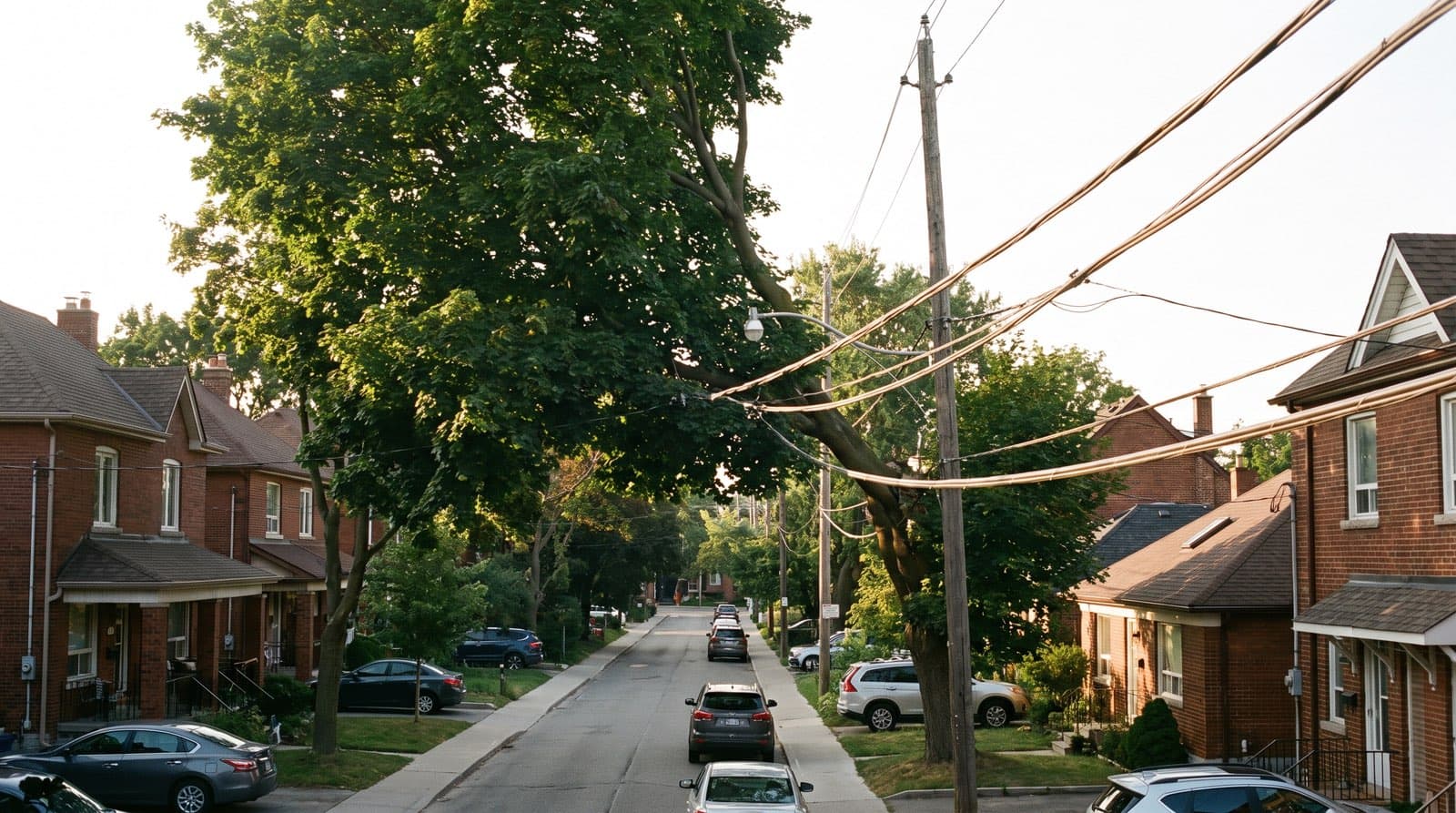
Answer First: Toronto Hydro trims trees near powerlines only when there is a public safety or electrical reliability concern, and mostly along public roads or on its own high-voltage (over 750 volt) lines. The low-voltage wire running onto your house sits under 750 volts, and on private property that line is usually the homeowner's responsibility to keep clear. Either way, never trim near a live wire yourself, Toronto Hydro's own advice is to hire a licensed arborist, and to call 416-542-8000 (press 1) if a tree is contacting a line.
A maple you planted twenty years ago is now brushing the wire that feeds your house. You call Toronto Hydro expecting a crew. Sometimes one comes, sometimes you are told it is your tree and your problem. Both answers can be correct, because who trims a tree near a powerline in Toronto depends on two things: which line it is, and whose property it is on.
Who is responsible for trimming a tree near a Toronto powerline?
Responsibility follows the line's voltage and location, not how inconvenient the tree is to you. Toronto Hydro trims to protect the grid and the public, so it handles the wires the public depends on and leaves the rest to owners.
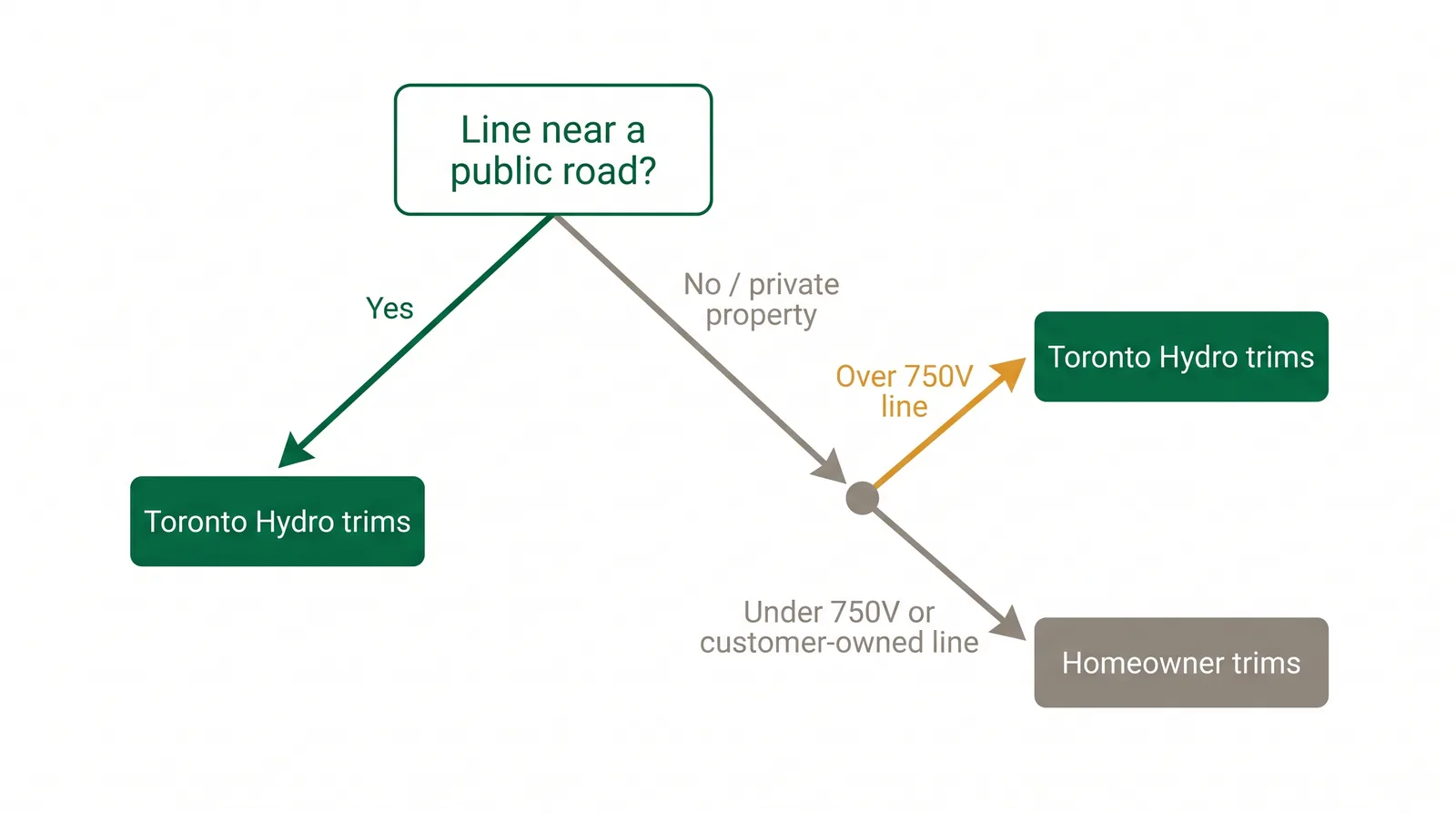
Here is how Toronto Hydro splits it:
| Where the line is | Voltage | Who trims |
|---|---|---|
| Along a public road | Any | Toronto Hydro |
| Private property, Toronto Hydro-owned line | Over 750V | Toronto Hydro |
| Private property, Toronto Hydro-owned line | Under 750V | Property owner |
| Private property, customer-owned line | Any | Property owner |
The wire most homeowners worry about is the service drop: the line from the pole to the mast on your roof. It runs below 750 volts, which puts it in the owner-responsible column on private property. So the branch touching the wire to your house is, in most cases, yours to deal with. Toronto Hydro also notes it "only trims or removes trees when there is a public safety or electrical reliability concern," so a tree that is close but not causing a problem will not get a City crew.
Quotable: Along public roads, Toronto Hydro trims trees near powerlines at no cost to you, but only when there is a public safety or reliability concern. The low-voltage wire running onto your own house is usually the homeowner's to keep clear.
What should I do if a branch is already touching the wire to my house?
Do not touch it, and do not send a general landscaping crew up a ladder. Toronto Hydro is direct about this: "do not attempt to trim them yourself. Always hire a licensed arborist to complete this work safely." A branch resting on a live service wire can energize the whole tree and the ladder leaning against it.
The order of operations matters. Call Toronto Hydro first at 416-542-8000. For anything actively dangerous, sparking, arcing, or a wire down, press 1, which reaches a line that is monitored around the clock. Toronto Hydro can confirm the line status or arrange a temporary disconnection so an arborist can work safely. Only then does the cutting happen, and it should be a certified arborist doing it, not a mow-and-go crew.
Quotable: A branch resting on a live service wire can energize the entire tree and any ladder against it. Ontario's utilities are unanimous: call the utility first, then let a certified arborist do the cut. Never a general crew, never yourself.
From the data: Of the 650 landscaping companies YardQuote tracks across the GTA, most handle planting, pruning, and cleanup, but work within reach of a live wire is arborist territory, a separate qualification. Before anyone climbs, confirm the pro is a certified arborist and that Toronto Hydro has cleared the line. That one question separates a routine job from a fatal one.
How close can I plant a tree to a powerline in Toronto?
Match the tree's mature height to its distance from the line, so it never grows into the wires in the first place. Toronto Hydro's planting guide splits the space under and around a line into three zones.
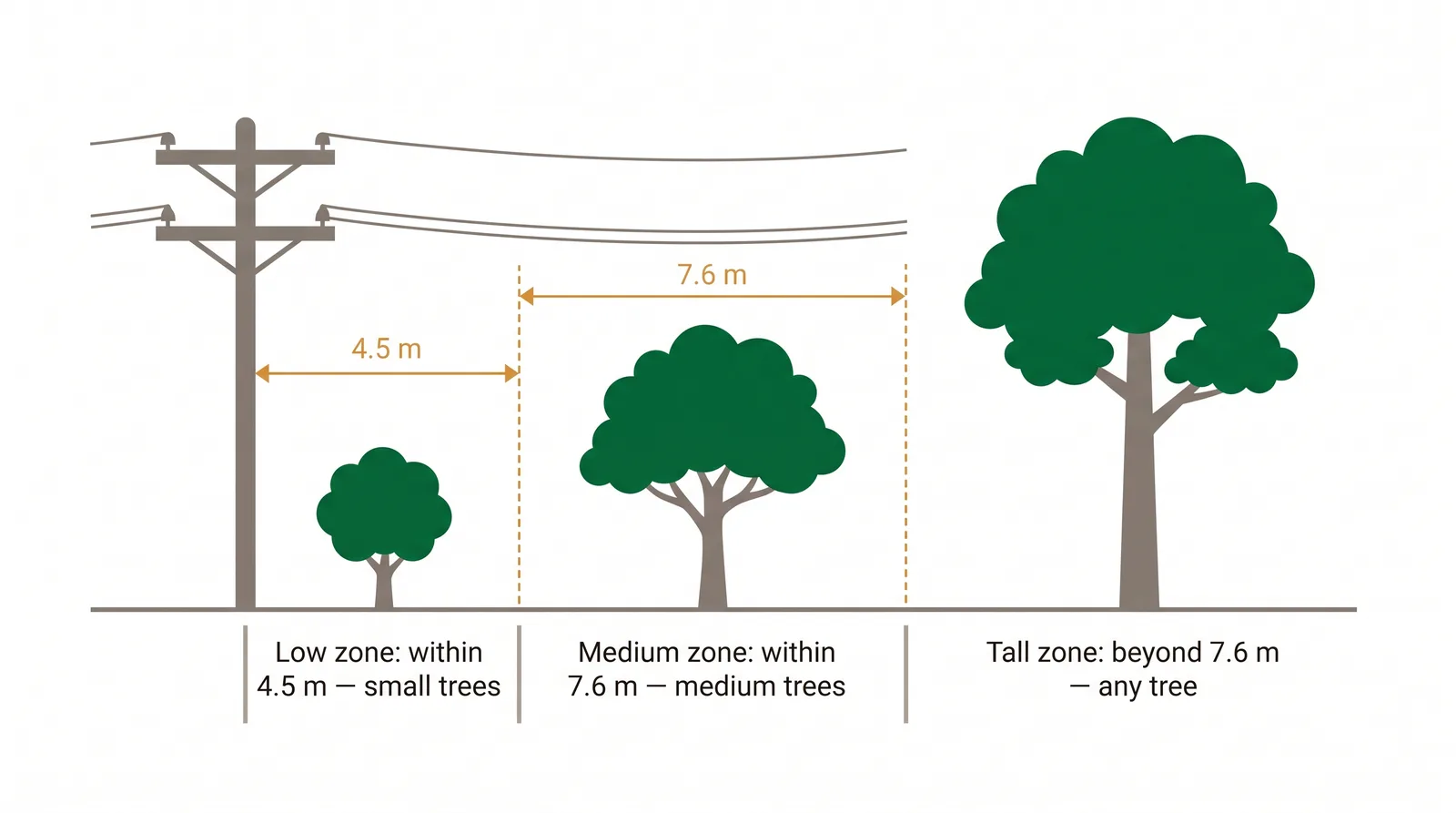
- Low zone: within 4.5 metres (15 feet) of the line. Plant only small trees with a mature height of about 4.5 metres or less.
- Medium zone: within 7.6 metres (25 feet). Keep to trees that top out around 7.6 metres.
- Tall zone: more than 7.6 metres from the line. Any healthy tree is fair game.
Getting this right on a new planting is the cheapest tree decision you will ever make. A large shade tree jammed into the low zone means a lifetime of one-sided utility pruning that leaves it lopsided and stressed. This is where a landscape crew earns its fee: choosing species by mature size, not just by what looks good at the nursery. If you are redesigning a front yard, fold powerline clearance into the plan from the start, you can see current planting and design ranges on the Toronto landscaping cost page or compare landscaping companies in North York and other areas.
Does a hydro hazard cancel Toronto's private tree bylaw?
No, and this trips people up. A tree threatening a wire is a safety concern, but it does not automatically let you remove the tree. Toronto's Private Tree By-law (Municipal Code Chapter 813) protects significant private trees, generally those 30 centimetres or more in diameter, and removing or seriously injuring one usually needs a City permit.
Private Tree By-law: the City of Toronto rule that protects larger trees on private land, requiring a permit to injure or remove a protected tree, with replanting often attached as a condition.
There are narrow exceptions: no permit is needed to remove a tree that is completely dead, and dead ash trees killed by emerald ash borer are exempt. But "it is near a wire" is not on that list. The clean sequence is: get Toronto Hydro to make the line safe, get an arborist's assessment, then apply for the City permit if the tree is protected and has to come down. Skipping the permit to solve a wire problem can turn a free hydro trim into a bylaw fine.
What does it cost, and who should you actually call?
For clearance pruning near a live line, the honest answer is that price is secondary to qualification. The number to compare is not dollars per branch; it is whether the person holds arborist certification and coordinates with Toronto Hydro before touching the tree. General maintenance quotes for routine pruning away from wires are a normal landscaping line item, and the same rule from our guide on why Toronto landscaping quotes vary so much applies here: a suspiciously cheap "we'll just cut it" quote usually means someone skipping the coordination step that keeps the job safe and legal.
If you are lining up tree or landscape work this season, get more than one bid and confirm certifications before you compare prices.
Want to know what tree and landscape work should cost for your yard? Request a quote and compare up to three vetted local pros side by side, your contact details only go to the one you pick.