
Answer First: In Canada, lawn care is tax deductible when it maintains a property you rent out or run a business from, and not deductible for a personal home. The Canada Revenue Agency lets a landlord deduct routine lawn care and snow removal as current expenses, and even lets you deduct landscaping the grounds in the year you pay for it (Form T776). If you simply live in the home with no rental or business use, lawn care is a personal expense you cannot claim.
The question turns on one thing: is the lawn helping you earn income? Grass in front of the house you live in is a personal cost, the same as painting your bedroom. The same grass in front of a house you rent to a tenant is a cost of running that rental, and the CRA treats it accordingly. Everything below is that one idea, applied to the three situations most GTA homeowners are actually in.
This is a plain-language guide to how the CRA rules read, not tax advice for your specific return. Confirm your own situation with an accountant.
When is lawn care tax deductible in Canada?
Lawn care is deductible in two situations and not deductible in a third. The table below is the whole answer at a glance; the sections after it explain each row.
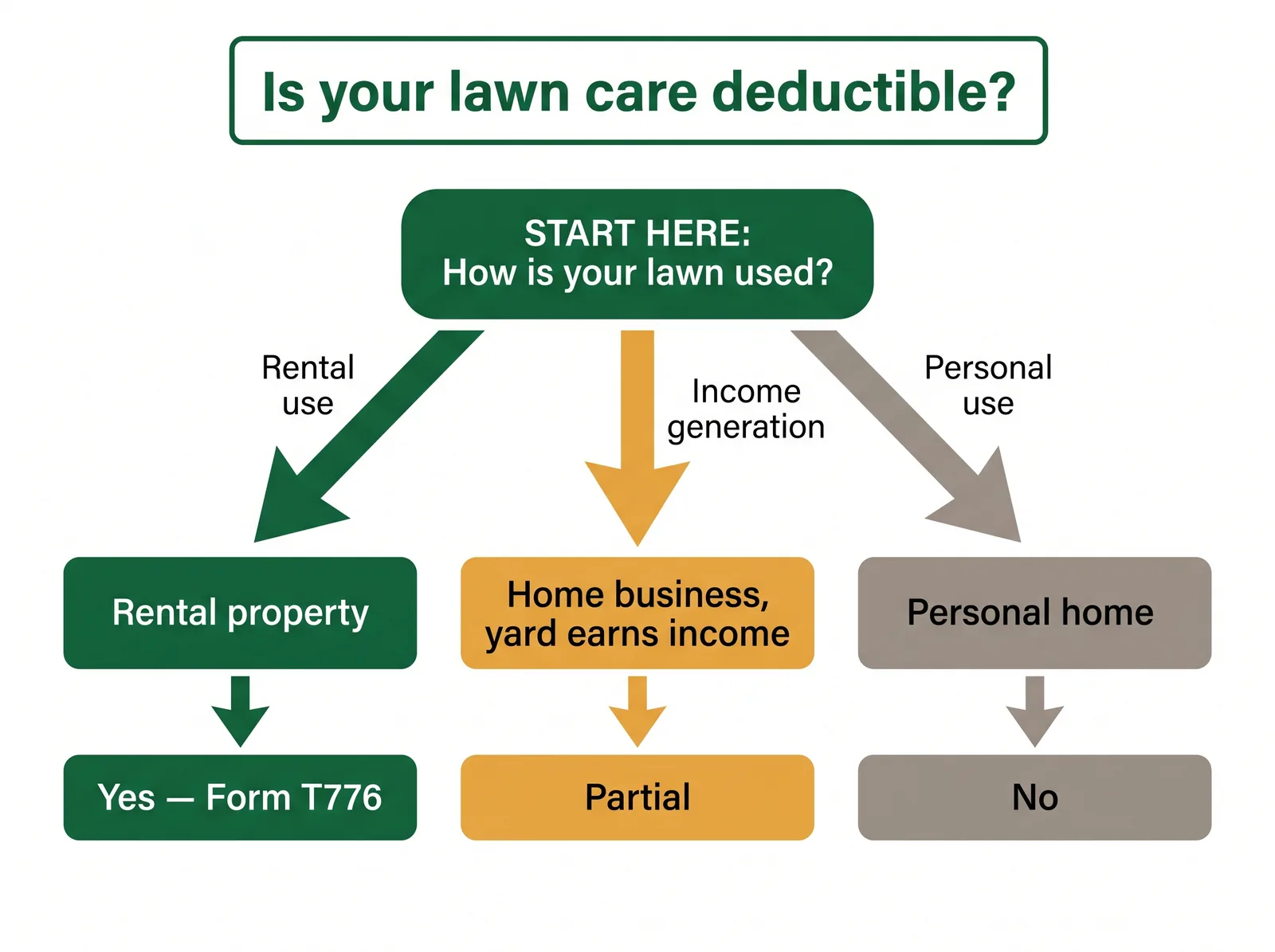
| Your situation | Deductible? | How the CRA treats it | Where it goes |
|---|---|---|---|
| You rent out the property (or a self-contained unit) | Yes | Routine lawn care = current expense; landscaping deductible in year paid | Form T776 |
| You run a business from home | Rarely | Business-use-of-home covers the work space inside, not the yard | Form T2125 (if it qualifies at all) |
| It is your personal residence, no rental or business use | No | Personal expense | Not deductible |
Quotable: The CRA's test for deducting lawn care is not where the grass is, it is whether the grass helps earn income. A rented property's lawn is deductible; the identical lawn at your own home is a personal expense.
Lawn care on a rental property: deductible
If you rent out the property, the CRA treats routine lawn maintenance the way it treats any other cost of keeping the unit rentable. Regular lawn care, snow removal and property management fees are current expenses, they maintain the property in its existing condition, so you deduct them in full against your rental income for that year on Form T776.
Landscaping gets a specific, more generous rule. Normally, a cost that improves a property rather than maintaining it is a capital expense, written off slowly over years through capital cost allowance. Landscaping the grounds is the exception. The CRA states you can deduct the cost of landscaping the grounds around your rental property in the year you paid the cost, even if you use the accrual method for your rental income, and it is not caught by the soft-cost rules that capitalize other construction expenses.
Current expense, a cost that keeps a property in its existing state (mowing, fertilizing, seasonal cleanup), deductible in full in the year you pay it. Capital expense, a cost that betters the property or extends its life, deducted gradually through capital cost allowance. For rental lawns, both routine care and landscaping land on the deductible-now side.
Quotable: For a rental property, the CRA lets you deduct landscaping the grounds in the year you pay for it, not spread over years, an unusually favourable rule that most other property improvements do not get.
That makes a seasonal contract a genuine tax event for a GTA landlord. A $1,500 mowing contract or a $2,100 full-service package, the ranges we break down in the lawn maintenance contracts guide, reduces your taxable rental income the year you pay it, HST included. On a unit taxed at a 40% marginal rate, a $2,100 deductible package is worth roughly $840 back in tax owed, turning a maintenance cost into a much smaller net expense.
Lawn care at your personal home: not deductible
If you own and live in the home and no part of it earns rental or business income, lawn care is a personal expense. The CRA does not allow a deduction for maintaining your own residence, and the lawn is no different from the roof or the driveway. Landscaping your own backyard, however much it costs, is not a line on your tax return.
There is no Ontario or federal credit that changes this for ordinary homeowners. The occasional "is my lawn deductible?" hope usually traces back to US content or to the rental and business rules bleeding into the wrong situation. For a personal residence, the honest answer is no.
Lawn care and a home office: usually not
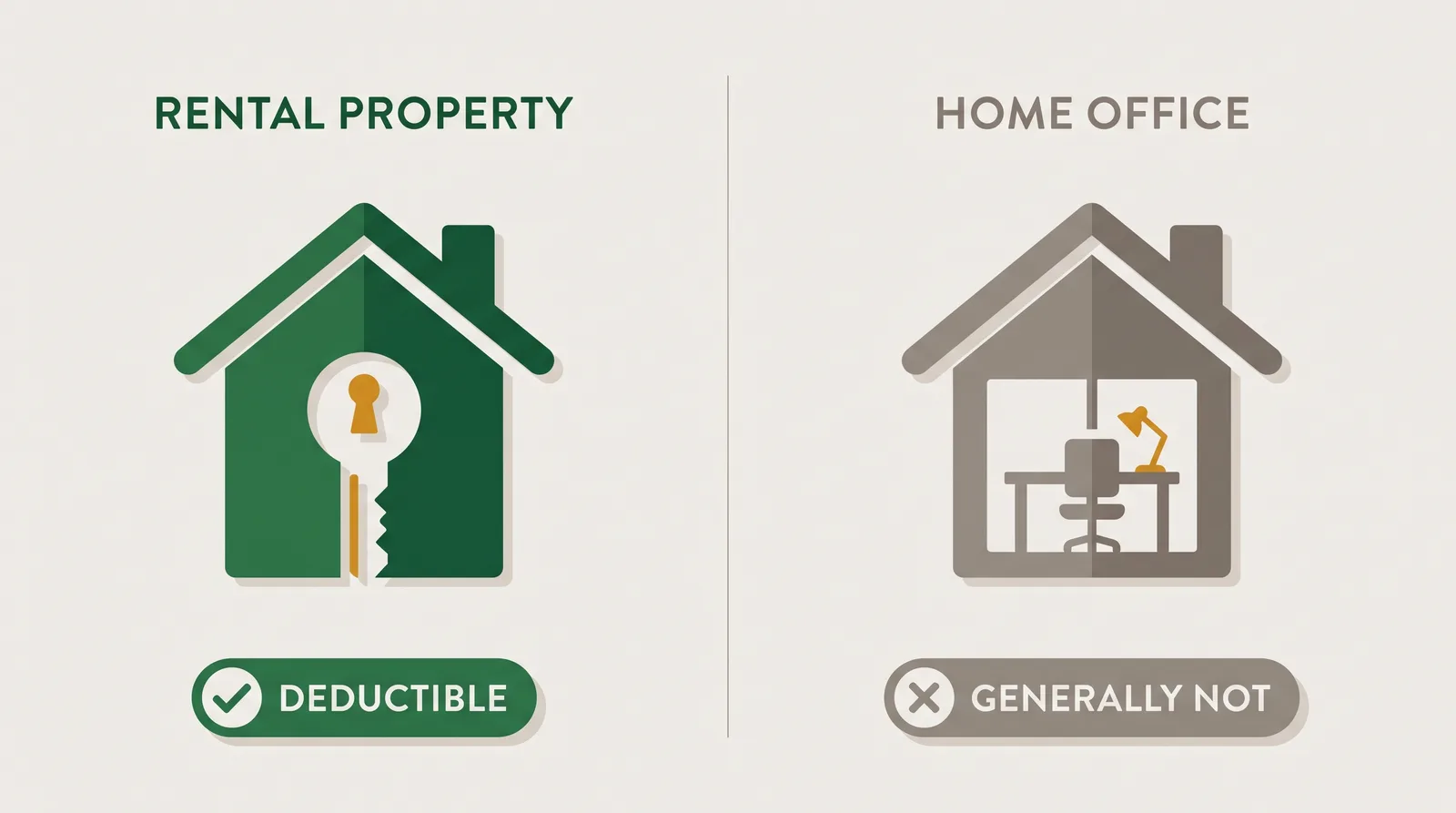
A home business is where people most often assume lawn care becomes deductible, and it is where the rules are narrowest. Business-use-of-home deductions are built around the work space inside your home. You can deduct a reasonable portion of heating, electricity, insurance, cleaning materials, property taxes, mortgage interest and capital cost allowance, prorated by the area of the work space divided by the total area of the home.
The yard is not the work space. Lawn care is an exterior, largely personal cost, so it generally does not fall into the business-use-of-home pool even if you have a legitimate home office. Two limits reinforce this: the deduction is based on the share of your home actually used for business, and business-use-of-home expenses cannot be used to create or increase a business loss, unused amounts carry forward to a future year instead.
The narrow exception is a business that genuinely uses the outdoor area to earn its income, a licensed home daycare whose children use the backyard is the classic example. There, a reasonable portion of yard-related costs can follow the same business-use logic as the indoor space. That is a specific, defensible use, not a general "I work from home so my lawn counts" claim. If your business truly uses the grounds, document how, and get an accountant to size the reasonable share.
What records does the CRA expect?
Keep dated invoices for every service you intend to deduct, showing what was done and the amount, HST included. The CRA requires deductions to be claimed in the year the cost is incurred, so timing and documentation both matter. A tidy folder of lawn care and snow removal invoices for a rental is exactly the kind of current-expense record the T776 process expects.
One HST note worth flagging: for a deductible service, the 13% Ontario HST is part of the deductible cost. But if you are a GST/HST-registered business, you may recover that tax as an input tax credit instead of deducting it as an expense, you do not get to do both. Which path applies depends on your registration, so confirm it rather than assume.
From the data: YardQuote tracks real GTA lawn care pricing, and the typical rental-friendly range is clear: seasonal mowing contracts run about $1,200–$1,800 and full-service packages $1,800–$2,500 before HST (YardQuote cost data, July 2026). For a landlord, those are deductible current expenses; for a homeowner in the same house, they are not.
The bottom line for GTA homeowners and landlords
If the property earns rental income, your lawn care and landscaping are deductible, and landscaping is deductible in the year you pay it, a real reason to keep clean invoices. If it is the home you live in, it is not deductible, home office or not, unless a genuine business uses the grounds. When you are pricing service for a rental, you can check current ranges on the lawn care cost page and compare rated crews before you commit.
Managing a GTA rental and want a fair, documented lawn care price you can deduct with confidence? Request a quote and compare up to three vetted local pros side by side. Your contact details only go to the one you pick, and you get a clean invoice for your records.